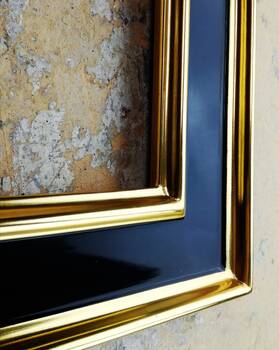
Black Gloss Picture Frame with Gold Trim in Real Gold Leaf
- Add feedback:
- Code: 61
- Manufacturer: Karol Milewski
-
Availability:
 Exists
Delivery time: 20 - 30 working days
- pcs.
- €247.22
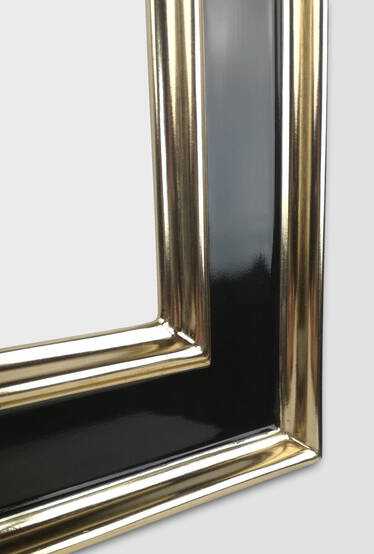
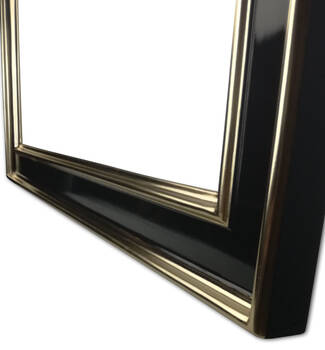
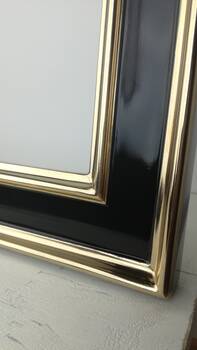
A black picture frame with a gold trim: two narrow milled bands, gilded in real gold leaf, close a wide black frieze on either side. I gild them in 22 karat moon gold or 23 karat yellow gold over red bole and seal the frame with lacquer, for a high gloss. Moulding 72 mm wide, rabbet 20 mm deep, made to measure.
This black gloss picture frame wears its gold as trim rather than as a surface. Two narrow milled bands of the same width, gilded in real gold leaf, close a wide black frieze on either side, and the shade of the leaf is chosen with the order: 22 karat moon gold or 23 karat yellow gold, in both cases over red bole. The whole frame is sealed with lacquer, so the black and the gold both carry a high gloss, and the 72 mm face with 37 mm of depth makes this a frame for larger oil and acrylic paintings on canvas rather than for small formats. It belongs with my black picture frames and is made to measure, by hand, in the workshop.
Moulding profile
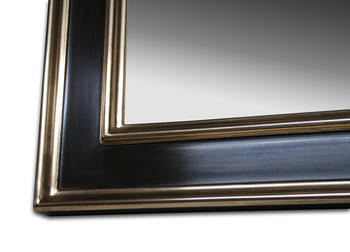
At the artwork the face begins with a milled band, set low and falling away towards the painting: this is the inner gilded line. Beyond it the face opens into a wide, flat frieze, painted black, which carries most of the width of the moulding. Towards the outer edge the face rises to a second milled band, set higher than the inner one and gilded to the same width, so the black frieze is closed by two parallel metal lines of identical thickness. The outer edge finishes the face, and the flank of the moulding stays black.
Specification
- style: black frame with two gilded milled bands, a classical profile in modern proportions
- profile: inner milled band (gilded), flat frieze (black), outer milled band (gilded), outer edge and flank in black
- moulding width: 72 mm
- moulding depth: 37 mm
- rabbet: 7 mm wide, 20 mm deep
- material: solid, low-tannin timber used in museum and conservation work
- corner joinery: mitred at 45 degrees and reinforced with wooden splines before gessoing
- gilding ground: gesso, then red bole
- gilding: real gold leaf, 22 karat moon gold or 23 karat yellow gold, chosen from the order menu
- black: acrylic paint applied by hand to the frieze and the flanks
- sealing: lacquer, high-gloss finish
- glass and backing: supplied without glass, as a mount for a stretched canvas; full archival framing to order
- artwork retention: spring clips as standard, brass plates with screws on request
- hanging: picture cord as standard, portrait or landscape orientation chosen with the order
- lead time: 20 to 30 working days
- suitable for: oil and acrylic on canvas, original prints, fine-art photography
The dimensions entered in the calculator describe the complete frame including the moulding. The opening itself is smaller by the width of the moulding. I make each frame 2 to 3 mm larger than the stated size of the painting: this is the technical allowance that lets the work go in without stress, and the rabbet then covers about 4 to 5 mm of the painting.
Which paintings and interiors it suits
The 72 mm width and the hard contrast of black against gold suit work with a clear, decided composition: oil and acrylic on canvas, still lifes, portraits, landscapes in a darker key, and equally original prints and fine-art photography. The black frieze separates the painting from the wall and quietens what surrounds it, while the two gold lines hold the composition without entering it.
The shade of the leaf changes the character of the frame. 22 karat moon gold is an alloy of gold and silver: paler, cooler, faintly silvery in some light, and it works with cool palettes and with white, grey and blue. 23 karat yellow gold gives the most classical and warmest glow, and it ties in with ochres, reds and browns. The red bole beneath the leaf adds a warm undertone in the depth of the metal in both versions.
In an interior the frame does well where black is already present in the joinery, the window frames or the furniture: studies, living rooms in a muted palette, gallery spaces and classical schemes. Related models are gathered in my gilded and partially painted picture frames.
How it is made and finished
The profile is machine-milled; everything after that is done by hand. I cut the lengths at 45 degrees and join the corners with wooden splines before any gesso goes on, so the mitres are held mechanically and not by glue alone. Only then do I ground the assembled frame with gesso and rub it smooth.
The two bands that take the gold are covered with red bole and then gilded on water. A leaf is about 80 mm square, so for bands this narrow I cut it with a knife on the gilder's cushion. I lay the leaves one beside the next with an overlap of about 1 mm, which gives a single layer of gold: what is built up in layers here is the ground, not the gilding. I describe the technique in more detail on my page about water gilding.
The frieze and the flanks are hand-painted black in acrylic. The frame is then sealed with lacquer, which lifts the gloss of both the black and the gold. That is a deliberate decision about the character of this version: the same profile finished with shellac and wax is noticeably more muted.
How it differs from mass production
In a factory frame the gilded element is usually paint or a metal imitation that darkens and shifts in tone over the years. The black is a sprayed coat on foil or veneer, and the core is often MDF. The corners are held by glue and staples, and they can open with time.
Here the gold is real leaf laid on water over gesso and bole, and its tone depends on the karat and on the colour of the bole underneath. The black is built up in coats on timber. The mitres are reinforced with splines, and the frame is made to the size of the painting rather than the other way round.
Functionality
I make this frame without glass, for mounting a stretched canvas directly, with spring clips. The rabbet is 20 mm deep, so it takes both thinner rigid supports and heavier artist's stretchers. Glass, backing and a mount are added on request, as part of the full archival framing described below.
The same profile can also be made without a rabbet, as a floating frame, where the canvas hangs inside the moulding with a visible gap around it and the sides of the stretcher stay exposed. I set out how that works in my article on the floating picture frame for canvas art.
Frequently asked questions
Which gold shade should I choose? 22 karat moon gold is paler and cooler and sits well with cool palettes; 23 karat yellow gold is warmer and more classical. Both are laid over red bole, which keeps a warm tone in the depth of the metal.
Will it take a thick stretcher? Yes. The rabbet is 7 mm wide and 20 mm deep, and the moulding is 37 mm deep, so standard and heavier artist's stretchers both fit.
Is the frame made to measure? Yes. Each one is built to the size of your painting, with a technical allowance of about 2 to 3 mm.
Can I have the same profile with less gloss? Yes. The identical profile is also made with a shellac and wax finish, which is noticeably more muted. Please get in touch and we will agree the configuration.
Complete framing – additional options
Every frame I make can be completed with full archival and museum-quality framing: anti-reflective UV-filtering glass (four classes to choose from), acid-free museum mat board, spacers wrapped in acid-free paper and a Dibond backing. This kind of mounting protects the work from light, acids and distortion. I set out the full glass and material specification on a separate page: archival and museum framing for paintings and photographs. All components are available at extra cost, as an individual quote on request.
Fixing and hanging
As standard the painting is held by spring clips, factory-fitted: they rotate, so swapping the work is quick. On request I prepare brass plates with screws, supplied loose for a permanent fixing you fit yourself. For hanging there is a picture cord as standard; a single D-ring is fitted on request, and portrait or landscape orientation is chosen with the order.
Made-to-measure ordering
The base price shown is the price per running metre of moulding. The perimeter of the painting is not the whole length the frame needs: the 45° mitres take extra length, more so the wider the moulding. The calculator accounts for the full use of moulding with the mitres and any options, and it handles paintings up to 120 × 80 cm; larger formats are made to individual order. The lead time is 20 to 30 working days.