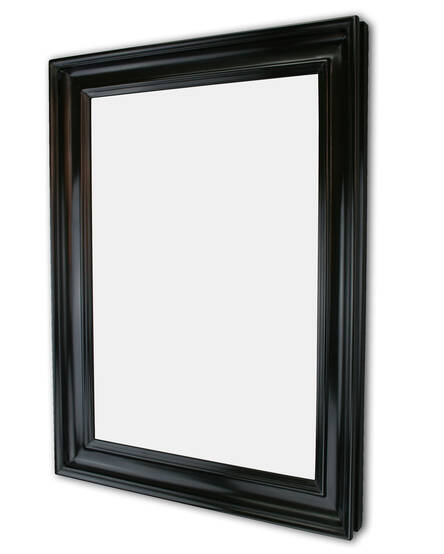
Black picture frame with a deep cavetto, made to measure
- Add feedback:
- Code: 108
- Manufacturer: Karol Milewski
-
Availability:
 Exists
Delivery time: 20 - 30 working days
- pcs.
- €163.89
A black gesso picture frame made to measure in my workshop: a traditional gesso ground built up in coats and sanded flat, black worked in layer by layer, then sealed with shellac and wax and hand-polished to a satin sheen. The profile runs from a small bead beside the artwork, through a deep cavetto, to a rounded torus at the outer edge.
A black gesso picture frame built the traditional way: a chalk gesso ground laid over the moulding, black worked into it coat by coat, and a wax polish that leaves a satin sheen instead of a sprayed film. The deep cavetto gives the frame genuine shadow, so the black reads as depth rather than as a flat border. I make every frame to measure, one at a time, alongside the rest of my black picture frames.
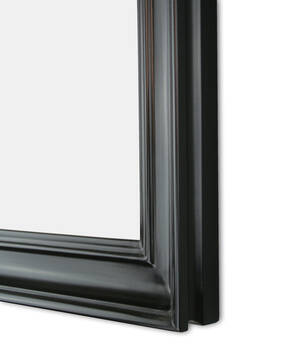
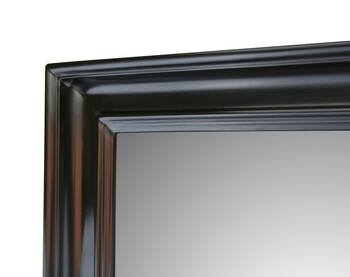
Moulding profile
Beside the artwork the moulding carries a small half-round bead, lifted clear by a shallow step. From the bead the cavetto begins almost flat, then rises across the full width of the face in one long, unbroken concave sweep. It closes against a narrow fillet, and above that a rounded torus forms the crown at the outer edge, the highest point of the moulding. The outer flank is cut with a half-round hollow that runs the length of the frame.
Specification
- Style: classical profile with a deep cavetto
- Finish: black, satin sheen, sealed with shellac and wax and hand-polished
- Moulding width: 52 mm
- Moulding thickness, face to back: 38 mm
- Rabbet: 7 mm wide × 20 mm deep
- Material: low-tannin timber of the kind used in museum and conservation framing
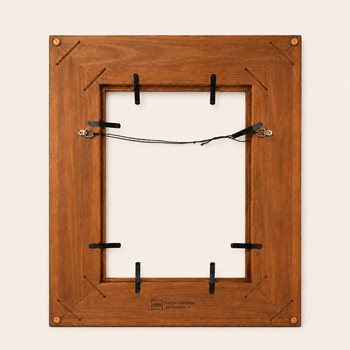
- Corner joinery: mitred corners reinforced with wooden splines
- Glass, backing and mounts: available as add-ons
- Mounting and hanging: sprung clips as standard, cord for hanging
- Suited to: oil and acrylic on canvas, watercolour, photography, fine-art prints
Enter the dimensions of the artwork itself. I build the frame 2–3 mm larger as a technical clearance, and the moulding overlaps the edge of the work by roughly 4–5 mm.
What it frames, and where it sits
The black cavetto suits oil and acrylic on canvas, watercolour and photography, and it is at its best with work that has a strong tonal range and clear light-and-shadow contrast. The black mass separates the picture from the wall and deepens the composition without arguing with the palette of the work itself.
It reads as well on a white gallery wall as on a dark painted one, in classical, modernist and loft interiors alike. The mass of this profile sits at the outer edge rather than beside the artwork, which is what separates it from a reverse profile; my guide to Dutch frames sets out that difference. If you need the same treatment in a pale frame, there is a white gesso picture frame in the workshop.
The gesso ground and finishing
The profile is routed from a single board on the workshop machine. Corners are cut at 45 degrees and reinforced with wooden splines, a conservation method in which a tongue of timber is set across the joint; it keeps the mitre dimensionally stable through the seasonal movement of a heated room. The splines go in before the ground does.
Over the bare timber I lay a traditional gesso ground in successive coats, sanding back between them until the surface is flat. The black is then built in layers rather than sprayed on as a single film, which is what gives the colour depth. The surface is sealed with traditional shellac and wax and hand-polished to a satin sheen.
What sets it apart from mass production
Mass-produced black frames are generally MDF or aluminium under a printed film or a sprayed lacquer, and the colour sits on the surface as a coating. Here it is built into the moulding: gesso ground, pigment in layers, sanded and waxed by hand. Under raking light the difference is plain, and it is the reason a black frame of this kind holds its own beside a serious painting instead of reading as a border around it.
Functionality
The frame is supplied without glass, as a setting for a painting on a stretcher. The rabbet is 20 mm deep, which takes an ordinary stretcher, so it is worth checking the thickness of yours before you order.
Every frame I make can also be built without a rabbet, as a floating frame, with the canvas held away from the moulding so a narrow shadow gap runs around the work. There is more on that construction in my guide to the floating picture frame for canvas art.
Complete framing – additional options
Every frame I make can be completed with full archival and museum-quality framing: anti-reflective UV-filtering glass (four classes to choose from), acid-free museum mat board, spacers wrapped in acid-free paper and a Dibond backing. This kind of mounting protects the work from light, acids and distortion. I set out the full glass and material specification on a separate page: archival and museum framing for paintings and photographs. All components are available at extra cost, as an individual quote on request.
Mounting and hanging
I hold the painting in the frame with sprung clips that turn aside when you change the work, which makes the frame easy to handle. On request I fit permanent, screwed brass plates instead. For hanging, I attach cord as standard, in portrait or landscape orientation; a single D-ring on request.
Ordering made to measure
The base price shown on the site is the price per running metre of moulding. The perimeter of the painting is not the full length the frame needs: corners cut at 45 degrees take extra length, and the wider the moulding, the more they take. The calculator accounts for the full moulding consumption with corners and for any options you choose, so you only need to enter the dimensions of your painting to within 0.1 cm. The calculator handles formats up to 120 × 80 cm, and I make larger sizes to individual order. The lead time is 20 to 30 working days.