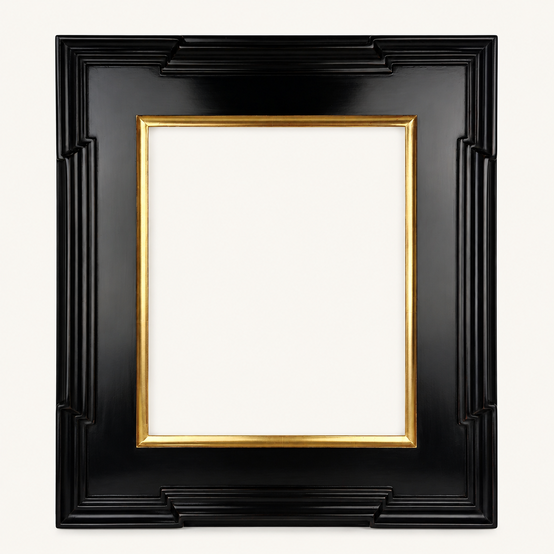
Black Flemish Picture Frame with 23-Karat Gold Trim
- Add feedback:
- Code: 344
- Manufacturer: Karol Milewski
-
Availability:
 Exists
Delivery time: 20 - 30 working days
- pcs.
- €247.22
A painted black picture frame with Flemish corners and a single gilded accent: one warm line of genuine 23-karat yellow gold leaf, water gilded over red bole and burnished with an agate stone, runs along the hollow at the inner edge. The moulding is 100 mm wide, about 4 inches, and I make each frame to the size of your painting.
The gold trim on this black Flemish picture frame is 23-karat yellow gold leaf, laid as a single line against a wide black moulding. It lies in a narrow hollow where the frame meets the painting; the flat, the stepped outer edge and the sides are painted black, so the gilding reads as one warm line at the edge of the canvas and the black carries the rest of the width. The moulding is 100 mm wide and 50 mm thick, and I make each frame to the measurements of one painting. A black moulding with a gilded inner edge has its roots in seventeenth-century Flemish and Dutch framing; I look at that tradition more closely in my article on Dutch and Flemish frames.
The moulding profile
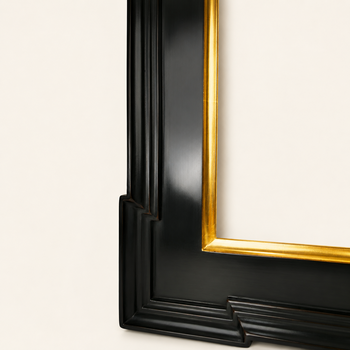
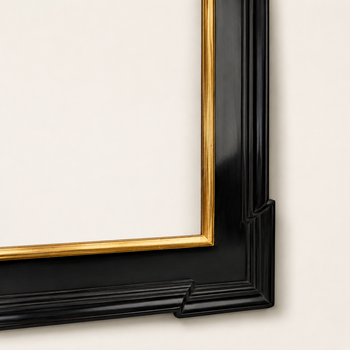
At the painting the moulding opens with a narrow hollow, the concave band that holds the gold. From the hollow the face rises onto a wide black flat, which takes up nearly half the width of the moulding and lies about 30 mm above the back of the frame. Towards the outside the section climbs in stages: first a short step with a narrow flat, then a quarter-round cavetto with a second narrow flat, and finally an ogee that lifts the face to a flat top edge along the outer perimeter. The top edge is the highest point of the profile, at the full 50 mm thickness of the moulding. Near the top, a concave recess divides the outer side, so seen from the side the frame shows two bands. At the corners the section turns into the Flemish corners that give the frame its name.
Specification
- style: black frame with Flemish corners and a gilded inner edge
- finish: painted black by hand and waxed to a satin sheen
- gilding: the hollow at the inner edge only, in 23-karat yellow gold leaf, water gilded over red bole, burnished with an agate stone and sealed with shellac and wax
- moulding width: 100 mm
- moulding thickness (face to back): 50 mm
- rebate: 7 mm wide, 20 mm deep
- material: timber with a low tannin content, of the kind used in museum work and art conservation
- corners: mitred and reinforced with wooden splines
- glazing, backing and mat: optional, quoted individually
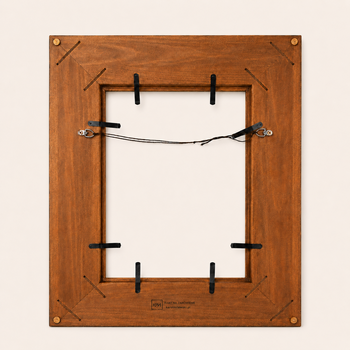
- fixings and hanging: sprung clips as standard, brass plates on request; picture wire, single D-ring on request; vertical or horizontal
- use: oil and acrylic paintings on canvas, on a stretcher up to 20 mm thick
You order the frame to the size of the painting, giving the dimensions of the canvas. I build in 2–3 mm of technical clearance, and the moulding overlaps the edge of the artwork by roughly 4–5 mm.
Paintings and interiors it suits
The 20 mm rebate takes a standard stretcher, so the frame is made first of all for oil and acrylic paintings on canvas, and at 100 mm the moulding has the width to hold medium and large works. Against black, 23-karat gold gives the strongest and warmest line of all the tones I lay, which suits paintings built on earth colours: browns, ochres, deep reds and olive greens. Portraits, still life and landscape in the older manner sit well in it, and so does a dark, densely worked contemporary canvas that needs a clean, warm edge between the paint and the black.
In a room the frame reads as a dark border with one warm line at the canvas. It sits comfortably with dark timber, panelling and deep wall colours, and on a white or pale wall it gives a single painting a firm, formal edge. It belongs to my painted frames with gilded accents, where a black or coloured moulding carries one gilded element.
How the frame is made
Before any finishing I cut the moulding to the size of the painting and join the corners, mitred and reinforced with wooden splines, so that each corner is closed in bare wood. Gesso follows: I build it up in several coats on the assembled frame and smooth it by hand. In the hollow at the inner edge I then lay red bole, the fine coloured clay on which the gold rests and against which it is later burnished.
The gilding is water gilding. Gold leaf comes in leaves of about 80 × 80 mm, much wider than this hollow, so I cut each leaf into strips with a knife on the gilder's cushion and lay the strips along the curve one after another, overlapping by about 1 mm. Laid this way, the gold is a single layer; the layering is in the ground beneath it. When the leaf has set, I burnish it with an agate stone until it takes a bright polish, then seal it with shellac and wax.
The 23-karat leaf is about 96% gold, the deepest and warmest of the golds I use. The red bole warms it further, and here and there a trace of the red shows through the burnished leaf. The rest of the face and the sides are painted black by hand and waxed to a satin sheen; the black stops at the edge of the hollow, so the gold runs as one unbroken line around the painting.
How it differs from a mass-produced frame
Factory-made black and gold frames are usually MDF or foam wrapped in printed foil, with the gold line printed or sprayed on, cut to stock sizes and stapled at the corners. Here the moulding is timber and the corners are splined before any finishing, the gold line is genuine 23-karat leaf laid on water over bole and burnished by hand, and the black is painted and waxed by hand rather than sprayed. Nothing is made in advance: each frame is cut, gilded and painted for one painting, and the small differences between two frames are the trace of that hand work.
Functionality
I supply the frame without glazing, for a painting on a stretcher. The rebate is 7 mm wide and 20 mm deep, so it takes a stretcher up to 20 mm thick, about ¾ inch; if yours is deeper, send me its depth before you order and I will make the rebate to suit.
The same section can also be made without a rebate, as a floating frame: the painting then stands inside the moulding with a narrow shadow gap around its edges. My guide to the floating picture frame for canvas art explains when that construction suits a painting better.
Frequently asked questions
Is the whole frame gilded, or only the inner edge?
Only the inner edge. This is a painted frame with gilded accents: genuine 23-karat gold leaf lines the hollow where the moulding meets the painting, and the flat, the stepped outer edge and the sides are painted black by hand.
Which gold tone should I choose for an oil painting?
23-karat yellow gold suits warm palettes, such as earth colours, deep browns, reds and ochres, where it gives the strongest and warmest line. For cool, muted or tonal paintings the same frame with 22-karat moon gold trim gives a paler line with a faint silvery cast, and 12-karat white gold goes cooler still. I make this section in all three tones, so if you are unsure, send me a photograph of the painting and I will suggest one.
Can this frame take conservation-grade low-reflection UV glazing?
Yes. It leaves the workshop without glazing because it is made for paintings on stretchers, but for a work on paper or a photograph I can add conservation-grade low-reflection UV glazing, an acid-free mat and a Dibond backing, quoted individually. With a moulding this wide, a traditional mat border of about 1½ to 2¼ inches, 38 to 57 mm, sits well, and the 20 mm rebate is deep enough for glazing, mat and backing together.
Can a gilded frame be made within a tighter budget?
Yes, and the saving comes from the section rather than from the gold. A narrower moulding with a smaller gilded element takes less leaf and less hand work per metre, while the gilding stays genuine gold leaf. Send me the size of your painting and a rough budget, and I will suggest a simpler profile.
Complete framing – additional options
Every frame I make can be completed with full archival and museum-quality framing: conservation-grade low-reflection UV glazing (four classes to choose from), acid-free museum mat board, spacers wrapped in acid-free paper and a Dibond backing. This kind of mounting protects the work from light, acids and distortion. I set out the full glass and material specification on a separate page: archival and museum framing for paintings and photographs. All components are available at extra cost, as an individual quote on request.
Mounting and hanging
Sprung clips are fitted as standard. They turn aside to let the work in and back to hold it, and they cope with anything from a thin board to a stretched canvas. Brass plates with screws are available on request and are supplied loose, for permanent fixing once the work is in place. Hanging orientation, vertical or horizontal, is chosen from the order menu. Picture wire is fitted as standard, and a single D-ring hanger can be fitted instead if you ask for it.
Ordering made to measure
Measure the artwork to within a millimetre, enter both figures in the calculator and choose the hanging orientation in the product options.
The base price shown is the price per running metre of moulding. The perimeter of the artwork is not the whole length a frame consumes: mitres cut at 45 degrees take extra length at every corner, and the wider the moulding, the more they take. The calculator accounts for the full consumption of moulding including the corners.
For this moulding width the calculator handles artworks up to 180 cm around the perimeter; anything larger is made to individual order, so send me the dimensions and I will price it. Glazing, backing and mat are quoted separately. Every frame leaves the workshop in 20–30 working days.