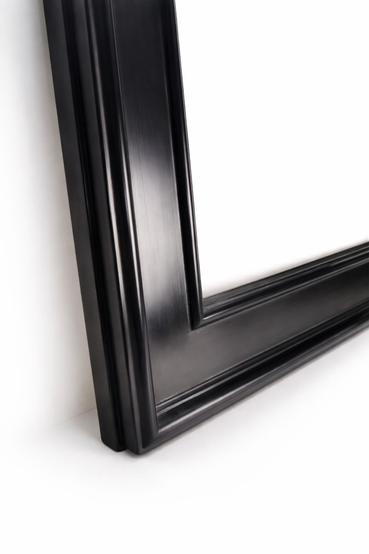
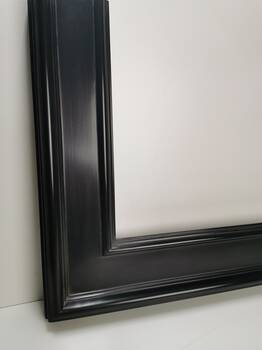
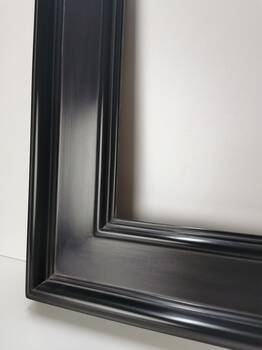
Wide Black Hand-Painted Picture Frame with Raised Edges
- Add feedback:
- Code: 249b
- Manufacturer: Karol Milewski
-
Availability:
 Exists
Delivery time: 20 - 30 working days
- pcs.
- €219.44
A wide black frame for paintings on canvas, painted by hand with soft brush marks, a light patina and a satin sheen. The moulding is 120 mm wide, about 4¾ inches: a broad flat set between two raised, rounded edges, with the higher one on the outside. I make each frame to measure, for stretched canvases and painting panels up to 20 mm (¾ inch) thick.
I make this wide black hand-painted picture frame to measure, for a particular painting on canvas. Its character comes from the section: the broad flat sits lower than the raised edges on either side, so even around a medium-sized painting the frame reads clearly on the wall. It is a thick moulding as well, 57 mm from face to back, so the frame keeps its weight when seen from the side. It belongs among my black picture frames, all made to order.
Frame profile
At the edge of the painting the moulding opens with a shallow, flat-bottomed hollow, behind which the section rises into a half-round. Falling away, the half-round runs into a broad flat that takes up most of the width. The section then climbs again, first through a cavetto, a quarter-round hollow, and then over a pronounced roll, the highest point of the frame. Beyond the roll and a short flat, the moulding ends in a vertical stepped side: its lower part projects beyond the upper one, with a step marking the line between them.
Because the broad flat sits lower than both the half-round and the outer roll, the section as a whole is concave, with its highest point on the outside. I explain how a concave section and a reverse one change the way a painting is seen in my article on reverse and concave frames.
Specification
- profile: concave, with a half-round at the painting, a broad flat, a pronounced roll at the outer edge and a stepped side
- moulding width: 120 mm
- moulding thickness (face to back): 57 mm
- rebate: 7 mm wide, 20 mm deep
- maximum artwork thickness: 20 mm; a deeper rebate is made to order
- colour and finish: black, painted by hand, with soft brush marks, a light patina and a satin sheen
- ground: several coats, each smoothed by hand
- material: timber with a low tannin content, of the kind used in museums and art conservation
- corner joinery: mitred corners reinforced with wooden splines
- personalisation: another colour, or water gilding on selected parts of the moulding
- mounting: sprung clips as standard, brass screw plates on request
- hanging: picture wire, portrait or landscape chosen in the order menu, a single D-ring on request
- glazing, backing and mat: optional extras, priced individually outside the calculator
- suitable for: paintings on stretched canvas and on painting panels
- lead time: 20 to 30 working days
I make the frame 2 to 3 mm larger than the painting, so the work goes into the rebate without strain, and the moulding then covers about 4 to 5 mm of its edge. With a moulding this wide, the finished frame is almost 23 cm, about 9 inches, larger than the painting in each dimension. That also sets the size of the parcel: the delivery cost appears once the frame is in the basket, and formats beyond standard parcel sizes I price together with their delivery.
Which paintings and interiors it suits
This is above all a frame for painting on canvas: oils and acrylics on stretchers, and paintings on panels up to 20 mm thick. The wide black moulding separates the composition from the wall, and because the section rises towards its outer edge, it leads the eye inwards, to the picture. It suits paintings with strong drawing and contrast: portraits, landscapes, still lifes and abstract work.
A painting in a wide black frame stands out clearly on a light wall, so this frame works well as the main focus of a living room, a study or a dining room. Where several works hang together, the same moulding brings order to the arrangement, even when the paintings differ in size. If you would like the same 120 mm width with a hollow at the painting, a flat outer edge and a grey patina, see the wide black picture frame for canvas paintings.
Craftsmanship and finish
I start by preparing the moulding and joining the corners, which I cut at 45 degrees and reinforce with wooden splines before any ground goes on. I then build up the ground in several coats and smooth each one by hand. At this width the groundwork matters more than usual, because any unevenness on the broad flat would show through the black.
I apply the black with a brush. On the flat and on the sides I leave soft brush marks and give the surface a light patina, so the colour does not have the uniformity of a sprayed finish. The frame is finished to a satin sheen, which avoids sharp glare when the painting is lit.
Colour and gilding to order
I can paint the same profile in another colour from a curated, richly pigmented paint range. Selected parts of the moulding, for example the half-round at the painting or the roll at the outer edge, can also be gilded, which turns it into a painted frame with gilded accents. For this I use water gilding: genuine gold leaf laid over bole, in a yellow, moon or white gold tone.
How it differs from mass production
Ready-made framing moulding is finished before it is cut, and the corners are cut and joined at the very end, so two separately finished lengths meet at every corner. With this frame the order is reversed: I join the corners first and only then apply the ground and the black, so both run across each corner without a break, and the frame is finished as a single object rather than four lengths assembled into a rectangle.
The second difference is size: I make the frame for a particular painting instead of fitting the painting to a catalogue format. I work alone and take on a limited number of orders at a time, and each frame differs slightly in its brush marks and in the way the patina lies. That is a feature of hand finishing, not a departure from the standard.
Functionality
As standard I make the frame without glazing, for the painting to be fitted directly. The rebate is 20 mm deep, so it takes stretchers and other supports up to 20 mm (¾ inch) thick; a thicker support needs a deeper rebate, which I make to order. When you order, please tell me whether the painting is on canvas over a stretcher or on a panel, and how thick it is. Photographs and the exact dimensions of the work help too, because they let me choose the best way of fixing the painting in the frame.
I can also make this profile without a rebate, as a floating frame. I describe how that differs from a classic frame in my article on the floating picture frame for canvas art.
Complete framing – additional options
Every frame I make can be completed with full archival and museum-quality framing: anti-reflective UV-filtering glass (four classes to choose from), acid-free museum mat board, spacers wrapped in acid-free paper and a Dibond backing. This kind of mounting protects the work from light, acids and distortion. I set out the full glass and material specification on a separate page: archival and museum framing for paintings and photographs. All components are available at extra cost, as an individual quote on request.
Mounting and hanging
This frame is intended for paintings on canvas and stretchers, so it does not include glass as standard. To hold the painting, I fit sprung retaining clips as standard; they pivot to the side, so the canvas can be removed and replaced quickly without tools. On request I supply brass plates with screws instead (provided loose, for permanent self-installation). The hanging orientation, portrait or landscape, is chosen at checkout. Picture wire is standard, with a single D-ring available on request.
Ordering made to measure
The base price shown on the site is the price per running metre of moulding. The perimeter of the painting is not the full length of moulding a frame needs: corners cut at 45 degrees take extra length, and the wider the moulding, the more they take. The calculator accounts for the full moulding consumption with corners and for any options you choose, so you only need to enter the dimensions of your painting. The calculator accepts artwork up to a perimeter of 180 cm, the limit set for a moulding of this width; larger formats I make to individual order, so please write to me first. The lead time is 20 to 30 working days.