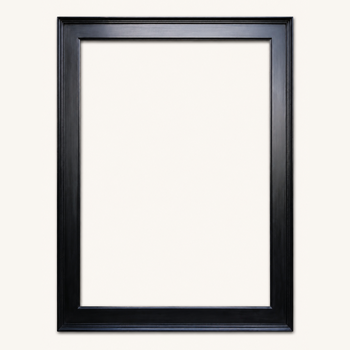


Wide black picture frame for canvas paintings, 120 mm
- Add feedback:
- Code: 269
- Manufacturer: Karol Milewski
-
Availability:
 Exists
Delivery time: 20 - 30 working days
- szt.
- €163.89
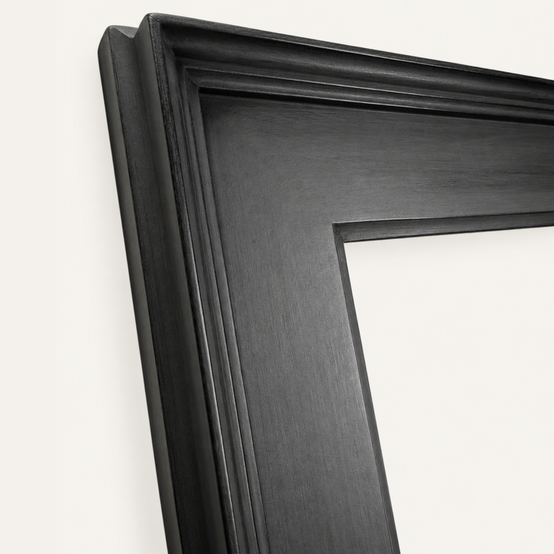
A wide black picture frame with a 120 mm moulding, hand painted and patinated with grey pigment in my workshop. The patina keeps the black off a flat factory coat: the surface sits closer to charcoal, and the light reads every step of the section separately. I cut and join each frame to the measurements of your canvas painting.
A black picture frame for canvas paintings, with a moulding 120 mm across the face and a broad flat frieze at its centre. I paint it by hand and work a grey patina over the surface, so the black never reads as a flat coat straight from the tin: it sits closer to charcoal, with an ashen cast. I make it without glazing, as a frame for an oil or acrylic on a stretcher, and I set out how I approach that kind of work on the page about framing oil paintings.
The moulding profile
At the artwork side the moulding opens with a concave hollow, a narrow band taken out of the timber that lifts the surface outwards. Beyond it runs a flat frieze covering close to half the width of the face, an unbroken plane of black that decides the character of the whole frame. Towards the outer side the surface begins to climb: first a quarter-round hollow, then an ogee that carries the section to its highest point, the flat crowning edge along the outer perimeter. The side of the moulding is cut by a further recess, so that it reads as two parts.
Specification
- Style: architectural section, a broad flat frieze between a hollow at the artwork side and an ogee at the outer edge
- Finish: hand painted black, patinated with grey pigment, satin sheen
- Moulding width: 120 mm
- Moulding thickness (face to back): 50 mm
- Rebate: 7 mm wide by 20 mm or 25 mm deep, chosen when you order
- Timber: low tannin timber of the kind used in museum work and art conservation
- Corner joints: mitred at 45 degrees and reinforced with wooden splines, before finishing
- Surface protection: shellac and wax
- Holding and hanging: sprung clips as standard, brass plates on request; cord fitted, portrait or landscape
- Glazing, mount board and backing: available on request, priced individually
- Suits: oils and acrylics on stretched canvas, prints, photographs
- Lead time: 20–30 working days
I make the frame to the measurements of the artwork itself, so please send me the size of the work rather than the size of the finished frame. The rebate is cut 2 to 3 mm larger than the work so that it drops in without forcing, and the moulding covers about 4 to 5 mm of the face all round.
Which paintings and interiors it suits
Black at the edge of a painting closes the composition and pushes the lit passages forward, which is why it holds work with a strong tonal range: oils and acrylics in a saturated palette, black and white photography, etchings, lithographs and woodcuts, contemporary figurative and abstract painting. At 120 mm the moulding gives a large canvas a substantial border and sets it away from the wall; on a smaller work the same width does the opposite and lends the picture scale. What a wide section actually does to a painting I have written about in the guide to a wide wooden painting frame.
In a room the frame works as graphic punctuation. It settles into a classical interior, into a loft with exposed brick, and into a plain modern scheme where the black is the only strong accent. The rest of the sections finished in this colour are gathered in black picture frames.
Making and finishing
I cut the moulding, mitre the corners at 45 degrees and reinforce each joint with a wooden spline before any finishing begins. On a section this wide the mitre is long and heavily loaded, and a joint cut into the timber holds where glue alone would eventually open.
The assembled frame is grounded with gesso, sanded, and painted by hand in successive layers. Once the black is dry I work grey pigment over the raised parts of the section, the hollow at the artwork side, the ogee and the crowning edge, so that a cooler tone comes through and the profile stays readable. Without that step a face this wide would flatten into a single dark rectangle. The finish is sealed with shellac and wax, which leaves a satin sheen and can be refreshed with wax for as long as the frame is in use.
The timber has a low tannin content and is of the kind used in museum work and art conservation, so it neither discolours the finish nor works against the painting it holds.
How this differs from a mass produced frame
Ready made frames in this width are usually MDF or plastic wrapped in a wood effect foil and sprayed to a uniform black. Here the black is paint on timber and the patina is laid on by hand on the individual frame, so it never falls in exactly the same places twice. Splined corners hold up where a glued mitre opens after a few seasons in a heated room. I keep no stock of finished sizes: each frame is cut and joined to the measurements you send.
Functionality
The frame is supplied without glazing, prepared for a canvas on a stretcher. The rebate depth is chosen when you order, 20 mm or 25 mm: 20 mm takes a typical painter's stretcher, 25 mm a deeper edged canvas. Glass, backing and mount board are quoted separately.
The same section can also be made without a rebate, as a floating frame for canvas art, with the painting standing free inside the frame and a shadow gap around it.
Complete framing – additional options
Every frame I make can be completed with full archival and museum-quality framing: anti-reflective UV-filtering glass (four classes to choose from), acid-free museum mat board, spacers wrapped in acid-free paper and a Dibond backing. This kind of mounting protects the work from light, acids and distortion. I set out the full glass and material specification on a separate page: archival and museum framing for paintings and photographs. All components are available at extra cost, as an individual quote on request.
Mounting and hanging
I hold the painting in the frame with sprung clips that turn aside when you change the work, which makes the frame easy to handle. On request I fit permanent, screwed brass plates instead. For hanging, I attach cord as standard, in portrait or landscape orientation; a single D-ring on request.
Ordering made to measure
The base price shown on the site is the price per running metre of moulding. The perimeter of the painting is not the full length the frame needs: corners cut at 45 degrees take extra length, and at 120 mm that difference is considerable. The calculator accounts for the full moulding consumption with corners and for any options you choose.
The calculator accepts artwork up to a perimeter of 180 cm, the limit set for a moulding of this width; larger formats I make to individual order, so please write to me first. Glass, backing and mount board are priced separately, outside the calculator. Lead time is 20–30 working days.