White picture frame with rounded corners for canvas
- Add feedback:
- Code: 103
- Manufacturer: Karol Milewski
-
Availability:
 Exists
Delivery time: 20 - 30 working days
- pcs.
- €163.89
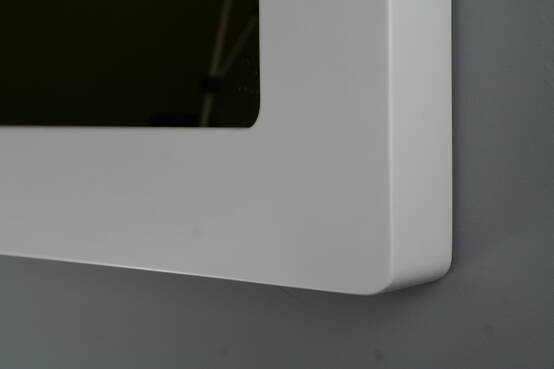
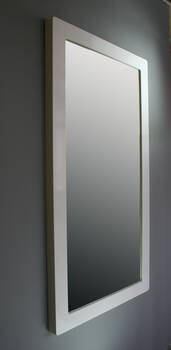
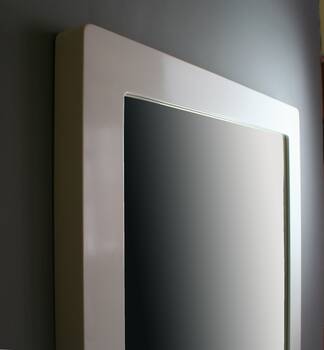
A white picture frame for paintings on stretched canvas, made to measure. The moulding is 70 mm wide and 40 mm deep, and the rebate goes back 35 mm, so it takes even a very thick stretcher. The form is plain and geometric, the corners are softly rounded, and I spray the white on in coats until the surface reads as one continuous plane with a satin sheen.
A white picture frame with rounded corners, made to measure in my workshop for paintings on stretched canvas. The moulding is 70 mm wide and 40 mm deep, and the rebate goes back 35 mm, so the frame takes deep stretchers that most ready-made frames will not hold. The form is plain and geometric, with the outline turning through a soft curve at each corner instead of a sharp right angle, and I spray the white on in coats until the surface reads as one continuous plane, with no brush marks.
Moulding profile
At the artwork the moulding opens with the rebate, 7 mm wide and 35 mm deep, one of the deepest I cut in a painted frame. From there the face runs flat across 70 mm, without ornament or steps, and both its inner and outer edges are lightly rounded rather than left sharp. The flank measures 40 mm and carries the same white as the face, so the frame casts a defined shadow on the wall and has real presence in the room. The corners are rounded: the outline does not close in a right angle but turns through a gentle arc that softens the block.
Specification
- Style: contemporary, minimalist
- Finish: white, spray applied, satin sheen
- Moulding width: 70 mm
- Moulding depth: 40 mm
- Rebate: 7 mm wide, 35 mm deep, so the maximum support thickness is 35 mm
- Corners: rounded, mitred at 45 degrees and reinforced with wooden splines
- Timber: low-tannin timber of the kind used in museum work and art conservation
- Glass and backing: supplied without glass as standard, for mounting the canvas directly; glazing, backing and matting available to order and priced individually
- Mounting: sprung clips as standard, screwed brass plates on request
- Hanging: cord, portrait or landscape orientation chosen when you order
- Suitable for: oil and acrylic painting on stretched canvas, including deep stretchers and supports with a recessed profile
You enter the size of the painting in the calculator, not the outside size of the frame. The finished frame is larger by the width of the moulding on every side, and I cut the opening 2 to 3 mm larger than the work so the painting slides in freely. The rebate covers the edge of the painting by about 4 to 5 mm.
Which paintings and interiors it suits
This is a frame for painting on canvas, above all oil and acrylic, mounted without glass. The 35 mm rebate is the deciding argument: it holds deep stretchers built from thicker battens, and supports with the canvas wrapped round the sides, which simply will not go into the opening of a typical frame with a 15 or 20 mm rebate. On large formats that depth also adds rigidity, because the frame holds the stretcher along its full height rather than gripping only its edge. I go through the way profile depth relates to different canvas builds in my guide to the types of picture frames for canvas paintings.
The white and the simplified geometry make this a neutral mount, one that does not argue with the composition. It works well with abstraction, contemporary painting, landscape in a cool palette and strongly coloured work that an ornate frame would only crowd. In an interior it belongs where clean form matters: Scandinavian, minimalist, japandi and contemporary schemes, against pale plaster, white brick and walls in grey, beige or sage. The rest of the models in this palette are gathered in my white picture frames category.
How it is made and finished
I cut the moulding to the size of your work, mitre the corners at 45 degrees and reinforce them with wooden splines, and only then round the corners off and sand the whole outline. The order matters: joining before finishing means the corner becomes one continuous block rather than two lengths butted together, and no joint line shows in the finished frame.
The white goes on with a spray gun, and that is a decision about the surface. Spraying gives an even film along the entire length, without streaks or brush marks, including on the rounded edges and on the arc of the corner, where a brush always leaves a ridge. I build the colour up in several coats, sanding between them, until the surface no longer shows the grain of the timber. The paint is heavily pigmented and does not yellow with age. The finish is satin: it returns light softly, without mirror gloss, so the white reads as full rather than flat. Every frame is painted individually, to order, so the colour and the degree of sheen stay identical right round the frame.
How it differs from mass production
In a mass-produced frame the white is usually a foil wrap over the profile or a coating on MDF, and the corners are held with glue and staples, so after a few years they can open and show a dark line at the joint. The rebate is typically 10 to 20 mm, which rules out thicker stretchers from the start, and the sizes come off the shelf, so it is the painting that has to fit the frame.
Here the finish is built up in layers on timber, after the corners have already been joined and sanded, so the rounded corner is a single block carrying the same surface as the rest of the moulding. The corners are reinforced with wooden splines, the rebate goes back 35 mm, and the frame is made to the dimensions you give me. I make it myself, from the first cut to the last coat of paint.
Functionality
As standard I make this frame without glass, for mounting a stretched canvas directly, with sprung clips. The rebate depth is 35 mm and is not an option here, because it is the defining feature of the model. Glazing is not part of the order menu: if a work needs glass, a backing board or a mount, whether a print, a drawing, a photograph or a document, I prepare that as a separate part of the order and price it individually.
I can also make this profile without a rebate, as a floating frame, with the canvas hanging inside and a visible gap around its edges. I explain the principle and the differences in my article on the floating picture frame for canvas art.
Complete framing – additional options
Every frame I make can be completed with full archival and museum-quality framing: anti-reflective UV-filtering glass (four classes to choose from), acid-free museum mat board, spacers wrapped in acid-free paper and a Dibond backing. This kind of mounting protects the work from light, acids and distortion. I set out the full glass and material specification on a separate page: archival and museum framing for paintings and photographs. All components are available at extra cost, as an individual quote on request.
Mounting and hanging
I hold the painting in the frame with sprung clips that turn aside when you change the work, which makes the frame easy to handle. On request I fit permanent, screwed brass plates instead. For hanging, I attach cord as standard, in portrait or landscape orientation; a single D-ring on request.
Ordering made to measure
The base price shown on the site is the price per running metre of moulding. The perimeter of the painting is not the full length the frame needs: corners cut at 45 degrees take extra length, and the wider the moulding, the more they take. The calculator accounts for the full moulding consumption with corners and for any options you choose, so you only need to enter the dimensions of your painting to within 0.1 cm. The calculator handles formats up to 120 × 80 cm, and I make larger sizes to individual order. The lead time is 20 to 30 working days.