
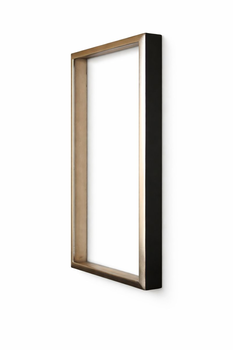
Slim palladium picture frame with a deep rabbet and black sides
- Add feedback:
- Code: 13.01
- Manufacturer: Karol Milewski
-
Availability:
 Exists
Delivery time: 20 - 30 working days
- pcs.
- €191.67
A slim picture frame made to measure, its face gilded in genuine palladium leaf and its sides painted black to a satin sheen. The moulding is 18 mm wide and 45 mm thick, and the rabbet runs 40 mm deep, so the frame closes over a thick stretcher, a mounted object or an air gap. Palladium holds a cool, silvery white reflection that does not tarnish with the years.
A narrow face with a lot of room behind it. The moulding is 18 mm wide and 45 mm thick, and the rabbet reaches 40 mm into it. It is a deep frame because of what it will hold, an object or an air space up to 40 mm thick, not because the moulding is heavy. The face is laid with genuine palladium leaf, a platinum group metal whose stays cool and silvery and does not darken with age, and the sides are painted black. Frames that set metal leaf against a painted surface are gathered in my category of picture frames gilded and partially painted.
The moulding profile
The highest point of the section is the edge at the artwork. From there the face descends outwards in a convex arc whose swell stays below the level of that edge: the reverse of a classic gallery section, with the full height of the profile at the work. The arc closes at the outer edge, where the moulding turns into a flat side, 45 mm thick measured from the face to the back plane. With a face this narrow the side carries the body of the frame, so I finish it as a surface in its own right. What a reversed section does to the reading of a painting I describe in my note on the reverse frame and the coved frame.
Specification
- Style: modern, minimalist
- Face finish: palladium leaf, water gilded over bole
- Side finish: black, satin sheen, shellac and wax
- Personalisation: the colour of the sides can be agreed
- Moulding width: 18 mm
- Moulding thickness (face to back): 45 mm
- Rabbet: 7 mm wide and 40 mm deep
- Material: timber with a low tannin content, used in museum work and conservation
- Corners: mitred at 45°, reinforced with wooden splines before gessoing
- Glass, backing and mount: outside the calculator, quoted individually; normally 2 mm anti-reflective glass with a UV filter, up to 60×80 cm
- Holding the work: spring clips as standard
- Hanging: picture cord, orientation chosen in the order menu
- Lead time: 20–30 working days
- Suited to: thick stretchers, photographs, prints, watercolours, objects with depth
I make the frame to the dimensions of your work. The figures you enter in the calculator are the dimensions of the artwork: I add 2–3 mm of working clearance, so the piece seats in the rabbet without strain, and the moulding overlaps its edge by about 4–5 mm.
Which artworks and interiors it suits
Palladium reflects cool and neutral, nearer polished steel than gold, so this frame is useful wherever a warm metal would push into the colour of the work: painting with a cool palette, black and white photography, prints and drawings. With oil on a heavy stretcher it is the rabbet depth that earns its place: the moulding takes in the whole support instead of resting on its edge. That kind of commission I describe under framing oil paintings.
The narrow face keeps the frame from competing with the picture. It sits well in modern and gallery like rooms, against white, grey, concrete and steel, and a slim moulding lets several pieces hang close together without the wall turning heavy. The black side closes the composition and leaves the palladium line as the one thing that catches the light.
How I make and finish it
I cut the lengths at 45° and join them with wooden splines before any finishing begins: the corner has to be closed before the ground goes on. The timber has a low tannin content, so it carries no acids into the framed work. The assembled frame is gessoed, sanded and coated with bole.
The gilding is done with palladium leaf, laid on water, leaf beside leaf with a slight overlap. The leaves are about 80×80 mm, so for a face 18 mm wide I cut them on the gilder’s cushion and lay them in narrow strips. Unlike silver leaf, palladium does not tarnish, so the cool tone of the face stays as it was on the day the frame left the workshop. The sides I paint black and finish with shellac and wax, to a satin sheen. Black is the standard, and the side can take another colour instead, either a finish shown on my other frames or a shade you specify.
How it differs from mass production
Slim silver toned mouldings in the trade are usually aluminium sections or foil wrapped board. Here every length starts as bare timber and goes through the whole sequence: cutting, splines, gesso, bole, palladium, then the finish on the sides. Small differences in the metal from one frame to the next follow from laying the leaf by hand.
Functionality
As standard I supply the frame without glass and without a backing board, as a setting for a stretched canvas. The 40 mm rabbet sets what the frame can enclose, a support, an object or an empty space up to 40 mm thick, and with work on paper that depth lets me fit spacers and hold the glass clear of the surface.
The same section can also be made without a rabbet, as a floating frame with a visible gap around the canvas, described in my note on the floating frame for canvas art.
Complete framing – additional options
Every frame I make can be completed with full archival and museum-quality framing: anti-reflective UV-filtering glass (four classes to choose from), acid-free museum mat board, spacers wrapped in acid-free paper and a Dibond backing. This kind of mounting protects the work from light, acids and distortion. I set out the full glass and material specification on a separate page: archival and museum framing for paintings and photographs. All components are available at extra cost, as an individual quote on request.
Mounting and hanging
As standard the frame comes with spring clips fitted in the workshop: the work is seated in the rabbet from behind and the clip is simply turned aside. On request I prepare brass plates with screws, supplied loose for you to fit yourself, where a permanent fixing matters more than quick access.
The hanging orientation, vertical or horizontal, is chosen in the order menu and the frame is made in that position only. A picture cord is standard; a single D-ring is available on request.
Ordering made to measure
The base price shown is the price per running metre of moulding. The perimeter of the artwork is not the whole length a frame needs: corners cut at 45° consume additional length, and the wider the moulding, the more each corner takes. The calculator accounts for the full consumption including corners and any options you select.
The calculator accepts artwork up to a perimeter of 200 cm, the limit set for a moulding of this width; larger formats I make to individual order, so please write to me first. It prices the frame alone, without glazing: glass, backing and mount are matched to the particular work, so send me a message if you want the piece framed under glass. Lead time is 20–30 working days. When you order, please give me the dimensions of the work and the thickness of its support.