Black Dutch Picture Frame with Hand-Carved Corners
- Add feedback:
- Code: 322
- Manufacturer: Karol Milewski
-
Availability:
 Exists
Delivery time: 20 - 30 working days
- pcs.
- €163.89
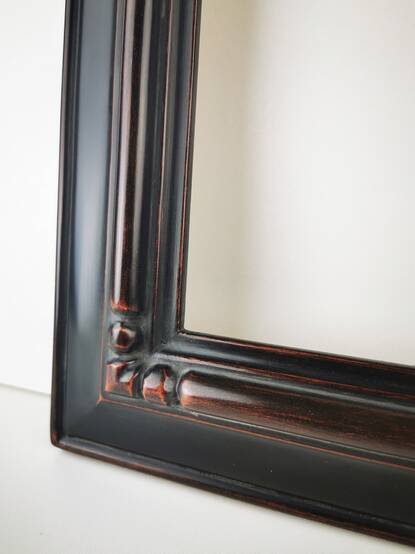
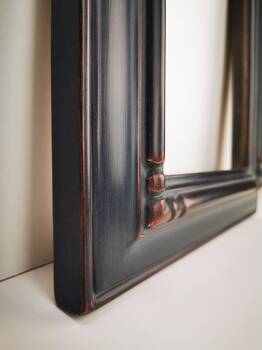
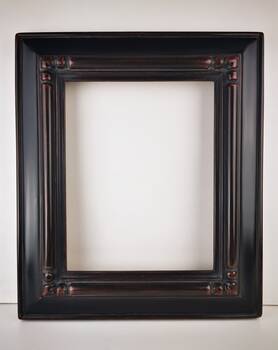
A black picture frame with a Dutch reverse profile and an ornament I carve by hand at each corner. I paint and patinate the black by hand, so a warm red ground shows on the carved corners and on the raised parts of the moulding. Made to measure for oil paintings on stretchers up to 20 mm (about ¾ inch) thick, with a moulding 67 mm (about 2⅝ inches) wide.
This black Dutch picture frame with hand-carved corners is made to measure for oil paintings on canvas. The long runs of the moulding stay plain and the decoration is gathered at the corners, where the edges of the painting meet. Because the reverse profile is highest at the painting and falls away towards the outer edge, the picture is carried forward rather than set back into the frame.
The reverse profile
The inner part of the moulding is a concave hollow rising to a half-round, which forms the crown of the section and its highest point. From the crown the surface falls away in a long sloping face that takes up the middle of the width, and a small bead closes the profile at the outer edge.
The shape of the moulding is milled; the ornament at each corner I carve by hand once the frame has been joined, so it is cut into the frame's own timber rather than applied.
Specification
- Style: reverse profile in the Dutch tradition
- Finish: black, hand-painted over a red ground and hand-patinated; satin sheen, sealed with traditional shellac and wax
- Moulding width: 67 mm
- Moulding thickness (face to back): 36 mm
- Rebate: 7 mm wide, 20 mm deep
- Material: timber with a low tannin content, of the kind used in museums and art conservation
- Corner construction: mitred corners reinforced with wooden splines, jointed before carving and painting
- Ornament: carved by hand at each corner of the joined frame, in the frame's own timber
- Artwork retention: sprung clips as standard, brass plates with screws on request
- Hanging: picture wire as standard, orientation chosen in the order menu, single D-ring on request
- Glazing, backing and mount: available as add-ons, quoted individually
- Suitable for: oil and acrylic paintings on stretched canvas; with glazing, prints, drawings, watercolours and photographs
- Lead time: 20–30 working days
The frame is made to the exact dimensions of your artwork, so enter the dimensions of the work itself in the calculator. I build in 2–3 mm of technical clearance, and the moulding overlaps the edge of the artwork by roughly 4–5 mm.
A black frame for oil paintings on canvas
This is first of all a frame for oil and acrylic paintings on stretched canvas. The patinated black suits landscapes, still lifes and portraits, particularly in a darker, subdued palette, and the red showing on the corners warms it slightly. The reverse profile is closely associated with 17th-century Dutch framing, where dark mouldings of this type were common; I write more about it in my article on Dutch frames and the reverse profile.
With its carved corners, the frame sits naturally in classic, country-house and eclectic interiors, and on a pale contemporary wall it reads as a firm dark outline around the work. How I choose a frame for a stretched oil painting is set out on my page about framing oil paintings, and other frames in this colour are gathered under black picture frames.
How it is made and finished
I cut the corners at 45 degrees and reinforce them with wooden splines, assembling the frame to the size of the painting in the order. Only then, in the joined frame, do I carve the ornament at each corner by hand.
Once the corners are carved, the frame takes a ground and a red layer, then black from my own range of richly pigmented paints. When the paint has set, I patinate the surface by hand, working the black back on the carved corners and the raised parts of the profile until the red shows through. I seal the frame in the traditional way with shellac and wax, which gives the black a satin sheen.
How it differs from a mass-produced frame
On a mass-produced decorative frame the corner ornament is usually a casting glued onto the finished moulding, the same on every copy, and the colour comes from spray or printed foil. Here the ornament is carved into the timber of the joined frame, and the black and the patina are worked by hand on this one piece, so the way the red shows on the corners and along the profile is never quite the same from one frame to the next.
What the frame will hold
The frame is supplied without glazing and without a backing, for a painting on a stretcher. The rebate is 20 mm deep, so it takes a stretcher up to 20 mm thick, seated from the back.
The same moulding can also be made without a rebate, as a floating frame, with the canvas set inside the frame and a narrow gap around the edges of the stretcher. I describe that construction in my guide to the floating picture frame for canvas art.
Frequently asked questions
Are the carved corners the same on every frame?
No two sets are exactly alike. I carve the corners by hand for each order, so small differences between one frame and the next are part of the work.
Will it take a canvas thicker than 20 mm (about ¾ inch)?
The rebate is 20 mm deep, so a thicker stretcher would stand proud at the back. In that case, write to me with the size and thickness of the painting before ordering.
Can I order it with glazing for a print or a photograph?
Yes. On request I fit conservation-grade low-reflection UV glazing, an acid-free mount, spacers and a Dibond backing. Send me the dimensions of the work and I will quote it.
Complete framing – additional options
Every frame I make can be completed with full archival and museum-quality framing: conservation-grade low-reflection UV glazing (four classes to choose from), acid-free museum mat board, spacers wrapped in acid-free paper and a Dibond backing. This kind of mounting protects the work from light, acids and distortion. I set out the full glass and material specification on a separate page: archival and museum framing for paintings and photographs. All components are available at extra cost, as an individual quote on request.
Mounting and hanging
Sprung clips are fitted as standard. They turn aside to let the work in and back to hold it, and they cope with anything from a thin board to a stretched canvas. Brass plates with screws are available on request and are supplied loose, for permanent fixing once the work is in place. Hanging orientation, vertical or horizontal, is chosen from the order menu. Picture wire is fitted as standard, and a single D-ring hanger can be fitted instead if you ask for it.
Ordering made to measure
Measure the artwork to within a millimetre, enter both figures in the calculator and choose the hanging orientation in the product options.
The base price shown is the price per running metre of moulding. The perimeter of the artwork is not the whole length a frame consumes: mitres cut at 45 degrees take extra length at every corner, and the wider the moulding, the more they take. The calculator accounts for the full consumption of moulding including the corners.
For this moulding width the calculator handles artworks up to 180 cm around the perimeter; anything larger is made to individual order, so send me the dimensions and I will price it. Glazing, backing and mount are quoted separately. Every frame leaves the workshop in 20–30 working days.