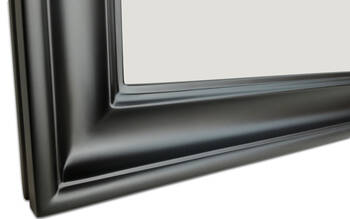
Modern Black Lacquer Picture Frame, 75 mm Wide
- Add feedback:
- Code: 138BK
- Manufacturer: Karol Milewski
-
Availability:
 Exists
Delivery time: 20 - 30 working days
- pcs.
- €163.89
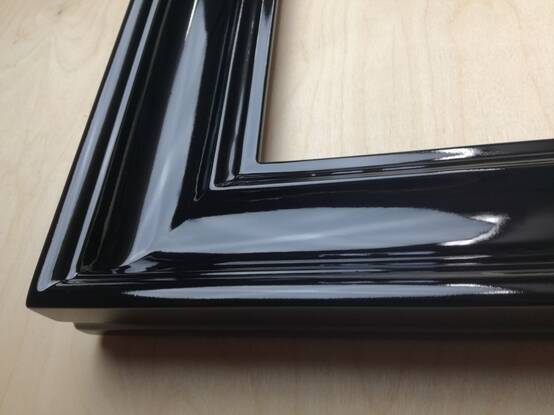
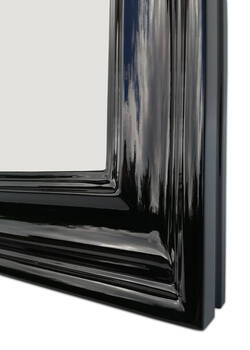
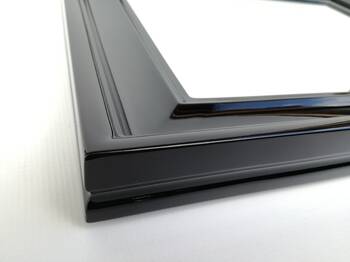
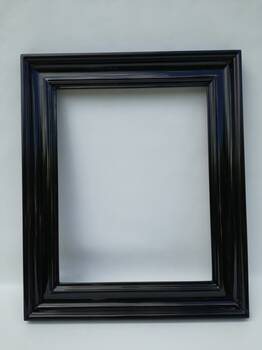
A modern black picture frame in lacquered finish, 75 mm wide, made to measure for one particular painting. The whole face is sprayed black and falls away in a single broad hollow, with gloss or semi-matt chosen in the order menu. The deeper rebate option takes a stretched canvas up to 20 mm thick.
This is the plainest frame among my black picture frames: no gilding, no ornament, no visible brushwork, just a broad lacquered black surface 75 mm across. The moulding is 75 mm wide and 41 to 52 mm from the face to the back, depending on the rebate depth, which gives a painting real weight on the wall without any decorative competition. I spray the black in thin coats and finish it in high gloss or semi-matt, and I make every frame in my workshop near Bialystok to the measurements of one artwork.
Frame profile
The face opens at the artwork edge with a flat step. Immediately beyond it the surface lifts in a shallow concave curve and drops straight back down, opening into a wide hollow that occupies most of the width. The lowest point of the hollow sits level with the inner edge, and from there the surface climbs gently outwards. A narrow step runs along the top of the outer side, and a quarter-round finishes the profile. The outer flank is undercut with a slight curve, which takes visual weight off the frame when it is seen from an angle. The profile shape is machine-milled; the handwork begins with the corner joinery, the priming and the paint.
Specification
- Style: modern concave profile, wide hollow across the face
- Finish: spray-lacquered black, high gloss or semi-matt, chosen in the order menu
- Moulding width: 75 mm
- Moulding thickness (face to back): 41 mm with the 9 mm rebate, 52 mm with the 20 mm rebate
- Rebate: 7 mm wide, 9 mm or 20 mm deep, chosen in the order menu
- Material: wood with a low tannin content, of the kind used in art conservation
- Corner joinery: mitred at 45 degrees, reinforced with wooden splines
- Glass: supplied without glass; museum glass, Dibond backing and mat board as add-ons
- Mounting: sprung clips as standard, brass plates on request
- Hanging: picture wire, portrait or landscape
- Use: oil and acrylic on stretchers, work on rigid supports, prints, photographs
I make the frame to the measurements of your painting. In the calculator you enter the dimensions of the artwork, not of the frame. I add 2 to 3 mm of technical clearance to those dimensions, and the moulding overlaps the edge of the painting by about 4 to 5 mm.
Which artworks and interiors it suits
A broad band of black works as a pause between the painting and the wall. It does most for work with strong drawing and clear contrast: oil and acrylic painting, printmaking, black and white photography, contemporary artist posters. Against a high-key palette it supplies the anchor the painting lacks on its own; around a dark, densely worked canvas it pulls the composition together. For work in oils, read what I set out about framing oil paintings before choosing the rebate depth.
In a room it reads as an architectural element rather than a decorative one. It suits white and grey walls, gallery, loft and minimalist interiors, and equally a classic living room that needs one strong accent. I write more about this idiom in the guide to modern picture frames.
Craftsmanship and finish
I cut the moulding at 45 degrees and spline the corners before any surface preparation begins. Only once the frame is assembled do I build up the grounds, sanding between coats, because with black every trace of grain comes to the surface as soon as the finish takes a shine. The black goes on by spray, in several thin coats, so the colour stays even along the whole hollow.
In the gloss version I bring the surface up to a high gloss that reflects light and deepens the concavity of the face; the step edge and the quarter-round then catch narrow highlights that draw the shape of the profile. In the semi-matt version I leave an even, low sheen that does not throw back windows or point sources of light and sits more quietly next to a canvas. Both share the same profile and dimensions; only the degree of sheen differs.
How it differs from mass production
A ready-made frame is cut to one of a dozen popular formats, and the painting has to be fitted to it. Here the dimensions of the artwork are the starting point. The corners are splined, so the joint moves with the wood and does not open up after a heating season. The black is not a foil or a laminated board but paint laid on prepared wood, so the edges stay sharp and the surface can be reworked later.
Functionality
The frame is supplied without glass, in the arrangement intended for painting: the artwork goes in from the back and rests on the shoulder of the rebate. You choose the rebate depth when you order. The 9 mm option suits thin supports, painting boards and rigid panels. The 20 mm option takes a typical stretcher up to 2 cm thick, and it is this depth that decides how thick a work can be enclosed; the moulding thickness then rises to 52 mm, because the rebate is cut deeper.
The same profile can also be made without a rebate, as a floating frame in which the canvas stands inside with a gap of air around it. I describe how that mounting behaves in the article on the floating picture frame for canvas art. If that is what you want, write to me before ordering, because it calls for different preparation of the moulding.
Complete framing, additional options
Every frame I make can be completed with full archival and museum-quality framing: anti-reflective UV-filtering glass (four classes to choose from), acid-free museum mat board, spacers wrapped in acid-free paper and a Dibond backing. This kind of mounting protects the work from light, acids and distortion. I set out the full glass and material specification on a separate page: archival and museum framing for paintings and photographs. All components are available at extra cost, quoted individually.
Mounting and hanging
Sprung clips are fitted as standard to hold the painting in the frame; they pivot to the side, so the artwork can be taken out and swapped quickly. On request I supply brass plates with screws instead (provided loose, for permanent self-installation). I prepare the frame to hang portrait or landscape as chosen in the order. Picture wire is standard, a single D-ring on request.
Ordering made to measure
The base price shown on the site is the price per running metre of moulding. The perimeter of the painting is not the full length the frame needs: corners cut at 45 degrees take additional length, and the wider the moulding, the more they take. The calculator accounts for the full moulding consumption with corners and for the options you select. For this moulding width it handles artworks up to 180 cm around the perimeter; anything larger is made to individual order, so send me the dimensions and I will price it.
Enter the artwork dimensions to within 0.1 cm, for example 35 x 30.2 cm. In the order you also choose the rebate depth, the finish and the hanging orientation. The lead time is 20 to 30 working days.