Dutch Black Picture Frame, Made to Measure for Canvas
- Add feedback:
- Code: 59
- Manufacturer: Karol Milewski
-
Availability:
 Exists
Delivery time: 20 - 30 working days
- pcs.
- €163.89
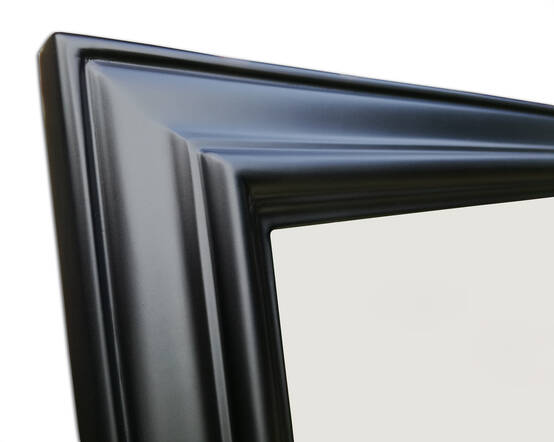
A black picture frame built on a Dutch section: the highest point of the moulding sits at the painting rather than at the wall, so the edge of the work is carried towards the viewer. The moulding is 67 mm wide and 32 mm thick, painted black by hand and finished to a satin sheen, with a 20 mm rabbet that takes a standard stretcher. I make each frame to the size of your painting.
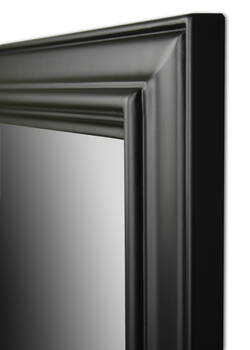
This is a black picture frame built on a Dutch section: the crest of the moulding stands at the artwork and the face falls away towards the wall, the opposite of the usual arrangement. The moulding is 67 mm wide and 32 mm thick, painted black by hand and finished to a satin sheen. There is no gilding and no applied ornament, so the effect rests on the geometry of the section and the depth of the colour: a plain black picture frame able to carry a serious painting without arguing with it. What that shape does to a work I set out in my note on Dutch frames.
The moulding profile
At the artwork the section opens with a concave hollow that rises into a half-round, and that half-round is the highest point of the whole moulding. From there the face descends along a long frieze that occupies the middle of the width, and closes in a small bead at the outer edge.
Specification
- Style: Dutch section, plain black painted finish, no ornament
- Finish: hand-painted black, sealed with shellac and wax to a satin sheen
- Moulding width: 67 mm
- Moulding thickness (face to back): 32 mm
- Rabbet: 7 mm wide, 20 mm deep
- Timber: low-tannin wood of the kind used in museum work and art conservation
- Corner joinery: mitred at 45 degrees, reinforced with wooden splines, joined before finishing
- Gilding: none, this is a painted frame
- Glass, backing and mat board: outside the calculator, individual quote on enquiry
- Artwork retention: sprung clips as standard, brass plates on request
- Hanging: picture wire as standard, single D-ring on request, portrait or landscape chosen at checkout
- Suitable for: oil and acrylic on canvas, prints, photographs, works on paper when glazed
- Lead time: 20 to 30 working days
I make the frame to the dimensions of the artwork itself, so enter the size of your painting in the calculator, not the size you want the frame to be. The frame is cut 2 to 3 mm larger than the size you give, the technical allowance the work needs to sit freely, and with it the moulding overlaps the edge of the painting by roughly 4 to 5 mm.
Which artworks and interiors it suits
The inverted section earns its keep on paintings. On an oil or acrylic on stretched canvas the crest standing at the artwork reads as a firm edge against the paint surface, and because the face then falls away outwards the eye is turned back into the picture rather than led off to the wall. At 67 mm the moulding has the width for medium and large formats; below roughly 30x40 cm I would suggest something narrower. Glazed, with spacers holding the work clear of the pane, it takes prints, drawings, photographs and fine art reproductions.
Black is the least neutral of the neutral choices. In a room it does the work of a dark mount: it draws a boundary and stops there, which makes it as usable on a pale gallery wall as in a panelled or saturated interior. If you are framing oils in particular, I have written about the choices involved in framing oil paintings, and the rest of the range is in my black picture frames.
Making and finishing
The profile is milled, not carved. Everything after that is hand work. I cut the lengths, mitre the corners at 45 degrees and reinforce them with wooden splines, and the frame is assembled before any colour goes on, so the joint is structural rather than cosmetic and the corner closes without a visible seam. The timber is low-tannin wood of the kind used in museum work and art conservation, stable in size and slow to bleed acids into the frame.
The black is built up in successive coats rather than sprayed on in one, which is what gives a dark colour its depth; a single thick coat sits on the surface and reads flat. The frame is then sealed with shellac and wax and worked by hand to a satin sheen, which catches the light softly along the half-round and the frieze. No two come out exactly alike.
How it differs from a factory frame
A production moulding of this width is normally MDF wrapped in a printed foil, cut to stock sizes and stapled at the corners, and nothing about it is made for one particular painting. Here the section is milled from timber, the corners are splined and closed before finishing, the colour is painted and hand finished rather than sprayed, and the frame is cut to your work. On a black frame the difference shows first at the corners, where a foil wrapped mitre opens into a pale line as the joint moves and a splined, painted corner does not.
Functionality
As standard the frame is supplied without glass, prepared for a painting on a stretcher. The rabbet is 7 mm wide and 20 mm deep, and it is the rabbet depth, not the 32 mm thickness of the moulding, that decides what the frame can enclose: a stretcher or panel up to 20 mm thick sits fully inside and finishes level with the back. If yours is deeper, tell me when you order and I will adjust the section.
I also make the same moulding without a rabbet, as a floating frame, where the painting sits in a narrow gap with the stretcher edges exposed. The difference is set out in my guide to the floating picture frame for canvas art.
Complete framing – additional options
Every frame I make can be completed with full archival and museum-quality framing: anti-reflective UV-filtering glass (four classes to choose from), acid-free museum mat board, spacers wrapped in acid-free paper and a Dibond backing. This kind of mounting protects the work from light, acids and distortion. I set out the full glass and material specification on a separate page: archival and museum framing for paintings and photographs. All components are available at extra cost, as an individual quote on request.
Mounting and hanging
To hold the painting, I fit sprung retaining clips as standard; they pivot to the side, so the canvas can be removed and replaced quickly without tools. On request I supply brass plates with screws instead (provided loose, for permanent self-installation). The hanging orientation – portrait or landscape – is chosen at checkout. Picture wire is standard, with a single D-ring available on request.
Ordering made to measure
The base price shown on the site is the price per running metre of moulding. The perimeter of the painting is not the full length the frame needs: corners cut at 45 degrees take extra length, and the wider the moulding, the more they take. The calculator accounts for the full moulding consumption with corners and for any options you choose, so you only need to enter the dimensions of your painting to within 0.1 cm.
The calculator accepts artwork up to a perimeter of 180 cm, the limit set for a moulding of this width; larger formats I make to individual order, so please write to me first. Lead time is 20 to 30 working days.