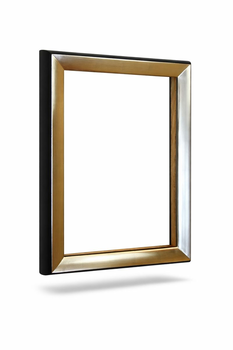
Gold leaf picture frame for canvas paintings, made to measure
- Add feedback:
- Code: 1170
- Manufacturer: Karol Milewski
-
Availability:
 Exists
Delivery time: 20 - 30 working days
- pcs.
- €275.00
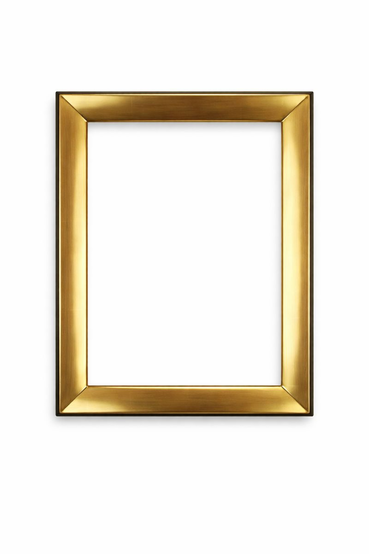
A gold leaf picture frame for paintings on canvas: a deep moulding, 44 mm wide and almost square in section, water-gilded by hand with genuine leaf. Five finishes to choose from, from 23-karat yellow gold to palladium with hand-painted black sides. I make every frame to the size of your artwork.
This is a gold leaf picture frame built for paintings on canvas: a deep moulding, 44 mm wide and almost square in cross-section, gilded by hand with genuine leaf. I make it to measure for oil and acrylic painting on stretcher, for photography and for fine-art prints on stretched canvas, and I gild it in one of five metals, from classical 23-karat yellow gold to palladium with hand-painted black sides. It sits with the rest of my gold gilded picture frames, and like all of them it is gilded on a gesso and bole ground, not sprayed, foiled or painted.
Moulding profile
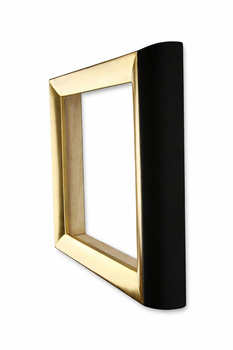
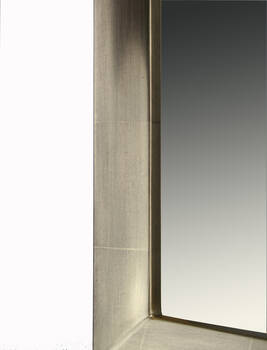
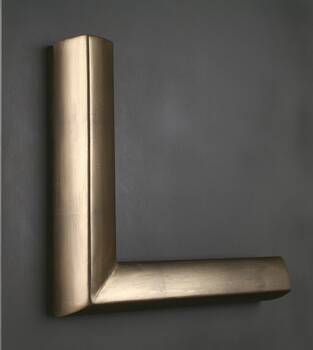
At the artwork the face rises and passes into a broad, uniform convex curve that runs across the whole visible width of the moulding. The crown of the profile lies at the outer edge, and that is where the moulding stands highest. The side is just as full and convex, so the cross-section as a whole comes close to a square.
Specification
- Style: single-arc convex profile
- Finish: gold leaf gilding or palladium, five variants to choose from
- Moulding width: 44 mm
- Moulding thickness (face to back plane): 42 mm
- Rabbet: 7 mm wide, 20 mm deep
- Material: low-tannin timber of the kind used in museum work and art conservation
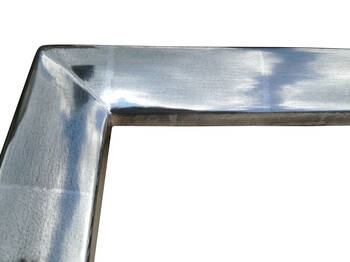
- Corners: mitred at 45°, reinforced with wooden splines, joined before gessoing
- Gilding: water gilding, leaf laid side by side
- Sealing: shellac and wax
- Glass, backing, mount board: additional options outside the calculator
- Lead time: 20–30 working days
- Application: oil and acrylic painting on canvas, photography and fine-art prints on stretched canvas
The dimensions you enter refer to the artwork, not to the frame. I build the frame 2–3 mm larger than the size you give so the work seats freely, and the rabbet then covers about 4–5 mm of its edge. The outer size of the finished frame is larger than the artwork by twice the width of the moulding.
Which artworks and interiors it suits
The frame is made as a setting for a stretched canvas, so it works for oil and acrylic painting, for photography printed onto canvas and for canvas prints and photographs on canvas. A full convex face of this width holds a painting with weight to it: impasto, strong colour, a large format that would look unfinished in a narrow moulding.
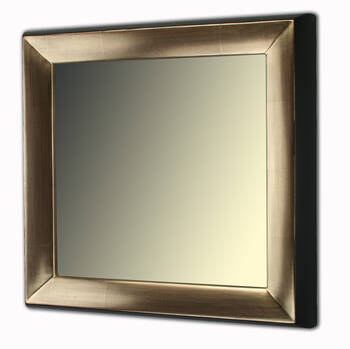
Which metal you choose decides the room. Yellow gold on plum bole reads as classical and belongs with old-master painting, sacred work and traditional interiors. Moon gold is paler and calmer, and carries contemporary painting as easily as work on paper. White gold and palladium are cool and close to chrome, and sit comfortably in a modern interior, next to monochrome photography or a restrained palette.
Five finishes to choose from
Every variant is built the same way: gesso on the timber, then coloured bole, then the metal leaf laid on water. The bole shows through the leaf where it has been burnished and along the edges, so it is the bole that decides the final tone of the metal. I describe the technique itself in more detail on my page about water gilding.
23-karat yellow gold on plum bole
The standard variant and the most classical of the five, with the warmest and most saturated reflection. The plum bole, a deep red-violet, shows through where the leaf is burnished with an agate stone and along the edges, giving the warm undertone familiar from old painting and from nineteenth-century salon frames.
22-karat moon gold on plum bole
Moon gold is lighter and cooler than 23 karat, with a subtly silvery cast, but without the metallic chill of white gold. Over plum bole it keeps a warm core, which places it between the classical and the contemporary.
6-karat white gold on grey bole
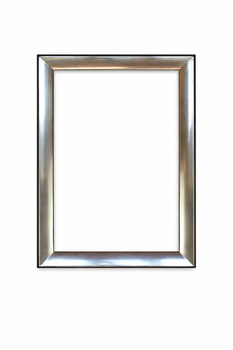
A cool, almost chrome-like reflection. The grey bole neutralises the tone completely, so the surface reads as a cool metallic grey with no warmth underneath. The most contemporary of the five.
22-karat moon gold on grey bole, side gilded
The same 22-karat leaf over cool grey bole, left unburnished, so the surface keeps the natural texture of the leaf rather than a polished shine. The side of the moulding is gilded as well, which gives a continuous gilded edge from any viewing angle. The most demanding variant to make, and priced accordingly in the calculator.
Palladium with hand-painted black sides
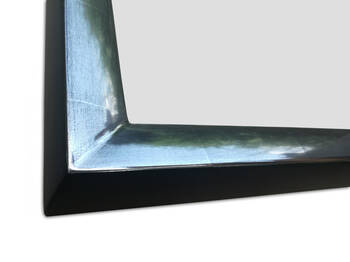
The face is laid with palladium, a precious metal with a stable, neutrally silver tone that does not tarnish the way silver does. The sides are painted black by hand and finished with wax to a satin sheen, which gives the frame a graphic, gallery-like edge.
How I make the frame
The profile is milled from low-tannin timber of the kind used in museum work and conservation. I cut the mitres at 45 degrees and join the corners with wooden splines before anything else happens to the surface, so the gesso, the bole and the leaf all go onto a frame that is already closed. That order matters: on cheap pre-gilded mouldings the leaf is laid on the straight stick and the corners are cut afterwards, which is why the gilding on them opens at the mitres.
The gesso is sanded smooth, the bole is laid over it and then wetted, and the leaf bonds to the damp surface by itself, with no adhesive. Leaf comes in sheets of roughly 80 by 80 mm and I lay it sheet beside sheet with an overlap of about a millimetre. Once the surface is dry I burnish chosen areas with an agate stone and leave the rest in the natural texture of the leaf. The finished gilding is sealed with shellac and wax.
How this differs from a production frame
Mass-produced gold frames are finished with imitation metal leaf or with gold paint. Both change colour within a few years, because their tone comes from pigment and from a copper alloy that oxidises. Here the surface is genuine gold leaf, 6, 22 or 23 karat, or palladium, and the colour of the metal comes from the alloy itself. The corners are splined and gessoed closed before gilding rather than glued after it, and the frame is made from timber rather than board, which is why it holds its shape and its gilding as the humidity in a room moves through the year.
Functionality
The frame is supplied without glass, as a setting for a canvas on stretcher. The rabbet is 20 mm deep, which takes a standard stretcher and leaves the work sitting inside a clearly defined perimeter rather than disappearing into the moulding.
Floater variant
Any of the five finishes can also be made without a rabbet, as a floating frame: the canvas is mounted inside the frame with a visible gap all round and the edges of the stretcher stay exposed. I explain how that construction works, and which paintings suit it, in my guide to the American box frame for a painting.
Complete framing – additional options
Every frame I make can be completed with full archival and museum-quality framing: anti-reflective UV-filtering glass (four classes to choose from), acid-free museum mat board, spacers wrapped in acid-free paper and a Dibond backing. This kind of mounting protects the work from light, acids and distortion. I set out the full glass and material specification on a separate page: archival and museum framing for paintings and photographs. All components are available at extra cost, as an individual quote on request.
Mounting and hanging
The artwork is held in the rabbet by spring clips, fitted to the back of the frame in the workshop. They rotate aside, so one work can come out and another go in without tools. Brass plates with screws are available on request instead: they are supplied loose with the screws, you fit them yourself once the work is in, and the fixing is permanent. This is not a menu choice, so add a note to the order if you want the brass plates.
Hanging orientation, portrait or landscape, is selected from the order menu, and the frame is prepared for that orientation only. Hanging cord is fitted as standard. A single D-ring hanger is available on request.
Made to measure
The price shown is the price per running metre of moulding. The perimeter of the picture is not the whole length a frame needs: the 45° mitres take additional length at each corner, and the wider the moulding, the more they take. The calculator works out the full consumption including corners, along with any add-ons you select.
Measure the artwork itself, width and height, to the nearest millimetre, and type those figures in. The calculator handles artworks up to 120 × 80 cm; anything larger is made to individual order, so send me the dimensions and I will price it. Lead time is 20–30 working days.