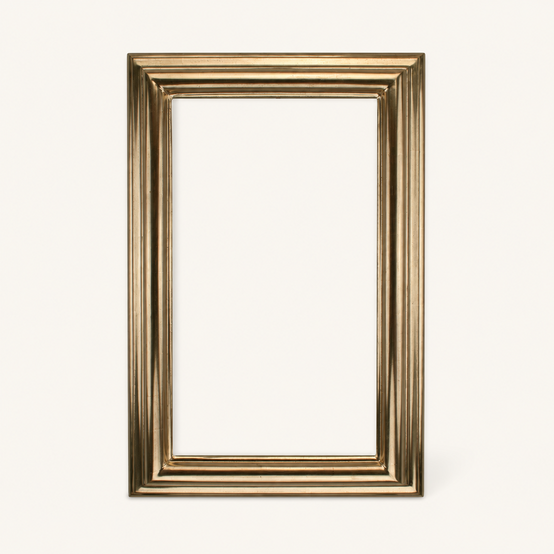
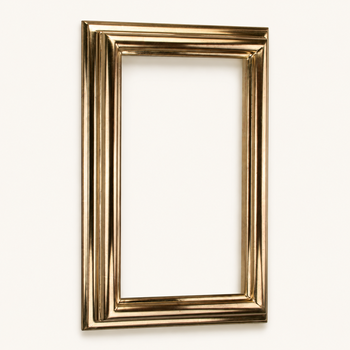
Gold gilt picture frame, hand-gilded with 22-karat gold leaf
- Add feedback:
- Code: 1123
- Manufacturer: Karol Milewski
-
Availability:
 Exists
Delivery time: 20 - 30 working days
- pcs.
- €358.33
A gold gilt picture frame with a moulded 50 mm face, water-gilded across the whole face in genuine 22-karat gold leaf over plum bole and burnished with an agate stone. On the frame photographed the gilding is even and closed, and the tone of the metal is cooler and paler than classic yellow gold. I make each one to the measurements of your painting.
This gold gilt picture frame carries a 50 mm moulding gilded over its whole face in genuine 22-karat gold leaf. The profile is milled with a clear rhythm of convex and concave forms, so the frame reads as a decorative object in its own right rather than a neutral border. I lay the gold by the traditional water gilding method, over plum bole, and burnish it with an agate stone to a smooth sheen. The frame shown here was not patinated: the gilding is even and closed, with no rubbing through to the bole. The tone of this gold is noticeably cooler and paler than classic yellow gold, with a faintly silvery note.
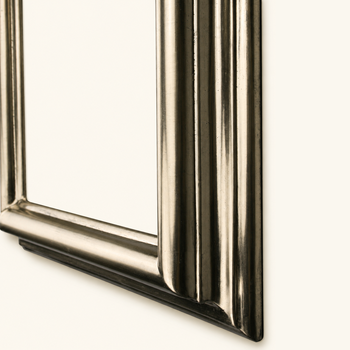
The moulding profile
At the artwork the moulding rises through a small convex swell that runs smoothly into the main element of the profile: a broad half-round torus, which sets the highest point of the moulding while still in its inner section. From there the face descends towards the outer edge, first through a stepped descent with a short flat, then a gentle ogee, and finally an ovolo that rounds off the outer edge of the frame.
Specification
- Style: moulded gilt picture frame, gilded across the whole face
- Finish: 22-karat moon gold leaf over plum bole, burnished with an agate stone, sealed with traditional shellac and wax
- Moulding width: 50 mm
- Moulding thickness (face to back plane): 39 mm
- Rabbet: 7 mm wide, 20 mm deep (fixed for this profile)
- Material: solid low-tannin timber, used in museology and art conservation
- Corner construction: mitred at 45 degrees, reinforced with wooden splines
- Artwork retention: sprung clips as standard, brass plates with screws on request
- Hanging: picture wire; portrait or landscape orientation chosen when ordering
- Intended use: oil and acrylic on stretched canvas, fine art prints, photography, watercolour framed with a mount
- Lead time: 20–30 working days
Dimensions. The outer dimension given covers the complete frame together with the moulding on every side, so the sight opening is correspondingly smaller. When ordering you give the dimensions of the painting itself: I build the frame 2 to 3 mm larger so the work slides in freely.
Which artworks and interiors it suits
This profile takes painting with a strong surface and saturated colour: oils on stretched canvas, landscapes, still life and portraits, as well as fine art prints and photography framed with a mount. A width of 50 mm is a universal proportion, working from intimate formats up to medium-sized paintings, where the frame is meant to build the field of reception rather than overwhelm the work.
The cooler tone of this gold gives more freedom in choosing an interior than yellow gold does. It sits quietly next to silver, pale timber, cool white and grey, and in a classical room with a warm palette it works as a quiet counterpoint. If you are looking for a different shade of metal or a wider moulding, it is worth looking through the other gold gilded picture frames.
Craftsmanship and finish
I mill the moulding from solid low-tannin timber, the kind used in museology and in the conservation of works of art. The corners are cut at 45 degrees and reinforced with wooden splines before gessoing, so the joint is closed under the ground layers and does not work later against the gilding.
Onto the prepared moulding I lay successive coats of gesso, sand them back, and then apply the plum bole, which forms the ground for the metal and decides its final tone. The gold is laid by water gilding: leaves of roughly 80 by 80 mm are placed side by side with an overlap of about 1 mm, which gives a single layer of gold across the whole surface. For the narrow sections of the profile I cut them with a knife on a gilder's cushion, separately for the swell, the ogee and the ovolo.
Finally I burnish the gold with an agate stone. This closes the pores of the bole and gives the surface a smooth, mirror-like sheen that oil gilding cannot produce. The gilding is then sealed with traditional shellac and wax.
How it differs from mass production
Mass-produced frames are usually MDF or polyurethane mouldings covered with metallic foil or gold-toned paint. From a distance they look similar, but in raking light you see a flat, uniform reflection with no depth. Here the metal is real, laid by hand over a multi-layered ground and burnished with stone, so it returns light unevenly, the way metal does rather than the way a print does. I make each frame singly, for one particular painting, from the first cut of the moulding to the last coat of wax.
Functionality
I make this frame without glass, for mounting a painting on its stretcher directly. The 20 mm rabbet depth takes typical painting stretchers together with the retaining clips, and for works on paper the frame is combined with glass and a mount ordered separately.
The same profile can also be made without a rabbet, as a floating frame: the canvas then remains visible in a narrow gap and the edges of the stretcher stay exposed. I describe the principle and the differences between the two solutions in my guide to the floating picture frame for canvas art.
Complete framing – additional options
Every frame I make can be completed with full archival and museum-quality framing: anti-reflective UV-filtering glass (four classes to choose from), acid-free museum mat board, spacers wrapped in acid-free paper and a Dibond backing. This kind of mounting protects the work from light, acids and distortion. I set out the full glass and material specification on a separate page: archival and museum framing for paintings and photographs. All components are available at extra cost, as an individual quote on request.
Mounting and hanging
This frame is intended for paintings on canvas and stretchers, so it does not include glass as standard. To hold the painting, I fit sprung retaining clips as standard; they pivot to the side, so the canvas can be removed and replaced quickly without tools. On request I supply brass plates with screws instead (provided loose, for permanent self-installation). The hanging orientation – portrait or landscape – is chosen at checkout. Picture wire is standard, with a single D-ring available on request.
Ordering made to measure
The base price shown on the site is the price per running metre of moulding. The perimeter of the painting is not the full length the frame needs: corners cut at 45 degrees take extra length, and the wider the moulding, the more they take. The calculator accounts for the full moulding consumption with corners and for any options you choose, so you only need to enter the dimensions of your painting to within 0.1 cm. The calculator handles formats up to 120 × 80 cm, and I make larger sizes to individual order.
I also make this profile in other shades of gold leaf: 23-karat yellow with the most intense, warm glow, 12-karat white gold, and 6-karat white gold with a cool, almost chrome reflection. Other bole colours, which change the tone of the metal, are chosen on request.
Lead time: 20–30 working days.