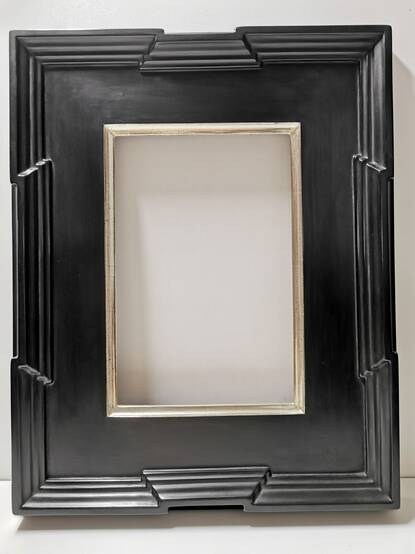
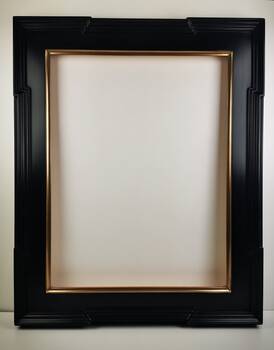
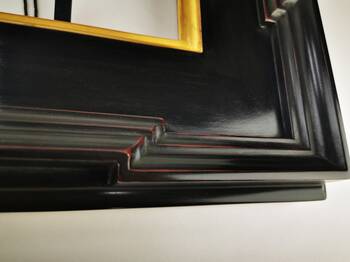
Black picture frame with Flemish corners, 100 mm
- Add feedback:
- Code: 246
- Manufacturer: Karol Milewski
-
Availability:
 Exists
Delivery time: 20 - 30 working days
- pcs.
- €247.22
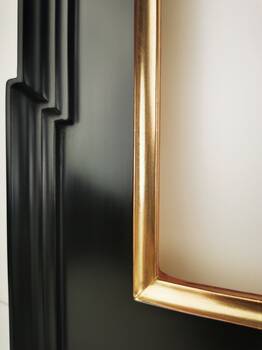
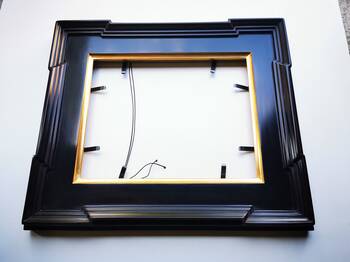
A black picture frame 100 mm wide, just under 4 inches, with Flemish corners and one band of genuine gold leaf laid in the hollow where the moulding meets the painting. Everything beyond that hollow is painted black, so the gold reads as a single bright line against the canvas rather than as a gilded surface. Made to measure, with a 20 mm rebate for a stretched canvas, in 23-karat yellow, 22-karat moon or 12-karat white gold.
This is a wide black frame carrying one line of gold. The leaf sits in the hollow at the very edge of the painting, about 10 mm across, and the rest of the face is painted black, so the frame reads as a broad dark border with a bright edge holding the canvas. The moulding is 100 mm wide and 50 mm thick, with a 20 mm rebate that takes a standard stretched canvas, and the corners are worked as Flemish corners. I make each frame to the measurements of one artwork and water gild it with genuine gold leaf over a coloured bole.
Profile
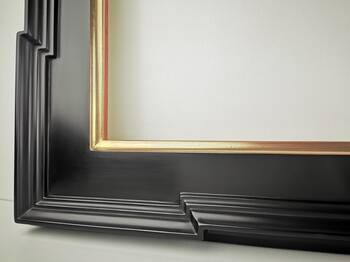
The section opens at the edge of the painting with a hollow about 10 mm wide, cut as a gentle arc. This is the one gilded element on the frame. It runs out into a flat face about 47 mm wide, close to half the section and the main field of the moulding.
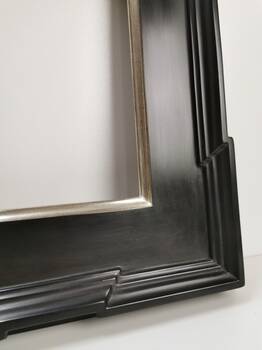
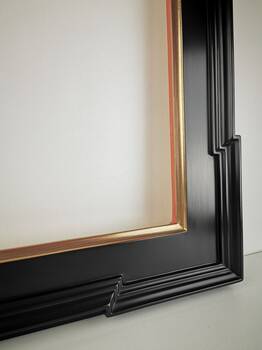
Beyond that field the surface climbs outwards through two steps, each separated by a narrow flat. The last step turns into an ogee, a double curve that lifts to the outer flat, the highest point of the whole section.
The side falls from that flat as a vertical face about 19 mm high, is then undercut with a concave curve, and widens again towards the wall into a distinct foot about 22 mm high. The undercut does practical work: a frame 50 mm thick reads lighter from an angle than the figure suggests, and the widest part of the section stays at the back edge, against the wall.
At the corners the profile is worked into Flemish corners, the decorative corner treatment that comes from seventeenth-century Netherlandish and Flemish framing. That detail is what gives this model its character, and I write about the wider family of these frames in my piece on Dutch frames.
Specification
- Style: classical, with Flemish corners
- Finish: black, hand painted
- Gilding: genuine gold leaf in the hollow at the inner edge only; 23-karat yellow, 22-karat moon or 12-karat white gold, water gilded and burnished with an agate stone, sealed with shellac and wax
- Bole under the leaf: red, grey, Victorian grey, plum or black
- Moulding width: 100 mm
- Moulding thickness (face to back): 50 mm
- Rebate: 7 mm wide, 20 mm deep; takes a stretcher up to 20 mm thick
- Material: timber of a low-tannin species, of the kind used in museum work and art conservation
- Corners: mitred and reinforced with wooden splines
- Sides: black as standard, another colour by arrangement
- Glazing, backing and mat board: not included, available as an add-on and quoted separately
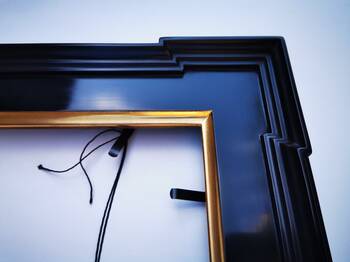
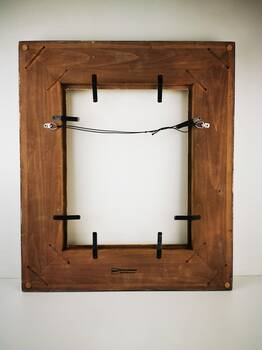
- Mounting and hanging: sprung clips and cord as standard, portrait or landscape
- Suited to: oil and acrylic paintings on canvas, from roughly 50 x 70 cm upwards
- Lead time: 20 to 30 working days
I cut the frame 2 to 3 mm larger than the artwork, so that the work drops in without being forced, and the moulding then covers 4 to 5 mm of the edge all round. Send me the height and width of the painting and I work from those figures.
Which artworks and interiors it suits
A rebate 20 mm deep takes a standard stretcher with its bars, so this is first of all a frame for oil and acrylic painting on canvas. The width asks for a certain scale: from about 50 x 70 cm, roughly 20 x 28 inches, upwards the 100 mm moulding sits in proportion, and below that it starts to take over the composition.
Black with one narrow gilded edge is a restrained answer to a strong palette. It suits painting in the old master tradition, portraits and still life, and it works equally well with contemporary abstraction, where gold across the whole face would be too much and a bare black frame too blunt. On a pale wall the dark border draws the canvas together; on a dark wall the gold line does the work. I go further into proportion, depth and glazing on my page about framing oil paintings, and the rest of this group sits in picture frames gold gilded and partially painted.
How it is made
The order of work is set by the technique. The lengths are mitred and joined with wooden splines first, so the corner is closed before any finishing goes on. Gesso is then built up on the assembled frame, layer over layer, and worked smooth. The bole, the coloured clay ground in the tone you choose, goes into the hollow, where the gold is to lie.
The gilding is done with gold leaf laid on water. The leaves measure about 80 x 80 mm and the hollow is about 10 mm wide, so the leaf is cut into narrow strips with a knife on the gilder's cushion and taken along the arc leaf against leaf, with an overlap of about a millimetre, so that it follows the curve without creasing. Once it has set I burnish it with an agate stone: the stone presses the metal into the bole and brings up a depth of shine no other method gives. The gilding is then sealed with shellac and wax. My page on water gilding sets out the method in full.
The rest of the face is painted black by hand. The boundary between black and gold falls on the edge of the hollow, so it stays straight and sharp all the way round the frame, corners included.
Choosing the gold and the bole
Three gold tones are available. 23-karat yellow gold gives the strongest classical shine and cuts most sharply against the black. 22-karat moon gold is clearly paler and cooler, with a faint silvery cast. 12-karat white gold is cooler again, quiet and subdued, reading against black more as a light line than as gold.
The bole is chosen separately: red, grey, Victorian grey, plum or black. On a band this narrow the bole works mainly at the edges of the hollow, where the leaf lies thinnest, and it sets the temperature of the metal from there. Red lifts the warm tones, the two greys quieten and cool the gold, plum sits well under white gold, and black gives the sharpest contrast.
How it differs from a mass-produced frame
A factory frame with this look is printed foil or sprayed paint on a length of moulding, cut and stapled to size. Here the gold is genuine leaf over bole, so it can be burnished, worked back by hand and left to age rather than peel, and the corner is a joined corner rather than a butted one. I keep no stock of finished sizes: every frame is cut, joined, gilded and painted for one painting.
Functionality
The frame is supplied without glazing, with the painting held directly in the rebate. The 20 mm depth takes a typical stretcher. If your stretcher is deeper than 20 mm, write to me with the thickness before you order, because the rebate then has to be made differently.
The same section can also be made without a rebate, as a floating frame, with the painting standing free inside the moulding and a shadow gap around its edge.
Common questions
Is the whole frame gilded, or only part of it?
Only part of it. This is a painted frame with gilded accents: the hollow at the inner edge carries genuine gold leaf, and everything beyond it is painted black. If you would rather have the whole face in leaf, I make this section fully in gold as well and can price it that way.
Which gold tone should I choose for an oil painting?
For warm earth palettes and for older varnished paintings, 23-karat yellow gold over a red bole gives the warmest and strongest line. For cool, muted or tonal palettes, 22-karat moon gold sits more quietly against the paint. 12-karat white gold, particularly over a plum bole, suits work with a cold or silvery cast. Because the band is narrow, the difference between the tones shows up as a change in temperature rather than in brightness.
Can this frame take conservation-grade low-reflection UV glazing?
Yes. The frame comes without glazing as standard, and glazing, an acid-free mat and a Dibond backing can all be added. For a work on paper I would normally allow a mat border of about 1½ to 2¼ inches, 40 to 57 mm, and set the rebate depth to suit the whole package rather than the artwork alone.
Can a frame like this be made to a tighter budget?
Yes, and the saving comes from the section rather than from the gold. A narrower moulding with a shorter gilded element uses less leaf and less hand work while keeping genuine gold leaf on the frame. Send me the size of the painting and roughly what you want to spend, and I will suggest a profile that fits both.
Complete framing – additional options
Every frame I make can be completed with full archival and museum-quality framing: anti-reflective UV-filtering glass (four classes to choose from), acid-free museum mat board, spacers wrapped in acid-free paper and a Dibond backing. This kind of mounting protects the work from light, acids and distortion. I set out the full glass and material specification on a separate page: archival and museum framing for paintings and photographs. All components are available at extra cost, as an individual quote on request.
Mounting and hanging
I hold the painting in the frame with sprung clips that turn aside when you change the work, which makes the frame easy to handle. On request I fit permanent, screwed brass plates instead. For hanging, I attach cord as standard, in portrait or landscape orientation; a single D-ring on request.
Ordering made to measure
The base price shown on the site is the price per running metre of moulding. The perimeter of the painting is not the full length the frame needs: corners cut at 45 degrees take extra length, and the wider the moulding the greater that difference, which at 100 mm is considerable. The calculator accounts for the full moulding consumption with corners and for any options you choose.
The calculator accepts artwork up to a perimeter of 180 cm, the limit set for a moulding of this width; larger formats I make to individual order, so please write to me first. Glazing, backing and mat board are priced separately, outside the calculator. Each frame is made in 20 to 30 working days.