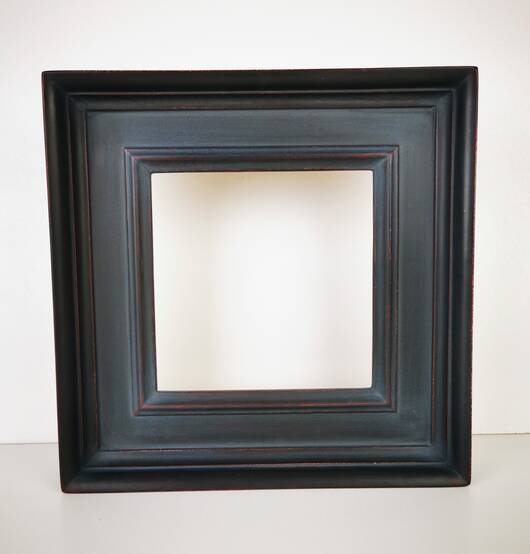
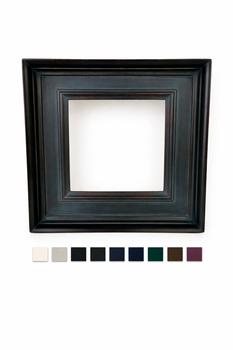
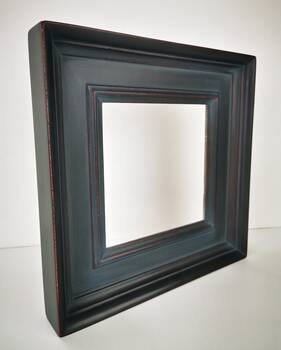
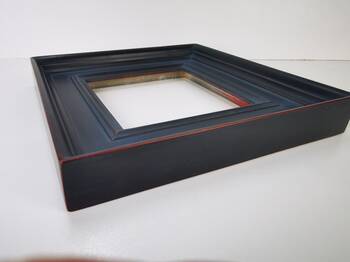
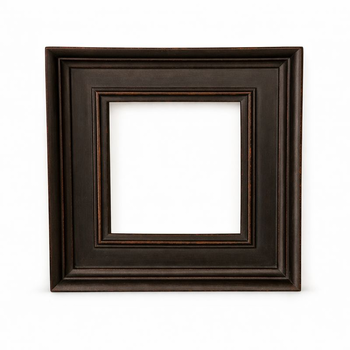
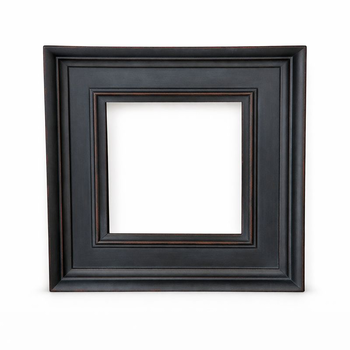
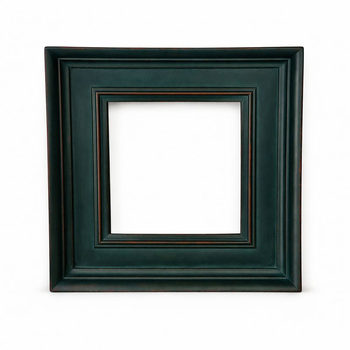
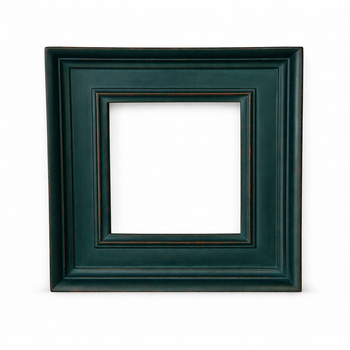
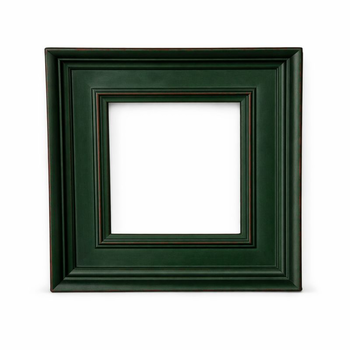
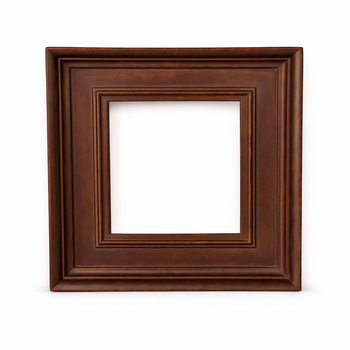
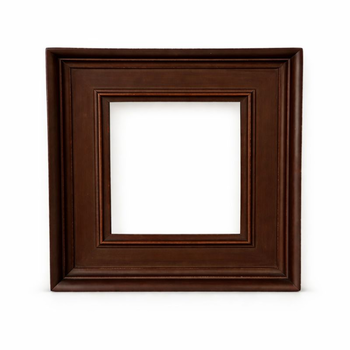
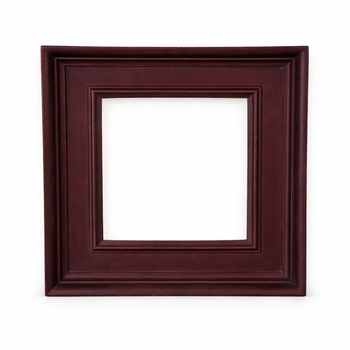
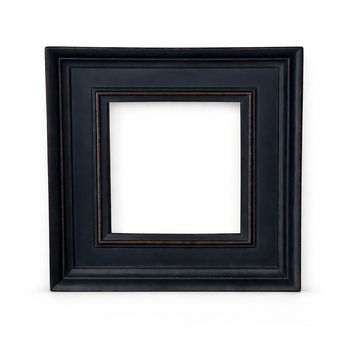
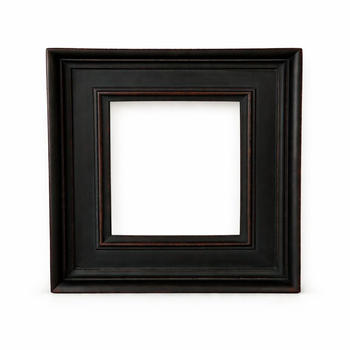
Hand-Finished Picture Frame for Canvas, 18 Colours
- Add feedback:
- Code: 277
- Manufacturer: Karol Milewski
-
Availability:
 Exists
Delivery time: 20 - 30 working days
- pcs.
- €136.11
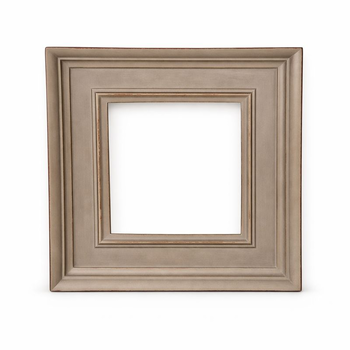
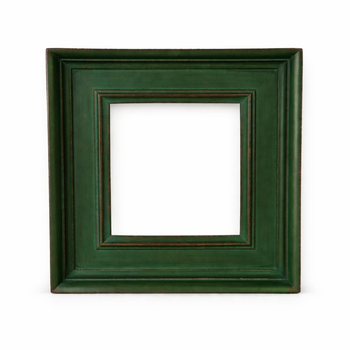
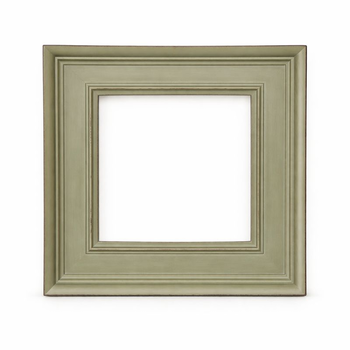
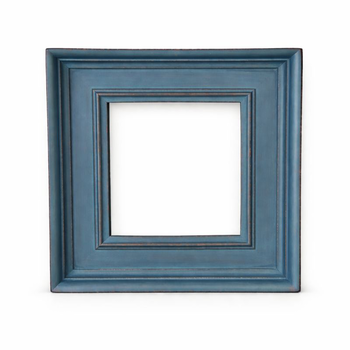
A hand-rubbed picture frame for canvas in solid timber, with a classic 55 mm profile featuring a half-round torus and frieze. Three layers of richly pigmented paint from a curated artisan range, hand-rubbed to bring through the colours beneath. 18 finishes — from blacks and deep greens to greys, navies and earth tones. Made to measure.
This is a picture frame for canvas paintings, hand-finished in my workshop and built as a setting for work on a stretcher. The moulding is 55 mm wide, about 2⅛ inches, and 36 mm thick from face to back, so it takes a standard stretcher without trimming the bars. The face carries three layers of paint from a curated, richly pigmented range, rubbed back by hand so that fragments of the colours underneath come through. Eighteen colours are available, and every frame ends up with its own pattern of rubbed-back marks.
Moulding profile
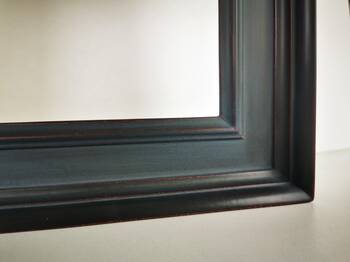
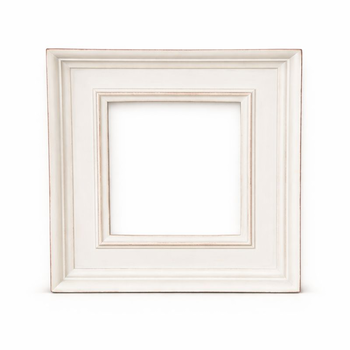
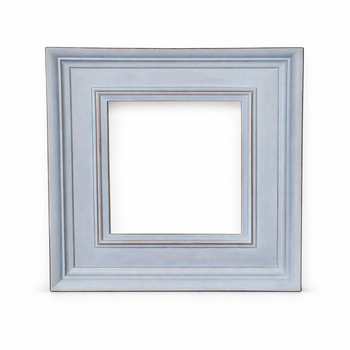
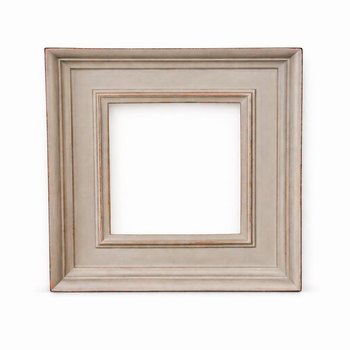
The face opens with a hollow at the inner edge, which rises into a torus standing a little above the rest of the surface. Beyond the torus the face falls away gently and steps down into the flat frieze, the widest and lowest field of the moulding. The frieze is closed by a cavetto, a quarter-circle hollow that climbs towards the outside, passes through a narrow flat into a quarter-round, and finishes the face at the outer edge, the highest point of the profile. Across 55 mm the frieze takes most of the face, with the two raised elements, the torus at the artwork side and the quarter-round outside, holding it between them.
Specification
- Moulding width: 55 mm
- Moulding thickness (face to back): 36 mm
- Rebate: 7 mm wide, 13 or 20 mm deep, chosen in the order menu
- Material: timber low in tannins, of the type used in museum and conservation framing
- Corner joinery: mitred at 45° and reinforced with wooden splines
- Finish: three hand-applied layers of paint, rubbed back by hand, sealed with shellac and wax, satin sheen
- Colours: 18, chosen in the order menu
- Artwork retention: spring clips as standard, brass plates with screws on request
- Hanging: cord as standard, portrait or landscape chosen in the order menu, single D-ring on request
- Glazing, backing and mats: available as an add-on, priced individually
- Suited to: oil and acrylic painting on canvas, mixed media, canvas prints
The dimensions you enter in the calculator are the dimensions of the artwork, not of the frame. I build the frame 2 to 3 mm larger than the work so it slides into the rebate without pressure, which leaves the moulding overlapping about 4 to 5 mm of the painted surface on each side.
Which artworks and which rooms
With the rebate cut to 13 or 20 mm the work sits in a recessed plane rather than flush with the face, which is what most oil and acrylic painting on canvas wants from a frame. Mixed media on canvas, canvas prints and deeper printed works sit the same way. If you are weighing this against a tray or floating construction, I set the options side by side in my guide to frame types for canvas paintings.
The rubbed-back surface reads as workmanship rather than as age. The darkest shades, Black, Blue Black and Deep Grey, are the gallery choice for high-contrast painting and sit with the rest of my black picture frames. The navies and dark greens hold their own against a saturated wall colour, in panelled libraries and drawing rooms. The browns and earth tones stay quiet in a sparse hang, where the frame should sit behind the work rather than in front of it.
Painting and finish
The profile itself is milled; everything after that is done by hand. Corners are mitred at 45° and reinforced with wooden splines before any priming goes on, so the finish runs across the joint instead of stopping at it. Three layers of paint follow, each left to dry before the next, and the dry surface is then rubbed back by hand: the rubbing opens fragments of the layers underneath, which is where the colour gets its depth. The frame is sealed in the traditional way with shellac and wax, which leaves a satin sheen.
The 18 colours
A cross-section of saturated but tempered tones, with two lighter accents:
- Blacks and deep greys: Black, Blue Black, Deep Grey, Dark Grey.
- Blues: Marine Navy (French Navy), Pale Blue, Brownish Grey-Blue.
- Greens: Deep Green, Dark Green, Light Bottle Green.
- Browns and earth tones: Chocolate Brown, Dark Brown, Warm Grey Brown, Brownish Grey, Earthy Grey, Light Coffee Brown.
- Accents: Aubergine, Champagne White.
All eighteen share the same surface character and differ in tone alone. A sample from the current pigment batch is available on request before you confirm the order.
How this differs from mass production
A factory moulding is sprayed in one mechanical pass, in a standard range. Here it is three hand-applied layers and a hand-rubbed surface, so no two frames come out alike. The corners are held by wooden splines rather than glue and staples, which is what keeps a large frame square over decades, and shellac and wax can be repaired in one area without stripping the whole frame back.
Functionality
The frame is supplied without glazing, as a setting for canvas on a stretcher. The rebate is 7 mm wide and cut to either 13 or 20 mm deep; 20 mm is the thickest stretcher bar this profile will take. The same moulding can also be made without a rebate, as a floating frame, leaving the edges of the stretcher visible. I explain how that construction differs in my note on floating frames for canvas art.
Common questions
Which rebate depth do I need, 13 or 20 mm?
Measure the stretcher bar, not the canvas. Shop-bought stretchers usually run 18 to 20 mm, so 20 mm is the safer choice; thin studio bars around 13 mm take the shallower one. If the bar is thicker than 20 mm, send me the measurement.
Which colour suits an oil painting?
For a dark or high-contrast oil, the blacks and deep greys hold the composition without competing with it. For a warm palette, the browns and earth tones carry the tone into the frame. The navies and greens work best against a strong wall colour rather than a white one. Tell me what the painting is doing and I will name two or three.
Will two frames in the same colour look identical?
No. Colour and sheen are consistent, but the rubbing is done by hand. If you are ordering a set to hang together, say so and I will keep the rubbing even across all of them.
Complete framing – additional options
Every frame I make can be completed with full archival and museum-quality framing: anti-reflective UV-filtering glass (four classes to choose from), acid-free museum mat board, spacers wrapped in acid-free paper and a Dibond backing. This kind of mounting protects the work from light, acids and distortion. I set out the full glass and material specification on a separate page: archival and museum framing for paintings and photographs. All components are available at extra cost, as an individual quote on request.
Mounting and hanging
The artwork is held in the rebate by spring clips, fitted to the back of the frame in the workshop. They rotate aside, so one work can come out and another go in without tools. Brass plates with screws are available on request instead: they are supplied loose with the screws, you fit them yourself once the work is in, and the fixing is permanent. This is not a menu choice, so add a note to the order if you want the brass plates.
Hanging orientation, portrait or landscape, is selected from the order menu, and the frame is prepared for that orientation only. Hanging cord is fitted as standard. A single D-ring hanger is available on request.
Made to measure
The price shown is the price per running metre of moulding. The perimeter of the painting is not the whole length a frame needs: the 45° mitres take additional length at each corner, and the wider the moulding, the more they take. The calculator works out the full consumption including corners, along with any add-ons you select. Enter the measurements of the artwork itself, width and height, to the nearest millimetre. For this moulding width the calculator handles artworks up to 180 cm around the perimeter; anything larger is made to individual order, so send me the dimensions and I will price it. The rest of my made-to-measure picture frames sit in the same section of the shop.
Lead time: 20–30 working days from confirmation of the order.