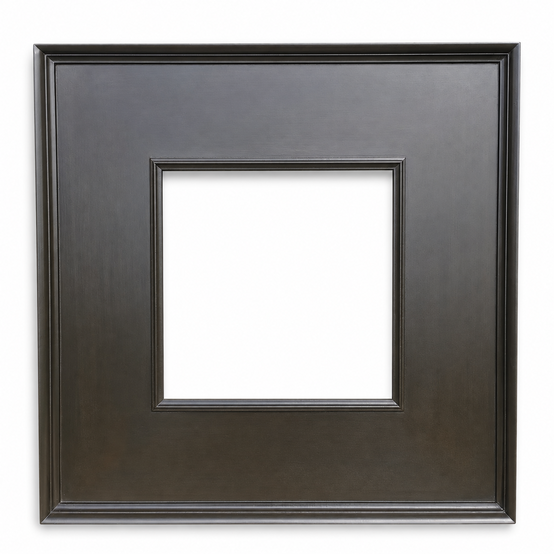
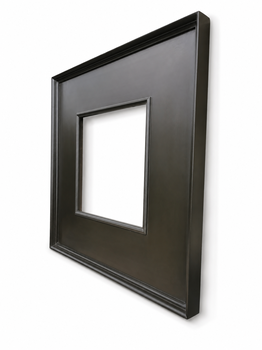
Wide brown picture frame for canvas paintings, 150 mm
- Add feedback:
- Code: 348
- Manufacturer: Karol Milewski
-
Availability:
 Exists
Delivery time: 20 - 30 working days
- pcs.
- €219.44
A wide brown picture frame with a 150 mm moulding (about 6 inches), painted and patinated by hand in my workshop. The brown is one of the darkest I mix: close to black at a distance, but warm underneath rather than grey. I make each frame to the measurements of your canvas painting, and with glazing it also takes prints, watercolours and photographs.
This wide brown picture frame for canvas paintings is built around a single broad flat. The moulding is 150 mm across the face and painted by hand in a brown so dark that from across a room it reads almost as black; close to, the warmth of the colour comes through. As standard I make it without glazing, for an oil or acrylic painting on a stretcher, and I describe how I approach that kind of work on the page about framing oil paintings.
The moulding profile
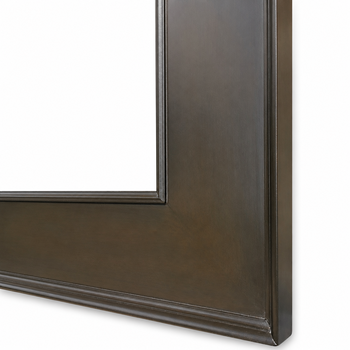
At the inner edge a low raised band lifts above the face, its section combining a shallow hollow with a slight swell. Beyond it a broad flat runs almost the entire width of the moulding, level and unbroken, and this single element sets the character of the frame. An ogee closes the face at the outer edge, and the side falls straight from it.
Specification
- style: wide moulding built around a single broad flat, with a raised band at the inner edge and an ogee at the outer edge
- finish: painted by hand in a very dark brown, patina on the raised band and the ogee, sealed with shellac and wax to a satin sheen
- moulding width: 150 mm
- moulding thickness (face to back): 36 mm with the 16 mm rebate; the 20 mm rebate version is made from a thicker moulding
- rebate: 7 mm wide, 16 or 20 mm deep, chosen in the order menu
- material: low-tannin wood of the kind used in museum framing and art conservation
- corners: mitred and reinforced with wooden splines
- glazing, backing and mount: optional, quoted individually
- fixings and hanging: sprung clips as standard, brass plates on request; picture wire, single D-ring on request; vertical or horizontal
- use: oil and acrylic paintings on stretched canvas; prints, watercolours and photographs with glazing
You order the frame to the size of the painting, giving the dimensions of the canvas. I build in 2–3 mm of technical clearance, and the moulding overlaps the edge of the artwork by roughly 4–5 mm.
Which paintings and interiors it suits
A brown this dark works at the edge of a painting much as black does: it closes the composition firmly and brings the lighter passages forward, which suits luminous, high-contrast work, landscape and portrait. The difference lies underneath. The warm tone keeps the frame from turning cold and graphic, and it sits more easily than a true black beside aged varnish and older paint surfaces. On a large canvas 150 mm gives the painting a substantial border and separates it clearly from the wall; on a smaller work the same width lends the picture scale. A moulding this wide also carries heavily worked, impasto surfaces. I have written more about what a wide moulding does to a painting in my guide to the wide wooden painting frame.
Dark brown with patina settles into rustic, vintage and classic rooms, and into eclectic schemes where a warm dark tone balances a cooler, modern background. My other hand-painted mouldings, some of them combined with gold leaf, are gathered among the gilded and partially painted picture frames.
Making and finishing
I cut the moulding to the size of your painting and join the corners first, mitred and reinforced with wooden splines, before any paint goes on. On a moulding this wide that matters more than on a narrow one: each mitre is longer and carries more load, and a splined joint holds where glue alone would eventually open.
I brush the colour on by hand, in layers. Once it is dry I work the patina over the raised parts of the section, the band at the inner edge and the ogee, so that a cooler tone from the coat beneath comes through. At this depth of colour the patina is what makes the profile readable: without it the flat and the ogee would merge into one dark surface, and the frame would read as a plain rectangle rather than a shaped moulding. A coat of shellac and wax seals the finish, deepens the brown and leaves a satin sheen.
The wood is low in tannins, of the kind used in museum framing and art conservation, so it does not discolour the finish or work against the painting it holds.
How it differs from a mass-produced frame
A ready-made frame of this width is usually MDF wrapped in a wood-effect foil, or a moulding printed to imitate grain, cut to stock sizes and pinned at the corners. Here the brown is paint laid by hand on wood, and the patina is worked on each frame individually, so it never falls in exactly the same places twice. I keep no stock of finished sizes: each frame is cut and joined to the measurements you send.
Functionality
As standard the frame is supplied without glazing, for a painting on a stretcher. The rebate is 7 mm wide, and its depth is chosen in the order menu under picture thickness: 20 mm for a standard painter's stretcher, 16 mm for a thinner support or a painting on panel. For the 20 mm option I make the frame from a thicker moulding. A ¾-inch stretcher fits the 20 mm option; if yours is deeper, send me its depth before you order.
The same moulding can also be made without a rebate, as a floating frame, with the painting standing free inside the frame and a shadow gap around it. I explain the difference between the two constructions in my guide to the floating picture frame for canvas art.
Frequently asked questions
What size of painting suits a 150 mm frame?
At 150 mm (about 6 inches) the moulding gives a large canvas a substantial border, and on a smaller painting it adds scale. The online calculator handles paintings up to 180 cm around the perimeter (just under 71 inches), for example 50 × 40 cm; for anything larger, send me the dimensions and I will price the frame individually.
Is this frame brown or black?
Brown. It is one of the darkest browns I mix, so from a distance it reads close to black, but the tone underneath stays warm rather than grey. The patina on the raised band and the ogee keeps the shape of the profile visible.
Complete framing – additional options
Every frame I make can be completed with full archival and museum-quality framing: conservation-grade low-reflection UV glazing (four classes to choose from), acid-free museum mat board, spacers wrapped in acid-free paper and a Dibond backing. This kind of mounting protects the work from light, acids and distortion. I set out the full glass and material specification on a separate page: archival and museum framing for paintings and photographs. All components are available at extra cost, as an individual quote on request.
Mounting and hanging
Sprung clips are fitted as standard. They turn aside to let the work in and back to hold it, and they cope with anything from a thin board to a stretched canvas. Brass plates with screws are available on request and are supplied loose, for permanent fixing once the work is in place. Hanging orientation, vertical or horizontal, is chosen from the order menu. Picture wire is fitted as standard, and a single D-ring hanger can be fitted instead if you ask for it.
Ordering made to measure
Measure the artwork to within a millimetre, enter both figures in the calculator and choose the picture thickness (which sets the rebate depth) and the picture setting, vertical or horizontal, in the product options.
The base price shown is the price per running metre of moulding. The perimeter of the artwork is not the whole length a frame consumes: mitres cut at 45 degrees take extra length at every corner, and the wider the moulding, the more they take. The calculator accounts for the full consumption of moulding including the corners.
For this moulding width the calculator handles artworks up to 180 cm around the perimeter; anything larger is made to individual order, so send me the dimensions and I will price it. Glazing, backing and mount are quoted separately. Every frame leaves the workshop in 20–30 working days.