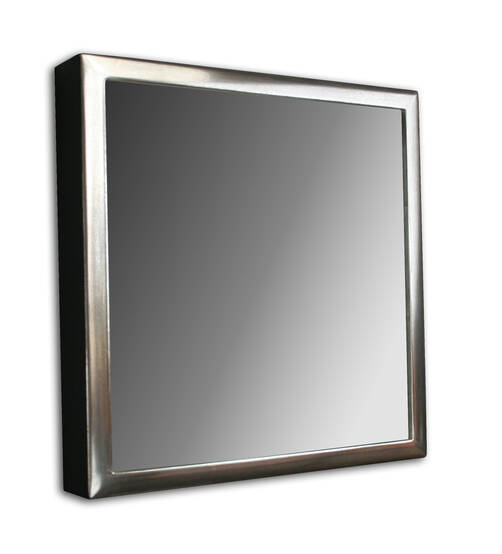
White gold picture frame for deep edge canvas
- Add feedback:
- Code: 13/01 WG
- Manufacturer: Karol Milewski
-
Availability:
 Exists
Delivery time: 20 - 30 working days
- pcs.
- €191.67
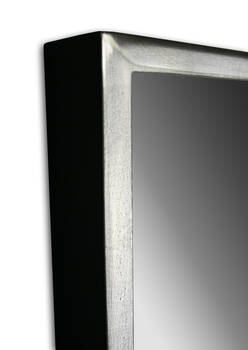
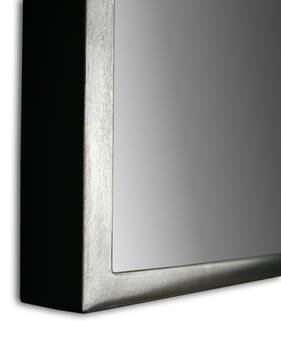
A slim moulding gilded on the face with 6-karat white gold leaf over grey bole, with black sides sealed in the same shellac and wax, and a 40 mm rabbet. The face is 18 mm wide, so the frame reads as a fine cool line around the work, while the depth behind it takes a deep edge canvas, a box canvas or, with spacers, an object. Made to measure for one particular work.
This is the frame I reach for when a painting on a thick stretcher wants an edge rather than a border. The face is 18 mm wide and water gilded in 6-karat white gold leaf, a cool, almost chrome-toned metal laid over grey bole, and the sides are painted black, so from the front the frame reads as a bright line and from an angle as a dark, quiet band. Behind that narrow face sits a rabbet 40 mm deep. That is what makes this a deep frame: the depth that counts is the depth of work it can hold inside it, not the thickness of the moulding on the wall. It belongs to the group of frames I make gilded on the face and painted on the sides.
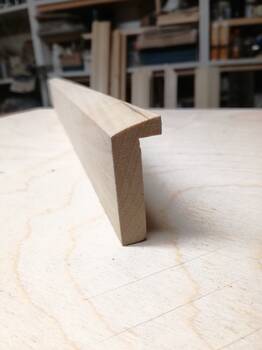
The moulding profile
The inner edge at the artwork side is the highest point of the section. From there the face falls away outwards in a convex sweep, the swell of the curve running below the line of that inner edge, and the sweep closes at the outer edge, where the section turns down into the side of the moulding.
Specification
- Style: modern, minimalist
- Finish: face water gilded in 6-karat white gold leaf over grey bole and patinated by hand, sides painted black, face and sides sealed alike with shellac and wax to a satin sheen
- Moulding width: 18 mm
- Moulding thickness, face to back: 45 mm
- Rabbet: 7 mm wide, 40 mm deep, which is the maximum thickness of work the frame takes
- Material: solid low-tannin timber of the kind used in conservation and museum framing
- Corner joinery: mitred at 45 degrees and reinforced with wooden splines
- Gilding: water gilding on gesso and bole, a single layer of leaf
- Glass, backing and matting: outside the calculator, priced individually on request
- Mounting and hanging: spring clips as standard, picture wire fitted, orientation chosen at the order stage
- Suits: deep edge canvas, box canvas, oil and acrylic on a stretcher, objects mounted on spacers
Enter the dimensions of the work itself. I make the frame 2 to 3 mm larger so that it seats without forcing, and the moulding overlaps the face of the work by roughly 4 to 5 mm.
What it suits
The 40 mm rabbet is cut for the deep stretchers most ready-made frames cannot take: oil and acrylic on a box canvas, canvas prints on a chunky bar, studies on board packed out to depth. Because the face is only 18 mm across, a large canvas keeps its own scale and the gilding sits on it as an outline. Add spacers and the same section becomes a shallow case for a textile, a medal or a cast, held clear of the glass; I set out how that works in the guide to mounts and spacers.
White gold is an alloy of gold and silver, so it reads silver at a distance and warms very slightly up close. That suits white and grey walls, oak floors, and gallery hanging where several works share one wall and want one shared outline.
How it is made and finished
The lengths are cut and mitred at 45 degrees and reinforced with wooden splines while the moulding is still bare, so the joints are closed before any ground goes on. Then come successive coats of gesso and, over them, grey bole, sanded to the smoothness that water gilding needs. The leaf goes on to water, leaf against leaf with an overlap of about a millimetre, a single layer. White gold leaf arrives in squares of about 80 by 80 mm, so for a face this narrow I cut it down on the gilder's cushion before laying it.
The gilded face is then patinated by hand, worked back so the grey bole reads through along the ridge of the curve and the metal settles into a quieter, slightly overcast tone. Face and sides are then sealed the same way, with traditional shellac and wax, so the gilding and the black carry one satin sheen.
How it differs from mass production
Ready-made frames in this look use moulding wrapped in silver-coloured foil or sprayed, in stock formats with a rabbet of 20 mm or less, which is why a deep canvas so often ends up standing proud of the back. Here the section is cut to the length your work needs, the rabbet is 40 mm from the start, and the metal is real leaf on a ground I have built up myself. One pair of hands takes it from bare timber to finished frame, which is also why each one carries small differences in the patination.
Functionality
The frame is supplied without glass as standard. The canvas goes into the rabbet from the back and is held with spring clips, so it can be taken out again without dismantling anything. Work thinner than 40 mm is packed out from behind, or set forward on spacers if you want a visible reveal between the work and the moulding.
The same profile can be made without a rabbet as a floating frame for canvas art, with the painting suspended inside the section and a shadow gap all round; tell me which reading you want when you order.
Complete framing – additional options
Every frame I make can be completed with full archival and museum-quality framing: anti-reflective UV-filtering glass (four classes to choose from), acid-free museum mat board, spacers wrapped in acid-free paper and a Dibond backing. This kind of mounting protects the work from light, acids and distortion. I set out the full glass and material specification on a separate page: archival and museum framing for paintings and photographs. All components are available at extra cost, as an individual quote on request.
Mounting and hanging
Spring clips are fitted as standard, installed in the workshop and rotated aside to seat or swap the painting without dismantling the frame. Brass plates with screws are available on request, supplied loose with the screws included, for you to fit once the work is in place; this is the permanent retention used in exhibition mounting.
Hanging orientation, portrait or landscape, is selected from the order menu, and the frame is fitted only in the chosen orientation. Picture wire is standard; a single D-ring hanger is available on request.
Ordering to measure
Measure the width and height of the work to within a millimetre and enter those figures into the calculator on this page, then choose the hanging orientation and add the frame to your basket. For this moulding width the calculator handles artworks up to 200 cm around the perimeter; anything larger is made to individual order, so send me the dimensions and I will price it.
The base price shown is the price per running metre of moulding. The perimeter of the work is not the whole length a frame needs: corners cut at 45 degrees take additional length, and the wider the moulding, the more each corner takes. The calculator accounts for the full consumption of moulding including the corners, together with any options selected. Each frame is made to order, and the current lead time is 20 to 30 working days.