White Gold Gilt Picture Frame, Antiqued by Hand
- Add feedback:
- Code: 112R
- Manufacturer: Karol Milewski
-
Availability:
 Exists
Delivery time: 20 - 30 working days
- pcs.
- €247.22
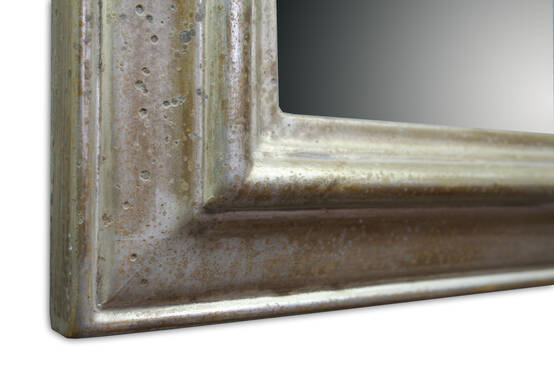
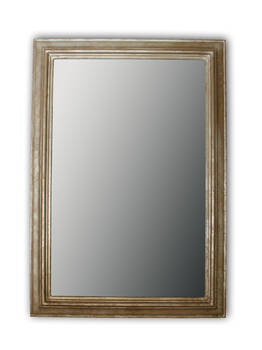
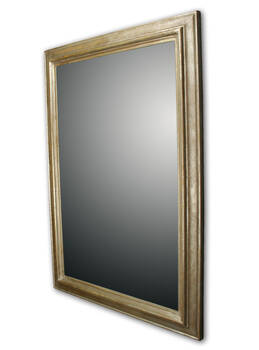
A wide picture frame gilded across the whole face in 6-karat white gold leaf, laid by the water gilding method over yellow bole and patinated by hand until the warm ground reads through the metal. The section is reversed, so the frame stands highest at the canvas. Made to measure for oil and acrylic paintings on stretched canvas.
This is a fully gilt picture frame: the whole face carries 6-karat white gold leaf, water gilded over a gesso ground and yellow bole, then patinated by hand until the warm ground breaks through at the crown and along the corners. 6-karat is the palest leaf I work with, cool and closer to chrome than to yellow gold, and the patination is what stops it reading as new metal. The section is 67 mm across and reversed, so the frame stands highest at the canvas and falls away towards the wall. I make it to measure for oil and acrylic paintings on stretched canvas.
Moulding profile
The moulding is a reverse section: the highest point stands at the artwork rather than at the wall. A hollow occupies the inner part of the face and rises to a half-round, which is the crown of the moulding. From there the surface descends in a long frieze running across the middle of the width, and a small round at the outer edge closes the section.
Specification
- Style: reverse profile, gilded over the whole face, patinated by hand
- Finish: water gilded and patinated, sealed with shellac and wax
- Gilding: 6-karat white gold leaf, water gilded over yellow bole
- Moulding width: 67 mm
- Moulding thickness (face to back): 32 mm
- Rabbet: 7 mm wide, 20 mm deep
- Material: low-tannin timber of the kind used in museum work and art conservation
- Corner joinery: mitred at 45 degrees, reinforced with wooden splines
- Glass, backing and matting: available as add-ons
- Mounting and hanging: spring clips, picture wire
- Suitable for: oil and acrylic paintings on stretched canvas
I make the frame to the dimensions of the painting, not to the dimensions of the finished frame. Please enter the size of the artwork itself in the calculator. I add 2 to 3 mm of technical clearance, and the moulding overlaps the edge of the painting by roughly 4 to 5 mm.
Which paintings and interiors it suits
This section is made for painting on canvas. It suits oils and acrylics where the surface itself is worked: impasto, broken colour, a palette that runs warm or dusty. Pale metal does not compete with the picture the way yellow gold can, and the patina gives a 67 mm face enough weight to hold a large canvas without becoming decoration in its own right. Watercolours, drawings and photographs are better served by a narrower section behind a mount.
A reverse arrangement behaves differently from a classical one. The crown stands at the canvas and everything beyond it falls away, so the frame closes the painting with a bright edge and then steps back instead of building outwards towards the wall. That is why the same moulding reads equally well in a period room and on a plain white wall in a contemporary flat. I have written about where these sections came from and what they do to a picture in my guide to Dutch frames and the reverse profile. For the same idea carried in yellow metal, the rest of my gold gilded picture frames covers 22 and 23 karat leaf.
How it is made and finished
The frame exists as a whole before it takes any colour. I cut the lengths at 45 degrees and join them with wooden splines, then lay up the gesso ground and rub it down until the profile is crisp again. Yellow bole goes over the gesso, and the bole decides how the metal will read once the surface is worn back.
Gilding is carried out with loose leaf at 6 karat white gold, laid by the water gilding method, leaf beside leaf with an overlap of about a millimetre. That is one layer of metal; what is built up in layers underneath is the gesso and the bole, not the gold. The leaves measure roughly 80 by 80 mm, so along the half-round and the small outer round I cut them with a knife on the gilder's cushion. Selected passages are then polished with an agate stone, which is where the depth of a water gilded surface comes from. The technique itself is set out in full on my page about water gilding.
Patination comes last. The metal is taken back locally to the yellow ground and, in places, further still, so the frame carries the warm and pale breaks of a surface that has been lived with. The gilding and the patina are then sealed with shellac and wax.
How it differs from mass production
Ready-made moulding with a silvered look is sprayed or foil-wrapped, and the ageing is printed at a fixed repeat, so the same marks come round every metre. Here each stage is done by hand on the individual piece: gesso, bole, real gold leaf, burnishing, patina. On a face this wide that difference reads from across the room, because the wear follows the geometry of this particular section.
The other difference is the fit. Stock frames come in standard formats and the painting is made to suit them. Here it is the other way round: you give the size of the canvas, and the painting sits square in the rabbet without standing proud of the back.
Practical points
The frame is supplied without glass as standard, which is how paintings on canvas are normally presented. The rabbet is 7 mm wide and 20 mm deep and takes a standard stretcher. The canvas goes in from the back and is held with spring clips, so it can be taken out again without dismantling the frame. Whether a frame counts as deep is a question of how much it will enclose, which is the rabbet depth, not of how far the moulding projects from the wall.
The same section can also be made without a rabbet, as a floating frame, with the canvas suspended inside the opening and a visible gap running round it.
Complete framing: additional options
Every frame I make can be completed with a full archival mounting prepared in the workshop: anti-reflective UV-filtering glass, museum-grade matting, spacers and Dibond backing. The glass classes, the selection criteria and the full material specification are set out separately: archival and museum framing for paintings and photographs.
Mounting and hanging
As standard the painting is held with spring clips, turned aside for fitting and removal. Brass plates and screws are available on request, sent loose and fitted once the painting is in the frame. Orientation, portrait or landscape, is chosen in the order menu. Picture wire is fitted as standard, a single D-ring hanger on request.
Ordering made to measure
The base price shown is the price per running metre of moulding. The perimeter of the painting is not the whole length a frame needs: corners cut at 45 degrees take additional length, and the wider the moulding the more they take. The calculator accounts for the full consumption including the corners, together with any options selected.
The calculator accepts artwork up to a perimeter of 180 cm, the limit set for a moulding of this width; larger formats I make to individual order, so please write to me first. Production takes 20 to 30 working days.