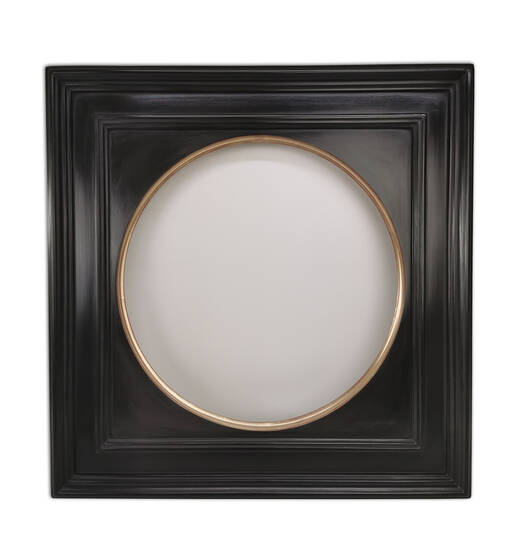
Round Frame with Tondo and Gilded Edge
- Add feedback:
- Code: 295
- Manufacturer: Karol Milewski
-
Availability:
 Exists
Delivery time: 20 - 30 working days
- pcs.
- €247.22
A round frame built around a tondo: a 90 mm moulding painted black by hand, with a water-gilded edge in 22-karat moon gold running around the opening. The opening follows the stretcher behind it, so a square or round stretcher gives a circle and a rectangular one an oval.
This is a round frame with a tondo, made to the diameter of one particular work. The moulding is 90 mm wide and painted black by hand to a satin sheen, and the single metallic element is the gilded edge at the opening, laid in genuine gold leaf over coloured bole. The frame in the photographs carries 22-karat moon gold over red bole; the leaf and the bole beneath it are both agreed with you before I start. Black and gold in this proportion is the reason the frame carries a round painting without competing with it: the gold reads as a drawn line at the picture, the black as mass beyond it. What goes behind that opening does not have to be round: the shape is cut to follow the stretcher, so a square or a round stretcher gives a circular tondo and a rectangular one gives an oval. It belongs to my range of gold gilded and partially painted picture frames.
The moulding profile
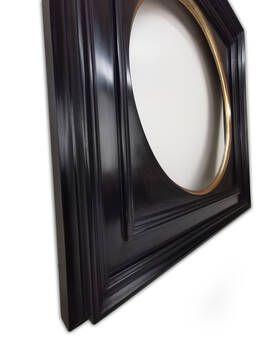
Right at the tondo opening runs the gilded edge, the only metallic element on the frame. From there the main moulding opens with a quarter hollow that rises to a small step. The step drops away at once into a flat frieze holding the centre of the width. On the outer side the frieze lifts again through an identical quarter hollow, and beyond that the profile fills out into an ogee. It then falls through a further step and a larger quarter hollow, which gives the frame its foot. The profile itself is machine-milled; the ground, the paint, the gilding of the tondo edge and the corner joinery are all work of the hand.
Specification
- Style: round frame with a tondo, architectural profile standing on a foot
- Moulding finish: black, hand-painted, satin sheen, waxed; other colours on request
- Tondo edge finish: genuine gold leaf, water gilded over coloured bole; the frame shown carries 22-karat moon gold over red bole
- Leaf options, on request: 23-karat yellow gold, 22-karat moon gold, 12-karat white gold, 6-karat white gold
- Bole, on request: red, ochre yellow, grey, Victorian grey, plum, brown, black, olive green, pale blue
- Moulding width, excluding the tondo: 90 mm
- Moulding thickness (face to back): 50 to 65 mm
- Rebate: 7 mm wide – 10, 15 or 20 mm deep, chosen from the menu, deeper to order
- Opening: cut to follow the stretcher, round from a square or round stretcher, oval from a rectangular one, arched to order
- Opening size: 3 to 4 cm smaller than the dimension of the support, so its edge covers the work
- Material: timber with a low tannin content, of the type used in museum and conservation framing
- Joinery: mitred at 45° and reinforced with timber splines
- Sealing: the gilding with shellac and wax, the black with wax polished by hand
- Mounting: sprung clips as standard, brass plates with screws to order
- Hanging: picture wire as standard, a single D-ring hanger on request
- Glass, archival backing and matting: available as an add-on, outside the calculator
- Lead time: 20 to 30 working days
- Suitable for: a painted tondo on canvas or panel, round photographs, prints and medallions
Enter the dimensions of the stretcher itself into the calculator, to the millimetre. I build the frame about 2 to 3 mm larger than the size you give me, so the work seats without forcing, and the opening is cut 3 to 4 cm smaller than the support, so its gilded edge covers the edge of the work all the way round. Equal sides give a circular tondo; unequal sides give an oval, and for that one send me the measurements rather than using the calculator.
What it suits
The tondo is a format with its own history, and it asks for a surround that closes the circle rather than boxing it. This frame takes a painting made on a round stretcher, but it does not insist on one. A square stretcher sits behind the same opening and reads as a tondo, because the circle is cut into the panel rather than into the canvas. A rectangular stretcher gives an oval by the same logic, which is the traditional answer for a portrait or a half-length figure. Beyond painting it suits a round photograph, a print, a medallion or a relief. Black with a gilded edge is the least demanding of the gold finishes, which is why it moves between a panelled room and a plain white wall without argument. Which leaf goes on that edge changes where the frame sits: 23-karat yellow gold is the warmest and most traditional, at home against oil paint; 22-karat moon gold, the one shown here, is paler and cooler, faintly silvery; the white golds read as silver, the 12-karat soft, the 6-karat almost chromium bright, and both suit grey, blue and monochrome work. The bole under the leaf shifts it again, red warming the gold, grey quieting and cooling it. My guide to gold and gilded frames goes further into how gilded surfaces behave against different walls and different paintings.
Making and finishing
The sections are mitred at 45° and reinforced with timber splines before any ground goes on, so the corners are held by the joint rather than by the finish. Then several coats of gesso, rubbed back between coats, and over that the red bole, the clay ground that gives water gilding its depth. Leaf arrives in squares of roughly 80 × 80 mm, far wider than the edge it is going on, so each is cut down on the gilder's cushion with a knife before laying. It goes on one leaf at a time onto wetted bole, each leaf overlapping its neighbour by about a millimetre, and that single laid layer is the gold you see. The gilding is then sealed with shellac and wax. The black is built up by hand over the same ground from pigment, resin and wax, then polished back to a satin sheen. Because it is polished rather than sprayed, the sheen is not even across the profile: the wax comes up brightest on the step, the ogee and the outer roll, and stays quieter down in the hollows, so the shape of the moulding is legible in the light rather than flattened by it. I set the process out on my water gilding page.
How it differs from a mass-produced frame
Round frames off the shelf come in fixed diameters, usually moulded from resin or a composite, with their gold sprayed or foiled onto a synthetic surface. Nothing about them is cut to your work, so the artwork has to fit the frame. Here the diameter follows the painting, the timber is jointed first and finished afterwards, so the gesso runs across the joints as one unbroken surface, and the edge at the opening is metal rather than colour. It reflects instead of glowing flat, shifts as you move past it, and ages rather than peeling.
Functionality
The frame is supplied without glass as standard, as paintings on canvas and on panel are normally framed. How much it holds is governed by the rebate depth rather than by the thickness of the moulding: 10 mm suits a panel or a mounted photograph, 20 mm takes a standard stretcher bar, and 15 mm sits between the two. You choose the depth from the menu when you order. A round photograph or a work on paper is held behind glass with a backing, and where the sheet must not touch the glazing I fit spacers. The shape of the opening is decided by what goes behind it: square and round stretchers both take a circular tondo, a rectangular stretcher takes an oval, and an arched opening can be cut into the same profile if that is what the work asks for.
Complete framing – additional options
Every frame I make can be completed with full archival and museum-quality framing: anti-reflective UV-filtering glass (four classes to choose from), acid-free museum mat board, spacers wrapped in acid-free paper and a Dibond backing. This kind of mounting protects the work from light, acids and distortion. I set out the full glass and material specification on a separate page: archival and museum framing for paintings and photographs. All components are available at extra cost, as an individual quote on request.
Mounting and hanging
As standard the frame is fitted with sprung clips, which turn to release and make it easy to change the canvas. On request I fit brass plates with screws instead, supplied loose for you to install for a permanent fixing. For hanging, the frame takes picture wire as standard, with a single D-ring hanger available on request; you choose portrait or landscape orientation when you order.
Ordering made to measure
The base price shown on the page is the price per running metre of moulding. The perimeter of the artwork is not the full length of moulding a frame needs: the corners, cut at 45°, take up additional length, and the wider the moulding, the more they consume. The calculator accounts for the full run of moulding including its corners, plus the fittings and options you choose. Glass, archival backing and matting are quoted separately.
The calculator is set up for the round version, so enter equal sides. For a rectangular stretcher and an oval opening, send me the two measurements and I will price it. For this moulding width the calculator handles artworks up to 180 cm around the perimeter; anything larger is made to individual order. Lead time is 20 to 30 working days. If your order is tied to a date or an exhibition, get in touch first and I will tell you what is realistic.