Round Picture Frame with Tondo for Canvas Paintings
- Add feedback:
- Code: 345
- Manufacturer: Karol Milewski
-
Availability:
 Exists
Delivery time: 20 - 40 working days
Exists
Delivery time: 20 - 40 working days
- pcs.
- €247.22
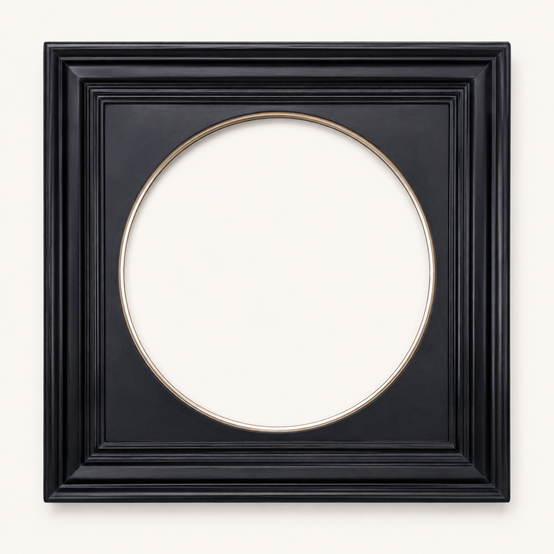
A round picture frame with a tondo – a handcrafted, deep solid-wood moulding, painted black with a satin finish, its narrow tondo ring gilded with 22-karat moon gold leaf. Each frame is made individually, to measure, with a choice of frame colour and bole colour beneath the gilding.
A circular painting calls for a frame that closes the composition with a ring rather than a right angle. This round picture frame for canvas paintings is a deep, substantial moulding with an architectural profile, painted black and satin-finished, in which the only note of gold is a narrow, gilded tondo ring. It is a painted frame with partial gilding, conceived for round oil and acrylic paintings and photographs mounted behind a circular aperture. I make each one individually, to measure, with a choice of frame colour and bole colour beneath the gilding.
Moulding profile
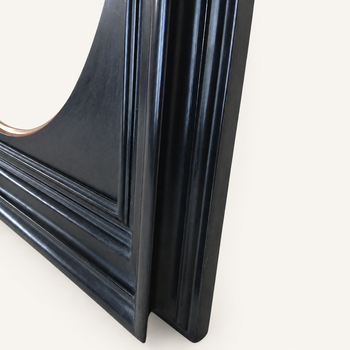
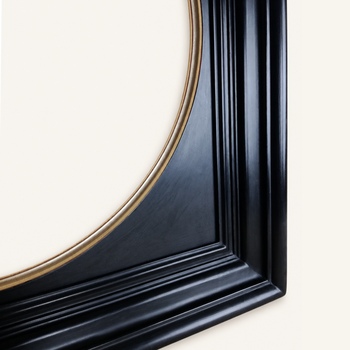
The profile, read from the artwork side outwards, is deep and boldly modelled. Right at the artwork runs the narrow, profiled, gilded tondo ring, set on a wide, flat frieze. The substantial main moulding then begins: from the frieze side a small roll and steps, from which the profile rises in a flowing ogee sweep, through a smaller rounded convex lobe, to a dominant, broad, rounded torus at the profiled outer edge. Only the tondo ring is gilded; the rest of the moulding stays black and satin. The moulding has considerable mass and depth (79 × 79 mm) and structurally consists of the main moulding and a flat panel set within it carrying the tondo ring. The profile is machine-milled; the priming, painting, gilding of the ring, burnishing with an agate stone and corner joining are all done by hand.
Specification
- Style: round frame with tondo, deep profile
- Frame finish: black, satin sheen, hand-waxed (other colours available)
- Tondo ring finish: 22-karat moon gold leaf, burnished with an agate stone
- Bole beneath the gilding (choice): red, ochre, grey, black
- Gilding technique: water gilding
- Moulding width (excluding tondo): 79 mm
- Moulding depth: 79 mm (with a 20 mm rabbet)
- Rabbet: 7 mm wide, 10 or 20 mm deep, selectable (10 mm shown)
- Material: solid, low-tannin wood used in museums and art conservation
- Corner construction: mitred at 45°, joined with wooden splines
- Gold sealing: traditional shellac and wax
- Black sealing: hand-polished wax
- Artwork retention: spring clips as standard; screw-fixed brass plates on request
- Hanging: picture wire; portrait / landscape orientation from the menu
- Tondo aperture: circular, 3–4 cm smaller than the canvas support (which may be square); oval or arched aperture on request
- Glass / backing / mount: optional extras (on request)
- Use: framing a canvas on a stretcher behind a circular aperture (no glass as standard)
The dimensions given when ordering refer to the canvas support (which may be square), not to the outer size of the frame or the diameter of the circular aperture. The profiled moulding adds to the overall size, and the circular tondo aperture is 3–4 cm smaller than the support, cropping it to a circle and covering its edges and corners. I make the frame about 2–3 mm larger than the size given, the standard technical clearance that lets the work sit freely.
Suitable artworks and interiors
The frame is conceived above all for round paintings (tondi) on canvas – oil, acrylic, tempera – and for photographs and prints cropped to a circle. The artwork need not be round: a rectangular canvas set behind the circular aperture is cropped to a circle, which lets the tondo format be used with a conventional stretched canvas as well. I write more about matching frames to canvas paintings on the blog. The satin black frieze gives a calm, neutral ground, and the narrow moon-gold ring – cooler, more silvery and distinctly paler than warm 23-karat gold – closes the composition with a discreet, light contour. The frame sits well in classical, Parisian and gallery interiors, while in a modern, minimalist setting the circular form becomes a deliberate, sculptural accent. It is addressed to collectors and serious art buyers.
Craft and finish
Every frame is made entirely by hand. I cut the moulding at 45° and join the corners the traditional way – with wooden splines, inner tongues that reinforce the joint; a technique from conservation workshops that gives dimensional stability and resistance to the seasonal movement of wood. The corners are joined before priming and finishing.
I gild the tondo ring by water gilding. It is the ground that is built up in many layers: first a chalk-and-glue gesso, then a layer of bole clay in the chosen colour. The bole gives a tonal ground that shows through the gold leaf and makes it possible to burnish with an agate stone – smoothing the gold by hand with a stone to a deep, velvety sheen. Onto this ground I lay the leaves of gold side by side, with a slight overlap. I describe the whole process on the water gilding page.
The ring is gilded with 22-karat moon gold leaf – an alloy with a cool, silvery tone, clearly lighter and paler than classic 23-karat yellow gold. The leaves, about 80 × 80 mm, are cut on a gilder's cushion to the width needed for the narrow ring. The colour of the bole beneath the gold – red, ochre, grey or black to choose from – shifts the final tone of the metal: grey calms and cools it, red gives a warmer reflection.
The black surfaces are finished by hand with polished wax, for a satin, even sheen. I seal the gold the traditional way, with shellac and wax. Each piece differs in the detail of its patination and finish, so every frame is a one-off.
What sets this frame apart from mass production
Three decisions of craft set this frame apart from catalogue products. First, the material: solid, low-tannin wood used in museums and art conservation, not moulded foam, MDF with an imitation profile, or polystyrene. Second, the gilding: genuine 22-karat moon gold leaf, water-gilded and burnished with an agate stone, not metallised foil or aerosol paint. Third, the construction: corners joined with wooden splines that absorb the seasonal movement of wood, instead of welded tape or glued plastic, and a separately set panel carrying the tondo ring – a detail not found in mass-produced frames. It is a frame made to serve the work for generations, not to be replaced periodically.
Function
The frame is offered without glass – as a mount for a canvas on a stretcher set behind the circular tondo aperture. The rabbet depth can be chosen from the menu: 10 mm (shown) or 20 mm, depending on the thickness of the stretcher. I make the tondo aperture 3–4 cm smaller than the canvas support (which may be square), so that the ring holds the edge of the work securely and crops it to a circle. On request I make an oval aperture or one closed with an arch instead of a circle – this variant needs to be agreed in advance. The frame can also be ordered in a colour other than black, from the available palette.
Complete framing – additional options
Every frame I make can be completed with full archival and museum-quality framing: anti-reflective UV-filtering glass (four classes to choose from), acid-free museum mat board, spacers wrapped in acid-free paper and a Dibond backing. This kind of mounting protects the work from light, acids and distortion. I set out the full glass and material specification on a separate page: archival and museum framing for paintings and photographs. All components are available at extra cost, as an individual quote on request.
Mounting and hanging
The frame is offered without glass – as a mount for a canvas on a stretcher. As standard, the artwork is held in the rabbet with spring clips – fitted inside the rabbet at the workshop; you simply turn them aside, insert the work and turn them back into the holding position. This allows a quick change of artwork without removing any fittings. On request I supply screw-fixed brass plates instead – loose, with screws included; you fix the work in the rabbet yourself from the back of the frame. This is a permanent fixing, for works intended for lasting display.
The hanging direction – portrait or landscape – is chosen from the menu of options; the frame is physically finished for that one orientation. As standard I supply a hanging system with picture wire fixed to rear hooks. On request, a single central eyelet can be ordered instead of the wire.
Made-to-measure ordering
Every frame is made individually to the artwork size you give. In the calculator on the product page, simply enter the side dimensions and the system will give the total cost of the frame.
The base price is the price per running metre of moulding. The perimeter of the painting alone is not the whole length of moulding the frame needs – corners cut at 45° take additional length, the more so the wider the moulding. The calculator accounts for the full use of moulding with corners and for the chosen extras.
For this frame the calculator takes dimensions in a square format (equal sides). When ordering, please give the size of the canvas support – I will make the circular tondo aperture 3–4 cm smaller than its side. Non-standard formats and variants with an oval or arched aperture are made to individual order – please get in touch with the dimensions and a description of the work.
Lead time: 20–40 working days from order confirmation.