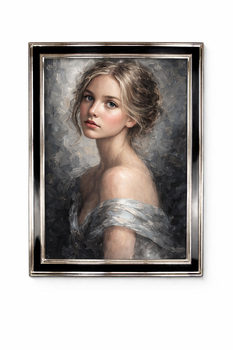
Modern Black Picture Frame with White Gold Leaf
- Add feedback:
- Code: 014
- Manufacturer: Karol Milewski
-
Availability:
 Exists
Delivery time: 20 - 30 working days
- pcs.
- €247.22
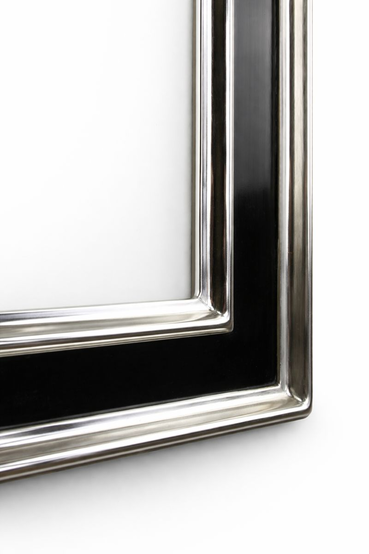
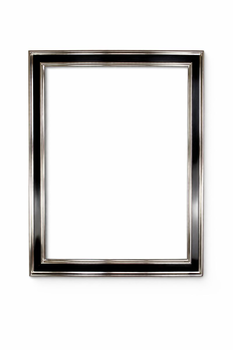
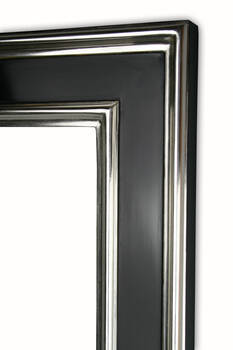
A modern black picture frame with two narrow bands of 6K white gold leaf running either side of a wide, flat frieze in satin black. I water gild the bands by hand and paint the frieze myself, so the face reads as two cool metal lines holding a dark field. Moulding 72 mm wide, rabbet 20 mm deep, made to measure for a stretched canvas.
This is a black painting frame built on a modern classic profile: a wide, flat frieze in deep satin black, closed on both sides by narrow milled bands gilded in 6K white gold leaf. Of the leaf I work with, 6K white gold gives the coolest reflection, close to chrome and almost mirror-like, and set against soft black it draws a hard, deliberate contour rather than a decorative border. At 72 mm the moulding has enough width to carry a large canvas, which makes it one of the more modern picture frames in the workshop and a direct choice for work with a decided composition. It sits with my other black picture frames and is made to measure, by hand, for one particular painting.
Moulding profile
At the artwork the face opens with a milled band set low and stepping down towards the painting: this is the inner gilded line. Beyond it the moulding runs out into a wide flat frieze, painted black, which carries most of the 72 mm width and forms an even field around the work. Towards the outer contour the face rises to a second milled band, gilded to exactly the same width as the inner one but set on a higher plane, and this is the crown of the profile. A narrow outer edge closes the face, and the flank below it is painted black like the frieze.
Specification
- style: modern classic, a black frieze between two gilded milled bands
- moulding width: 72 mm
- moulding thickness, from the face to the back plane: 37 mm
- rabbet: 7 mm wide, 20 mm deep
- material: low-tannin timber of the kind used in museum work and art conservation
- corner joining: mitred at 45 degrees, reinforced with wooden splines before gessoing
- gilding: 6K white gold leaf on both milled bands, water gilded over gesso and bole, burnished with an agate stone
- black finish: frieze, outer edge and flank hand-painted, sealed with shellac and wax, satin sheen
- gilding sealed with: traditional shellac and wax
- glass, backing and mount: not part of the order menu, available as archival add-ons priced individually
- artwork retention: spring clips as standard, brass plates with screws on request
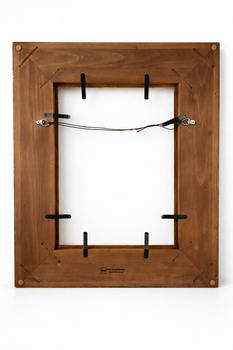
- hanging: picture wire as standard, portrait or landscape orientation chosen with the order
- suitable for: oil and acrylic on stretched canvas, original prints, fine-art photography
- lead time: 20 to 30 working days
The dimensions entered in the calculator describe the complete frame including the moulding. The opening itself is smaller by the width of the moulding. I make each frame 2 to 3 mm larger than the stated size of the painting: this is the technical allowance that lets the work go in without stress, and the rabbet then covers about 4 to 5 mm of the painting.
Which paintings and interiors it suits
The contrast between black and cool white gold is at its strongest on work built from a clear, decided composition. It carries black and white photography particularly well, especially portraits and figure studies, along with minimalist prints, monochrome graphics and fine-art posters. In painting it suits strong light and shadow, chiaroscuro and darker baroque work, and equally contemporary abstraction in a restricted palette. The wide frieze separates the picture from the wall, and the two metal lines close the composition without entering it.
In an interior the frame belongs to modern classicism, to loft and gallery spaces, and to art deco and glamour schemes. The cool tone of 6K white gold sits naturally with chrome, brushed steel, polished stone and glass, in rooms where the warmer 22 karat or 23 karat leaf would read as a different language altogether. The same profile is also made in a high-gloss version with warm gold trim: see the black gloss picture frame with gold trim if your painting asks for warmth rather than cool metal.
How it is made and finished
The profile is machine-milled; everything after that is done by hand in a one-person workshop. I cut the lengths at 45 degrees and join the corners with wooden splines before any gesso goes on, so the mitres are held mechanically and not by glue alone. Only then do I ground the assembled frame with successive coats of gesso and rub it smooth, which matters here because gold leaf reveals every irregularity in the substrate underneath it.
The two bands that take the metal are covered with bole and gilded on water. A leaf is roughly 80 by 80 mm, so for bands this narrow I cut it with a knife on the gilder's cushion and lay the pieces one beside the next with an overlap of about 1 mm. That gives a single layer of gold: what is built up in layers here is the ground, not the gilding. The gilded surfaces are then burnished with an agate stone to bring up the cool metallic sheen, and sealed with traditional shellac and wax. I describe the technique in more detail on my page about water gilding.
The frieze, the outer edge and the flanks are hand-painted in a richly pigmented paint range and finished with wax to a deep satin sheen. Satin is a deliberate decision on this version: the black holds its depth without throwing point reflections from lamps, so it does not compete with the painting, and the white gold keeps a quiet, cool lustre beside it.
How this differs from mass production
In a factory frame a cool metal accent is almost always something else: mechanically applied metallic foil, silver-effect paint, or an imitation leaf made from a base-metal alloy, which oxidises and darkens over the years. Here the metal is real 6K white gold leaf laid on water over a bole ground, so it holds its tone and its depth instead of dulling.
The black is not sprayed lacquer over foil or a vinyl wrap on an MDF core. It is paint built up in coats on timber and finished with wax, which is why the surface reads as satin rather than plastic. Wax wears slightly in exposed places over the years and can be refreshed in the workshop. The last difference is fit: I do not select the nearest ready-made size, I build the frame to the measurements of one painting, so the canvas needs no packing and no forcing.
Functionality
In the standard version I make this frame without glass, as a direct mount for a painting on a stretcher, held with spring clips. The rabbet is 20 mm deep, which takes a standard stretcher and most heavier artist's supports. Glass, backing and a mount are added on request rather than from the menu, as part of the archival framing described below.
The same profile can also be made without a rabbet, as a floating frame, where the canvas sits inside the aperture with a visible gap around it and the sides of the stretcher stay exposed. I set out how that works in my article on the floating picture frame for canvas art.
Frequently asked questions
Why white gold rather than yellow gold? 6K white gold is the coolest leaf I use, close to chrome in its reflection. It works where yellow gold would warm the picture too much: black and white photography, monochrome painting, cool palettes, and interiors built around steel, chrome and glass.
Will it take a thick stretcher? The rabbet is 7 mm wide and 20 mm deep, which covers a standard stretcher and most heavier artist's supports. If your support is deeper than that, write to me before ordering and I will confirm what can be done.
Can I have the same profile with a warmer metal or more gloss? Yes. The identical profile is made in 22 karat moon gold and 23 karat yellow gold with a high-gloss lacquer finish. Please get in touch and we will agree the version.
How large a painting can I frame? The calculator prices frames for paintings up to 120 by 80 cm. Larger formats I make to individual order, once the dimensions and the method of shipping are agreed.
Complete framing – additional options
Every frame I make can be completed with full archival and museum-quality framing: anti-reflective UV-filtering glass (four classes to choose from), acid-free museum mat board, spacers wrapped in acid-free paper and a Dibond backing. This kind of mounting protects the work from light, acids and distortion. I set out the full glass and material specification on a separate page: archival and museum framing for paintings and photographs. All components are available at extra cost, as an individual quote on request.
Fixing and hanging
As standard the painting is held by spring clips, factory-fitted: they rotate, so swapping the work is quick. On request I prepare brass plates with screws, supplied loose for a permanent fixing you fit yourself. For hanging there is picture wire as standard; a single D-ring is fitted on request, and portrait or landscape orientation is chosen with the order.
Made-to-measure ordering
Measure your painting to within a millimetre and enter the dimensions into the calculator: you give the size of the work itself, and I add the technical allowance on my side. You then choose the thickness of your painting and the hanging orientation from the order menu.
The base price shown is the price per running metre of moulding. The perimeter of the painting is not the whole length the frame needs: the 45 degree mitres take extra length, more so the wider the moulding. The calculator accounts for the full use of moulding with the mitres and any options, and it handles paintings up to 120 by 80 cm; larger formats are made to individual order. The lead time is 20 to 30 working days.