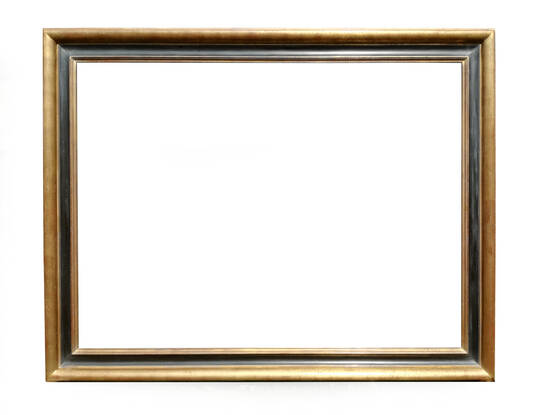
Large gilded picture frame in 23-karat gold leaf
- Add feedback:
- Code: 86
- Manufacturer: Karol Milewski
-
Availability:
 Exists
Delivery time: 40 - 50 working days
- pcs.
- €441.67
A large picture frame water gilded in 23-karat yellow gold leaf, built for paintings that need scale. The moulding is 180 mm across the face and 70 mm from the face to the back plane, with a wide black cove running between two gilded bands. The rebate starts at 35 mm deep, so it takes thick stretchers and deep-edge canvases.
The widest and deepest moulding I make, built to measure for paintings with the scale to carry it. The pattern comes from eighteenth-century Italian workshops: a coved section 180 mm across the face and 70 mm from the face to the back plane, with a wide black hollow between two bands of gold. The gilding is genuine 23-karat yellow gold leaf, laid by hand on water over a bole ground. Other finishes built the same way sit together in my picture frames gold gilded and partially painted.
The moulding profile
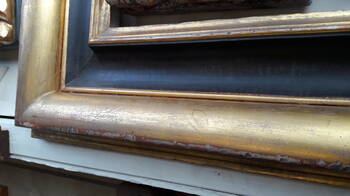
At the artwork side the moulding opens with a gilded half-round hollow of medium size, which lifts into a small bead. Beyond the bead the surface turns black and falls away into a wide, deep cove, the lowest and broadest element of the face. The cove climbs back and closes against a second bead, this one gilded. From it rises a tall gilded outer edge, carried steeply upward and canted outwards, the highest point of the moulding. On its outer side that edge is undercut and sits back behind a lateral moulding with a profile of its own. The section is milled; every stage after is done by hand.
Specification
- Style: coved classical section after an eighteenth-century Italian pattern
- Colour: black cove, with a gilded hollow at the artwork side and a gilded outer edge
- Finish: gesso ground, bole, water gilding in 23-karat yellow gold leaf sealed with shellac and wax; the cove hand painted in black
- Moulding width: 180 mm
- Moulding thickness (face to back plane): 70 mm
- Rebate: 7 mm wide, from 35 mm deep, cut to the thickness of your stretcher
- Material: low-tannin timber used in conservation and museum framing
- Corner joinery: mitred at 45 degrees, reinforced with wooden splines
- Gilding: a single layer of leaf laid over a multi-layer gesso and bole ground
- Glass, backing and mount: available separately, priced individually
- Mounting and hanging: sprung clips fitted as standard; orientation chosen at order
- Suitable for: large paintings on deep stretchers, old master copies and formal portraits
Enter the dimensions of the artwork itself into the calculator. I build the frame 2 to 3 mm larger for clearance, and the moulding overlaps the edge of the work by roughly 4 to 5 mm.
Which works and interiors it suits
At 180 mm across the face this moulding will overwhelm a small canvas and settle a big one. Oil and acrylic paintings on thick stretchers are its natural subjects, along with old master copies, sacred painting and large landscapes. The black cove behaves like a band of shadow that separates the canvas from the wall, while the two lines of gold close the picture from the inside and from the outside. How a coved section changes the way a painting reads, and how it differs from a reverse profile, I set out in my article on the reverse frame and the coved frame.
A frame of this width needs a wall that can hold it: high-ceilinged living rooms, formal staircases, galleries and church interiors, and classical rooms where the gold has a partner in other details. Choosing a broad moulding is a judgement about proportion, which I go through in my guide to the wide wooden painting frame.
Making and finishing
Mitres are cut at 45 degrees and reinforced with wooden splines first, so the joints are closed before any ground goes on and the seam is not working underneath the gold. Layers of gesso follow, rubbed back between coats, then the bole, the coloured clay ground the leaf is laid onto, which decides the final tone of the metal.
The leaf is floated onto the wetted bole, leaf beside leaf with an overlap of about a millimetre. It is a single layer of gold; what sits underneath is multi-layered, not the metal itself. The sheets are roughly 80 by 80 mm, wider than the beads and the outer edge, so for those elements each sheet is cut down with a knife on a gilder's cushion. The gilding is sealed with shellac and wax, and the cove is hand painted in black once the gilded elements are finished. The full process is set out on my page about water gilding.
How it differs from mass production
A 180 mm moulding is close to unobtainable ready made, and where something of that width does appear it is usually a resin section cast onto a timber core, then wrapped in metallic foil or sprayed with a bronze-loaded finish. Here the metal is real: leaf on bole, on gesso, on timber. It can be burnished, patinated and repaired years later; a sprayed surface cannot. The corners are cut for one painting and locked with splines rather than staples, so the joint does not open through the gilding with time.
Functionality
The frame is supplied without glass as standard, as a mounting for a painting on a stretcher. The rebate is at least 35 mm deep and I cut it to your particular support, so it takes an ordinary stretcher, a heavy strainer or a battened panel. It is the depth of the rebate, not the bulk of the moulding, that decides what can be enclosed inside the frame. The same profile can be made without a rebate at all, as a floating or shadow frame, with a gap around the canvas and the edge of the stretcher left in view. I describe that construction in my guide to the floating picture frame.
Complete framing – additional options
Every frame I make can be completed with full archival and museum-quality framing: anti-reflective UV-filtering glass (four classes to choose from), acid-free museum mat board, spacers wrapped in acid-free paper and a Dibond backing. This kind of mounting protects the work from light, acids and distortion. I set out the full glass and material specification on a separate page: archival and museum framing for paintings and photographs. All components are available at extra cost, as an individual quote on request.
Mounting and hanging
Sprung clips are fitted as standard. They turn aside to let the work in and back to hold it, and they cope with anything from a thin board to a stretched canvas. Brass plates with screws are available on request and are supplied loose, for permanent fixing once the work is in place. Hanging orientation, vertical or horizontal, is chosen from the order menu. Picture wire is fitted as standard, and a single D-ring hanger can be fitted instead if you ask for it.
Ordering made to measure
The base price shown is the price per running metre of moulding. The perimeter of the artwork is not the whole length of moulding a frame consumes: mitres cut at 45 degrees take extra length at every corner, and the wider the moulding, the more they take. The calculator accounts for the full consumption including corners, along with any extras you select. For this moulding width the calculator handles artworks up to 180 cm around the perimeter; anything larger is made to individual order, so send me the dimensions and I will price it. Production time is 20 to 30 working days.