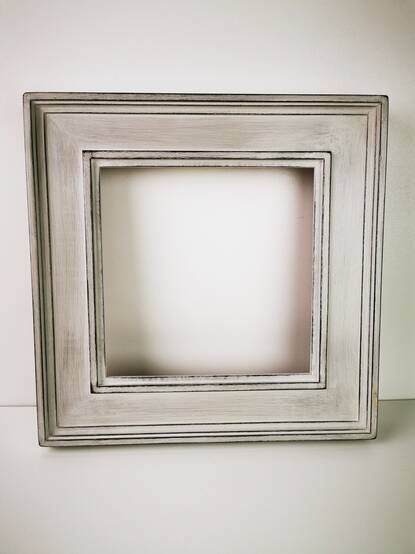
Hand-Painted Grey Picture Frame for Oil Paintings
- Add feedback:
- Code: 270
- Manufacturer: Karol Milewski
-
Availability:
 Exists
Delivery time: 20 - 30 working days
- pcs.
- €136.11
A grey picture frame I hand-paint in a deep, box-like profile. Layer on layer of paint, worn back at the edges to reveal warmer tones, so no two frames are alike. I make it to measure for oil and acrylic paintings on canvas.
A grey picture frame I paint by hand in a deep, box-like profile. I build the dominant grey in layers, and where I rub the paint back at the edges it reveals warmer tones beneath: light brown, white and black. Visible brush marks and the grain of the wood mean every frame is a little different, and the painting it holds takes on a character of its own. I make it to measure, like the rest of the custom picture frames in my workshop, for oil and acrylic paintings on canvas and stretcher bars.
Frame profile
This is a deep profile with a wide, flat frieze down the centre and raised edges on both sides. From the artwork side the moulding rises in a step, then opens into the broad frieze that takes up most of the width. The frieze closes with a hollow and a step matching the one beside the artwork.
Specification
- Colour and finish: grey, painted in layers, with the edges worn back to reveal warmer tones; satin sheen
- Frame width: 56 mm
- Frame depth: 37 mm
- Rebate depth: 10 or 20 mm (selected from the menu)
- Rebate width: 7 mm
- Material: low-tannin timber of the type used in museum and conservation framing
- Corner joining: mitred at 45° and reinforced with wooden splines
- Mounting: sprung clips as standard, or Opti White 4mm glass with a 3mm backing board (menu option)
- Hanging: wall fixing, portrait or landscape orientation from the order menu
- Suitable for: oil and acrylic paintings on canvas and stretcher bars
- Lead time: 20–30 working days
A note on dimensions: the figures above describe the full frame, including the moulding. The opening for the artwork is smaller, and I make each frame to the measurements of your painting.
What paintings and interiors it suits
The deep profile and neutral grey work well with oil and acrylic paintings on canvas, especially pieces with strong texture and saturated colour that need a calm, uncompeting surround. Here the grey acts as a backdrop: it doesn’t push against the painting, but it clearly separates it from the wall.
In a room the frame suits settings where a natural, handmade texture matters: rustic and loft interiors, industrial spaces, and modern rooms that want a warmer, less polished accent. The brush marks and visible wood tie it to raw materials such as concrete, brick and worn timber.
How I make and finish it
I start from a wooden moulding and prepare it for painting. I cut the corners at 45° and join them with wooden splines, then do the finishing once the frame is glued up, so the joins at the corners are even and almost invisible.
I build the colour in layers: coat after coat of paint, rubbed back in places to reveal the warmer tones underneath, so light brown, white and black come through at the edges. I leave the brush marks and the grain legible, which is why each frame differs in its detail. I seal and finish the surface with shellac and wax to a satin sheen.
How it differs from mass production
Each frame is made singly, to the measurements of a particular painting, rather than in a fixed size. The layered paint and hand-worked edges can’t be reproduced identically: what would be a fault of repeatability in mass production is an advantage here. Corners joined with wooden splines are stronger and more carefully finished than the taped-together joints of factory frames.
Functionality
As standard I make the frame without glass, to hold a canvas on its stretcher: I secure the canvas with sprung clips that turn to release and take supports of different thicknesses. You choose the rebate depth from the menu, 10 or 20 mm, depending on how thick your stretcher is. For work that needs glazing there is the option of Opti White 4mm glass with a 3mm backing board.
I can also make the same profile as a floating frame, without a rebate, so the canvas appears to hover within the frame. I write more about that in my guide to floating frames for canvas art.
Complete framing
Every frame I make can be completed with a full mount: anti-reflective UV-filtering glass, an acid-free mat and a Dibond backing board, to a museum standard that protects the artwork from light and acids. I set out the glass classes and details on my archival and museum framing page.
Mounting and hanging
As standard the frame is fitted with sprung clips, which turn to release and make it easy to change the canvas. On request I fit brass plates with screws instead, supplied loose for you to install for a permanent fixing. For hanging, the frame takes picture wire as standard, with a single D-ring hanger available on request; you choose portrait or landscape orientation when you order.
Ordering to measure
You order the frame through the calculator on the product page. Measure your painting to the millimetre and enter the dimensions: I make the frame with a small technical allowance of about 3 mm, needed to seat the artwork freely. The calculator handles formats up to 120×80 cm; larger sizes I make to individual order.
The base price shown is the price per linear metre of moulding. The perimeter of your painting isn’t the full length of moulding the frame needs: the corners, cut at 45°, take up extra length, more so the wider the moulding. The calculator accounts for the full run of moulding with its corners, along with the options you choose: rebate depth, glass and backing, and the hanging method. The standard lead time is 20–30 working days.