Gilded Dutch Frame for Oil Paintings, Made to Measure
- Add feedback:
- Code: 121G
- Manufacturer: Karol Milewski
-
Availability:
 Exists
Delivery time: 20 - 30 working days
- pcs.
- €219.44
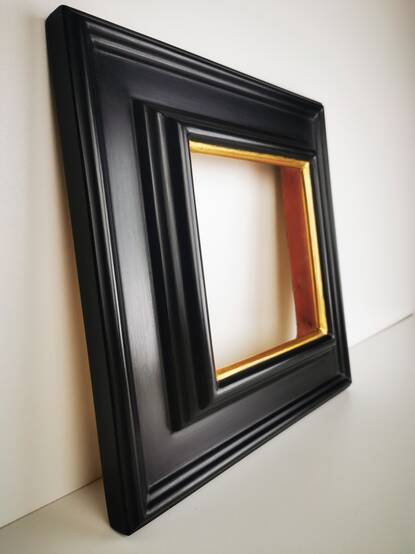
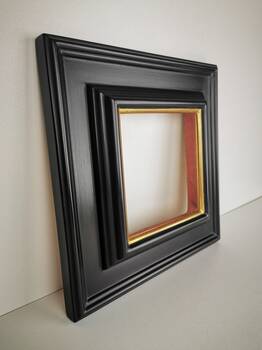
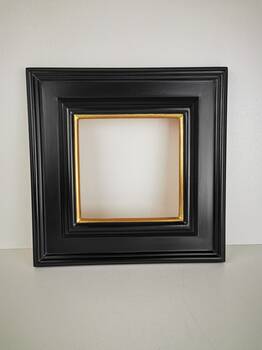
A Dutch frame in a fully gilded version: a reverse profile with a flat frieze, bordered on both sides by a run of rounds. The moulding is 68 mm wide with a 20 mm rebate, so it takes standard stretchers. I gild it by hand, on water, leaf beside leaf, and I make every frame to the measurements of one particular painting.
A Dutch frame in a fully gilded version: a reverse profile, a flat frieze and a run of rounds, the arrangement that came out of seventeenth-century Netherlandish workshops, where the frame did not compete with the painting but built a quiet, architectural border around it. I make it to order only, in dimensions matched to one particular work, and I gild it by hand using water gilding. A moulding width of 68 mm and a rebate depth of 20 mm place it first of all as a frame for oil paintings on stretchers.
Frame profile
At the artwork the moulding begins with the rebate, and immediately behind it climbs to the highest point of the whole section: a strong convex ridge running along the inner edge. This is the reverse arrangement, in which the crown of the profile stands at the painting and not at the outer edge. From that crown the face steps outwards through a run of rounds, successive convex mouldings set one behind another, each lower than the one before. They descend to a flat frieze: a wide, smooth band lying lowest in the whole face, the only quiet plane in the section. Past the frieze the profile rises again through further rounds, finer this time, up to a rounded outer edge. The frieze is therefore bordered by convex work on both sides, and the moulding, for all its 68 mm width, reads as a rhythm of small elements rather than as one broad plane. Where this arrangement comes from, and how it differs from a profile that grows towards the outer edge, I explain in my guide to Dutch frames and the reverse profile.
Specification
- Style: Dutch frame, reverse profile with a flat frieze
- Finish: hand water gilding, gold leaf laid over gesso and bole
- Moulding width: 68 mm
- Moulding depth: 40 mm
- Rebate: 7 mm wide, 20 mm deep
- Material: solid low-tannin timber of the kind used in museum work and art conservation
- Corner joinery: mitred at 45 degrees, reinforced with wooden splines before gessoing
- Glass and backing: supplied without glass as standard; Opti White 4 mm low-iron glass with a 3 mm backing panel available in the order menu
- Mounting and hanging: spring clips and picture wire, vertical or horizontal orientation chosen when ordering
- Suitable for: oil and acrylic on stretchers, old master painting and copies of it, portraits, still life, landscape
The dimensions given on the page are the outer dimensions of the complete frame. The frame overlaps the painting by a 7 mm rebate, and I cut the inner dimension with a technical allowance of 2 to 3 mm against the artwork, so the moulding actually covers about 4 to 5 mm of the canvas. Every frame is built individually to the measurements of your work.
Which paintings and interiors it suits
The reverse profile has one practical property: the highest point of the moulding stands right at the edge of the canvas, and everything beyond it falls away. The frame does not build an outward-growing cascade around the painting, it sets a clear threshold beside it and then withdraws. That is why it works well with painting of dense surface and strong tonal value: with oils, with dark works, with portraits and still life, with copies and pastiches of old master painting. It also suits smaller formats, where wide, outward-growing profiles can easily overwhelm the image.
In an interior a Dutch frame reads as unambiguously classical but without display, because its decoration is geometric rather than ornamental. It belongs in studies, libraries and dining rooms with dark timber, and the flat frieze lets it hold its own on a pale, smooth wall in a contemporary flat, where baroque ornament would be too loud. The remaining gilded variants are gathered in the gold gilded picture frames category.
Making and finishing
I cut the mouldings at 45 degrees and join the corners on wooden splines before any gessoing, so the gilding is laid on a finished, rigid structure and the joint line at the corner does not move over the years. The shape of the section itself is machine-milled; everything after that is done by hand: grounding, the bole, the gilding and the finish.
Onto the assembled frame I lay a multi-layer ground: animal glue, successive coats of gesso rubbed down to a smooth surface, and bole over that. The bole decides the tone of the metal, because it shows through the leaf and tints it from beneath. The gilding is done on water: I lay the leaves one beside another with an overlap of about a millimetre, which gives a single layer of gold across the whole surface. On the narrow bands of the profile the leaf is cut with a knife on the gilder's cushion, since a standard sheet measures roughly 80 by 80 mm and is simply too large for a round a few millimetres wide.
The gilded surface is sealed with traditional shellac and wax. The whole gilding process, from gesso through to burnishing with an agate stone, I set out in detail on my page about water gilding.
How it differs from mass production
Trade moulding is extruded or foil-wrapped and cut to stock sizes, and the frame comes about by fitting the painting to whatever is on the shelf. Here the order is reversed: I receive the measurements of the work and build the frame to them. The corners are reinforced mechanically, not merely glued and stapled. The gold is real metal laid on bole, not a sprayed coating or a foil imitating gilding, so with time it does not flake or go grey; it simply wears naturally, which in classical framing is a virtue rather than a fault.
Function
As standard I make this frame without glass, for mounting the stretcher directly, with spring clips. The 20 mm rebate depth takes typical painting stretchers as well as thinner rigid supports. The order menu also offers a version with Opti White 4 mm low-iron glass and a 3 mm backing panel, useful for prints, drawings, photographs and documents.
I can also make this profile without a rebate, as a floating frame, in which the canvas hangs inside with a visible gap around its edge and the sides of the stretcher stay exposed. The principle and the differences are described in my article on the American box and floating frame.
Complete framing, additional options
Every frame I make can be completed with full archival and museum mounting: anti-reflective UV-filtering glass in four classes, matting cut from museum-grade acid-free board, spacers faced with acid-free paper, and a Dibond backing panel. Mounting of this kind protects the work from light, acids and mechanical distortion. The full specification of the glass and the materials is set out on a separate page: archival and museum framing for paintings and photographs. All components are available for an additional fee, priced individually on request.
Mounting and hanging
The painting is held in the frame with spring clips fitted in the workshop. They turn aside with a finger, without tools, so the work can be taken out and put back at any time, and the clips accept supports of different thicknesses. On request I supply brass plates with screws instead, sent loose for you to fit yourself: they give a permanent fixing, intended for mounting the work once. For hanging I use picture wire, and the orientation of the frame, vertical or horizontal, is chosen when ordering. A single D-ring hanger is fitted on explicit request.
Ordering to size
The dimensions of the painting are entered in the calculator to within 0.1 cm, for example 35 cm x 30.2 cm. The base price shown on the page is the price per running metre of moulding. The perimeter of the painting is not the whole length of moulding a frame needs: corners cut at 45 degrees take up additional length, and the wider the moulding, the more they take. The calculator accounts for the full consumption of moulding including the corners, along with any extras chosen: glass, backing, mounting. The calculator handles paintings up to 120 x 80 cm; larger formats I accept as individual orders. Production time is 20 to 30 working days.