Closed corner picture frame with rounded corners
- Add feedback:
- Code: 131
- Manufacturer: Karol Milewski
-
Availability:
 Exists
Delivery time: 20 - 30 working days
- pcs.
- €136.11
A closed corner picture frame with rounded corners, made to measure for your painting. The corners are joined, filled and sanded before any paint goes on, so the radius runs round the frame as one unbroken surface. The face is a flat 22 mm and the rebate is 30 mm deep, which takes a deep stretched canvas or a shallow object.
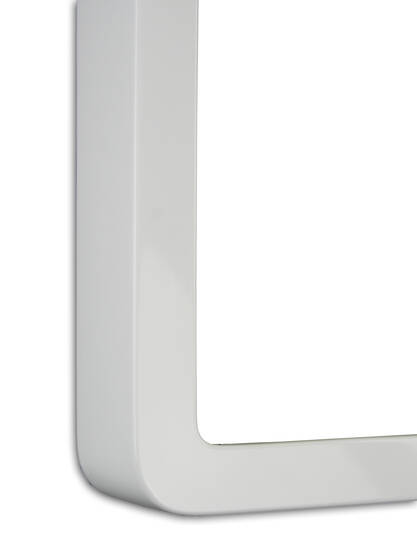
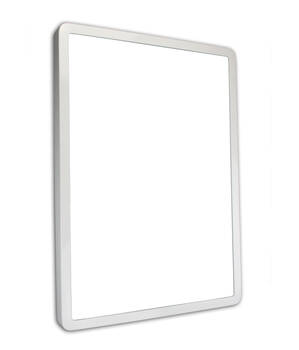
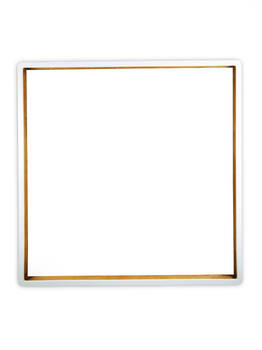
A closed corner picture frame, made to measure, with rounded corners and a plain flat face in white high gloss. Closed corner means the frame is built first and finished afterwards: the lengths are cut and joined for one particular work, the corners are filled and sanded, and only then does the paint go on. On a frame this plain that is the whole argument: a rounded corner shows every shortcut, and on this one there is no joint line to find.
The moulding profile
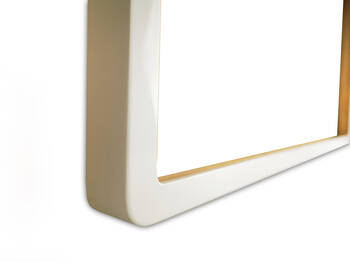
The face is flat and 22 mm across, one level plane of gloss from the inner edge to the outer, where the side turns square and runs 35 mm from face to back. At each corner the face and the side turn through a radius rather than meeting in a point, and the same gloss carries round the curve.
Specification
- Style: closed corner frame, rounded corners, flat section
- Finish: white high gloss paint
- Moulding width: 22 mm
- Moulding thickness, face to back: 35 mm
- Rebate: 7 mm wide × 30 mm deep
- Material: low-tannin timber of the kind used in museum work and art conservation
- Corners: mitred at 45° and reinforced with wooden splines, then rounded, filled and sanded before painting
- Glass, mounts and backing: available to order, at extra cost
- Mounting and hanging: spring clips as standard, picture wire, portrait or landscape
- Suits: oil and acrylic on stretched canvas, deep stretcher bars, painting panels, photographs and prints
Every frame is made to the measurements of one particular work. Enter the width and height of the artwork itself into the calculator: I build the frame 2–3 mm larger than the figures you give, so the piece seats without forcing, and the moulding then covers roughly 4–5 mm of the edge of the work all round.
Which works and interiors it suits
A 22 mm face is a quiet border: it gives a painting a defined edge without competing with it, which suits contemporary work on canvas, photography and prints, and any hang where several pieces share a wall and need to read as a set. White gloss keeps the frame visually light even at larger sizes. Other frames in the same register are collected under white picture frames.
The deep rebate widens the range. A canvas on a thick stretcher, a cradled panel or a board mounted on battens all sit inside this frame without packing, which is where a shallow moulding fails. I compare the options in my guide to types of picture frames for canvas paintings, and set out how I approach oils under framing oil paintings.
How it is made and finished
I cut the lengths to the size of the work, mitre the corners at 45° and reinforce each joint with a wooden spline. The radius is worked once the frame is closed, so the curve runs continuously across the joint. The frame is then filled, sanded and primed, and the high gloss is built up in successive coats, each one flatted back before the next.
That sequence is what the trade calls a closed corner frame. It is slower than the alternative, and it is also the only way to get a rounded corner and a mirror surface in the same object: a frame finished before assembly leaves a seam at the mitre, and gloss shows a seam more clearly than any other finish.
How it differs from a factory frame
A shop-bought gloss frame is cut from pre-finished moulding in stock lengths and joined at the end, which is why its corners are square and the mitre is visible if you look for it. This one is built the other way round, one frame at a time, to the dimensions of your work. The timber is low in tannin, of the kind used in museum work, so nothing migrates into the painting.
Function
The rebate is 7 mm wide and 30 mm deep. That depth sets how much the frame can enclose: a deep stretched canvas, a cradled panel, or a shallow three-dimensional object behind glass. The frame is supplied without glass, as a setting for a painting; glass, mounts and archival backing are added to order.
The same section can be made as a floating frame, without a rebate, so the canvas sits inside the frame with a visible gap around it. I have written about that type in my guide to floating picture frames for canvas art. Tell me when you order and I will build it that way.
Frequently asked questions
What is a closed corner frame?
A frame that is joined before it is finished. The corners are filled and sanded while the frame is already assembled, and the paint is applied over the whole object, so the corner reads as continuous.
How thick a canvas will it take?
Up to 30 mm, measured from the face of the painting to the back of the stretcher. Send me the depth of your stretcher if you are close to that figure.
Can I have it in another colour?
Yes. The frame is painted to order, so a colour other than the one shown can be matched. Send me the reference before ordering.
Complete framing – additional options
Every frame I make can be completed with full archival and museum-quality framing: anti-reflective UV-filtering glass (four classes to choose from), acid-free museum mat board, spacers wrapped in acid-free paper and a Dibond backing. This kind of mounting protects the work from light, acids and distortion. I set out the full glass and material specification on a separate page: archival and museum framing for paintings and photographs. All components are available at extra cost, as an individual quote on request.
Mounting and hanging
Spring clips are fitted as standard, installed in the workshop and rotated aside to seat or swap the painting without dismantling the frame. Brass plates with screws are available on request, supplied loose with the screws included, for you to fit once the work is in place; this is the permanent retention used in exhibition mounting.
Hanging orientation, portrait or landscape, is selected from the order menu, and the frame is fitted only in the chosen orientation. Picture wire is standard; a single D-ring hanger is available on request.
Ordering to measure
Measure the width and height of the painting to within a millimetre and enter those dimensions into the calculator on this page. The frame is made 2–3 mm larger than the figures you give, so the work seats cleanly. Then select the hanging orientation and add the frame to your basket. For this moulding width the calculator handles artworks up to 180 cm around the perimeter; anything larger is made to individual order, so send me the dimensions and I will price it.
The base price shown is the price per running metre of moulding. The perimeter of the painting is not the whole length the frame needs: corners cut at 45 degrees consume additional length, and the wider the moulding, the more each corner takes. The calculator accounts for the full length of moulding used, corners included, together with any extras you select. Production takes 20–30 working days.