Custom Black Picture Frame with Gold Trim
- Add feedback:
- Code: 301
- Manufacturer: Karol Milewski
-
Availability:
 Exists
Delivery time: 20 - 30 working days
- pcs.
- €247.22
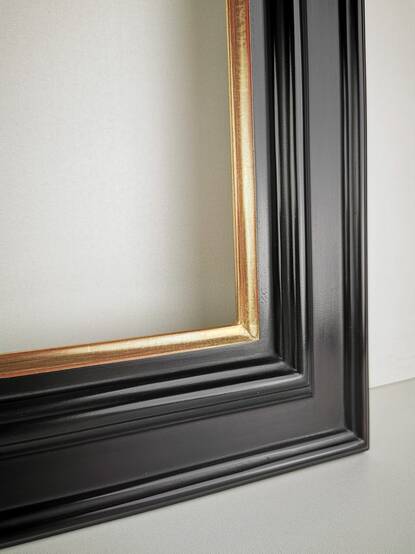
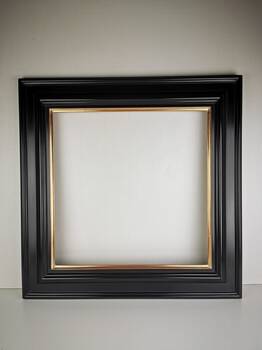
On this frame the gilding is held to a single narrow channel right at the edge of the canvas, a hand-laid gold trim in real gold leaf, while the rest of the 90 mm moulding, about 3½ inches, stays black and works as a quiet ground. That division of roles lets the gold lift the painting instead of competing with it. I make each frame singly, to the size of one particular work, in my workshop in Czarna Białostocka.
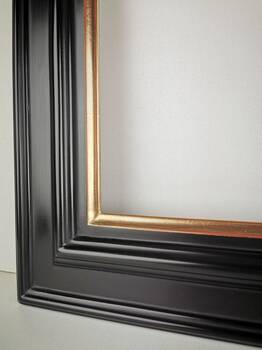
A black picture frame with gold trim, made to measure and gilded by hand in real gold leaf. The moulding runs to a reverse profile of the kind used on seventeenth century Dutch frames: the crest sits on the painting side rather than against the wall, and the only gilded element is a narrow concave channel at the sight edge. Everything outboard of it is black, finished in a satin sheen and waxed by hand.
The moulding profile
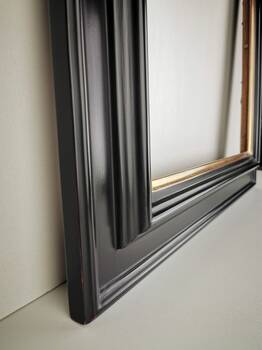
Read from the painting outwards, the section begins at the rebate. Immediately above it runs the gilded hollow, a concave channel laid with gold leaf; this is the single gilded element on the whole moulding. The hollow flattens out and passes into black, after which the surface rises through a quarter-round and then a half-round, which is the highest point of the profile. From that crest the moulding steps outwards over two beads and opens into a wide flat face taking up the middle of the width. The face is closed on the outside by three elements in sequence: a quarter-round, a half-round and a second quarter-round that repeats the shape of the one beside the gilding. A vertical outer edge finishes the section. The profile is milled, and the ornament here is the gilded channel rather than applied decoration. I have written about how this reversed arrangement changes the way a painting reads in Dutch frames uncovered, more than just a reverse profile.
Specification
- Style: classic reverse profile in the Dutch manner
- Colour and finish: black in a satin sheen, hand-waxed; the inner hollow gilded
- Moulding width: 90 mm
- Overall depth, face to back: 40 mm
- Rebate: 7 mm wide by 20 mm deep
- Material: timber with a low tannin content, of the kind used in museum work and art conservation
- Corner joining: mitred at 45 degrees, reinforced with wooden splines
- Gilding: 22-karat moon gold leaf, water gilded over red bole and burnished with an agate stone
- Glazing, backing and matting: available as add-ons, see the complete framing section below
- Mounting: sprung metal clips as standard
- Hanging: cord as standard, portrait or landscape selected in the order menu
- Production time: 20 to 30 working days
About the dimensions. Any size given for a frame is the size of the frame itself with the moulding included; the opening behind the rebate is smaller. I build each frame to the measurements of your artwork, so please order by the size of the work rather than by the outside size of the frame.
Which paintings and interiors it suits
At 90 mm the moulding gives a painting a generous margin, so it does its best work with oil and acrylic on a stretched canvas: portraits, landscapes, still life, and copies after the old masters. The narrow line of gold lightens the dark passages of a canvas exactly where the two meet, and the black closes the composition and separates it from the wall. The same profile suits works on paper, drawings and watercolours among them, once the sheet has been lifted away from the glazing by a mat. In a room it sits naturally in classic and gallery-style hangs, and the clean geometry of the section keeps it workable in modern interiors as well.
Making and finishing
The order of work here is the reverse of what happens with a frame assembled from a ready-finished moulding. I cut the lengths at 45 degrees and join the corners with wooden splines first, and only then does the finishing begin. Every later layer therefore runs through the corner without a break.
Over the assembled carcass I lay gesso, a chalk and glue ground, coat by coat, sanding by hand between coats. On the gesso goes the bole, the clay ground that sits under the metal; under this gilding the bole is red, which warms the tone of the gold and stays visible on the arrises once the surface has been patinated. The leaf is laid on water, sheet against sheet, with an overlap of about a millimetre. Once it has set I burnish the gilding with an agate stone, which gives the metal a depth that no paint or imitation foil reaches. The black is brushed by hand and waxed to a satin sheen, so it does not throw back points of light and does not pull attention off the painting. The technique itself is set out at greater length on my page about water gilding.
How it differs from a ready-made moulding
A frame cut from bought-in, pre-finished moulding is sawn and pinned, and its surface was made before anyone knew which painting it would hold. Here the structure comes first, and the ground, the colour and the gold are all laid onto a finished shape. The wooden splines in the corners carry the stresses that a glue line on its own will not hold at larger sizes. The gilding is real gold leaf rather than paint or foil, so it does not darken or shift colour over the years. Every finished frame is signed and numbered.
Personalisation
I make this same profile in several finishes. The following are settled when you order:
- Metal in the hollow: 23-karat yellow gold, 22-karat moon gold, 12-karat white gold, 6-karat white gold, palladium or silver leaf
- Bole colour under the metal: red, grey, green or black; the clay shows through after patination and shifts the tone of the metal
- Degree of sheen on the black: satin sheen or high gloss
If you are after a different pairing of colour and gilding on this type of frame, I have gathered them in the category picture frames gold gilded and partially painted.
Practical points
The frame is made without glazing, to take a stretched canvas directly. The rebate is 20 mm deep, which holds a standard stretcher as well as thinner painting panels and boards. I build the frame 2 to 3 mm larger than the measurement of the work so that there is a working tolerance, and the moulding covers about 4 to 5 mm of the edge of the painting. The same profile can be made without a rebate as a floating frame, with the painting set back and separated from the moulding by a visible gap.
Frequently asked questions
Is the whole frame gilded, or only the trim?
Only the trim. The gold leaf is confined to the concave channel at the sight edge; the remaining 85 mm or so of the width is painted black. If you want the whole moulding in leaf, that is a different frame and I will quote it separately.
Which gold tone should I choose for an oil painting?
For a warm palette, earths and reds, 23-karat yellow gold holds its own against the canvas. For cooler paintings, greys, blues and silvered greens, 22-karat moon gold is paler and calmer and is what you see on this frame. With a trim this narrow the tone reads as a line of light rather than as an area of metal, so the difference is subtler than it would be on a fully leafed moulding.
Can this frame take conservation-grade low-reflection UV glazing?
Yes. The rebate is deep enough for glazing, a mat and a backing panel together, and I fit all three in the workshop. Sizes and glazing class are settled by email before I start.
What mat proportions suit a frame like this?
With a 90 mm moulding a mat border of roughly 1½ to 2¼ inches, 40 to 57 mm, keeps the proportions balanced without crowding the gold. For larger sheets I usually widen the bottom margin slightly.
Complete framing, additional options
Every frame I make can be completed with full archival and museum framing: conservation-grade low-reflection UV glazing in four classes, matting cut from acid-free museum board, spacers faced with acid-free paper, and a Dibond backing panel. Framing of this kind protects the work from light, from acids and from distortion. The full specification of the glazing and the materials is set out on a separate page: archival and museum framing for paintings and photographs. All components are available as add-ons, priced individually on request.
Mounting and hanging
As standard I fit sprung metal clips. They turn with a finger, so the work can be taken out and put back without tools. To order I prepare screwed brass plates; these are sent loose with their screws and are fixed permanently. For hanging, cord is standard, and I add a single D-ring on request. Portrait or landscape orientation is chosen in the order menu, because the spacing of the fixing points depends on it.
Made to measure
The price shown is the price for one linear metre of moulding. The perimeter of a painting is not the whole length of moulding a frame needs: corners cut at 45 degrees take up extra length, and the wider the moulding the more they take. The calculator works out the full consumption of moulding including the corners, adds the base order price and any options you select, and returns the final figure. For this moulding width the calculator handles artworks up to 180 cm around the perimeter; anything larger is made to individual order, so send me the dimensions and I will price it. Production time is 20 to 30 working days.