Black Hand-Painted Picture Frame, Made to Measure
- Add feedback:
- Code: 207ST
- Manufacturer: Karol Milewski
-
Availability:
 Exists
Delivery time: 20 - 30 working days
Exists
Delivery time: 20 - 30 working days
- pcs.
- €163.89
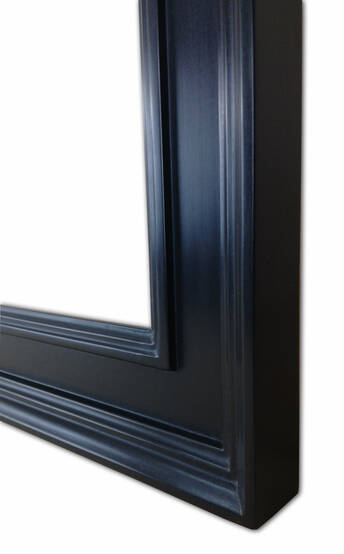
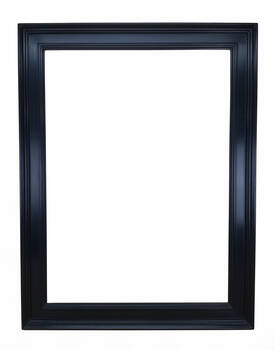
A black picture frame 70 mm across the face, about 2¾ inches, painted by hand in the workshop and finished to a satin sheen. The section reads as a hollow: a cavetto at the artwork, a wide flat holding the centre, and a scoop lifting to a flattened crest at the outer edge. Made to measure for oil and acrylic on stretched canvas.
This is a custom black picture frame I paint by hand, one at a time, for one particular painting. The face is 70 mm across, about 2¾ inches, the black is built up in coats and finished to a satin sheen, and the brush leaves a fine, even movement in the surface that a sprayed length of moulding does not have. The whole section carries a single colour, which is usually what a strongly coloured canvas wants around it.
The moulding profile
At the artwork the face opens with a cavetto, a shallow quarter-round hollow, closed by a step that lifts in a small ogee to a narrow flat about 7 mm across. From there the face falls into a wide flat holding the centre of the section, then rises again in a quarter-round scoop to a flattened crest at the outer edge, the highest point of the moulding. The outer side stands flat and vertical. The section draws as a hollow: the centre sits below both the narrow flat at the artwork and the crest at the outer edge.
Specification
- Style: concave section, a wide flat centre held between a narrow flat at the artwork and a flattened outer crest
- Finish: black, hand-painted, satin sheen, sealed with shellac and wax
- Moulding width: 70 mm
- Moulding thickness (face to back): 35 mm
- Rebate: 7 mm wide, 10 mm or 20 mm deep, chosen in the order menu
- Material: timber with a low tannin content, used in museum conservation
- Corner construction: mitred corners reinforced with wooden splines, jointed before grounding
- Artwork retention: sprung clips as standard, brass plates with screws on request
- Hanging: picture wire as standard, orientation from the order menu, single D-ring on request
- Glazing, backing and mount: available as add-ons, quote on request
- Lead time: 20–30 working days
The frame is made to the exact dimensions of your artwork, so enter the dimensions of the work itself in the calculator. I build in 2–3 mm of technical clearance, and the moulding overlaps the edge of the artwork by roughly 4–5 mm.
Which paintings and interiors it suits
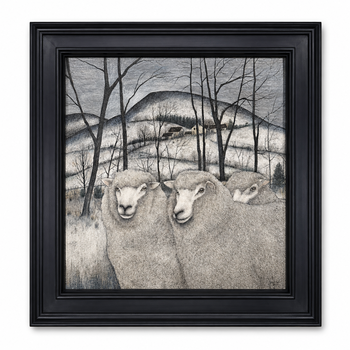
A frame for painting on canvas: oils and acrylics on a stretcher up to 20 mm thick, and works laid down on a rigid support of the same thickness. It also takes drawings, prints and photography once glazing and a mount are added. Black holds the wall quiet and gives the picture an edge without putting any pattern next to it, so it carries strong colour, landscape and portrait work as readily as restrained monochrome. In a room it sits with timber and brass, in studies and libraries, and against anthracite, ivory and taupe walls. On matching a moulding width to a canvas, see my guide to types of picture frames for canvas paintings. Other models in the same palette are in my range of black picture frames.
How it is made and finished
The corners are cut at 45 degrees and reinforced with wooden splines before any ground goes on, so the geometry is fixed before the first coat and the finish runs across the joints. Nothing can be adjusted afterwards without breaking the surface.
The section is grounded and rubbed down, then the black goes on in several hand-applied coats, each one cut back lightly before the next is laid. That is where the depth of the colour comes from, and it is why two black frames from the workshop never read as quite the same tone. Everything is sealed with shellac and wax to a satin sheen. The fine brush movement left in the surface is deliberate: it is the record of the painting, and it is what separates this frame from a factory-lacquered length of moulding.
How it differs from a mass-produced frame
A factory black frame is usually an ABS or MDF section wrapped in black foil or sprayed in a single pass: flat, even and identical every metre. Here the colour is laid by hand in coats over a prepared ground, on one frame cut for one painting. Timber holds its dimension where MDF moves with humidity, and a splined corner holds where a stapled mitre opens up after a few seasons. That is the difference between a frame bought for a wall and a frame built for a picture you expect to keep.
What the frame will hold
The frame is supplied without glazing and without a backing, as a mount for a stretched canvas. What it encloses is set by the rebate depth, not by the 35 mm the section stands off the wall: 10 mm suits a thin support, 20 mm takes a standard stretcher, and the work seats in from the back. Measure the stretcher rather than estimating it.
The same section can be made without a rebate at all, as a floating frame, where the canvas hangs inside it with a visible gap around the edges of the stretcher. For contemporary painting that changes the presentation entirely, and I describe the construction in my guide to the floating picture frame.
Frequently asked questions
Which rebate depth should I order?
Measure the thickness of the stretcher or the board the work is on. A 10 mm rebate suits thin supports, panels and work on card; 20 mm takes a standard stretcher. The depth is chosen in the order menu and it does not change the face of the frame.
Can this frame take conservation-grade low-reflection UV glazing?
Yes. The calculator prices the frame on its own, but I fit conservation-grade low-reflection UV glazing, acid-free mount board, spacers and a Dibond backing to order.
Can the same section be made in another colour, or with a gilded edge?
Yes to both. The colour is mixed to order from a richly pigmented range, and a high-gloss lacquered finish is possible on the same section. The 70 mm section with real gold leaf laid by hand along the sight edge is listed separately as the black picture frame with gold trim.
Complete framing – additional options
Every frame I make can be completed with full archival and museum-quality framing: anti-reflective UV-filtering glass (four classes to choose from), acid-free museum mat board, spacers wrapped in acid-free paper and a Dibond backing. This kind of mounting protects the work from light, acids and distortion. I set out the full glass and material specification on a separate page: archival and museum framing for paintings and photographs. All components are available at extra cost, as an individual quote on request.
Mounting and hanging
Sprung clips are fitted as standard. They turn aside to let the work in and back to hold it, and they cope with anything from a thin board to a stretched canvas. Brass plates with screws are available on request and are supplied loose, for permanent fixing once the work is in place. Hanging orientation, vertical or horizontal, is chosen from the order menu. Picture wire is fitted as standard, and a single D-ring hanger can be fitted instead if you ask for it.
Ordering made to measure
Measure the artwork to within a millimetre, enter both figures in the calculator and add the frame to the basket. In the product options you also choose the rebate depth and the hanging orientation.
The base price shown is the price per running metre of moulding. The perimeter of the artwork is not the whole length a frame consumes: mitres cut at 45 degrees take extra length at every corner, and the wider the moulding, the more they take. The calculator accounts for the full consumption of moulding including the corners, together with the options you select.
The calculator accepts artwork up to a perimeter of 180 cm, the limit set for a moulding of this width; larger formats I make to individual order, so please write to me first. Every frame leaves the workshop in 20–30 working days.