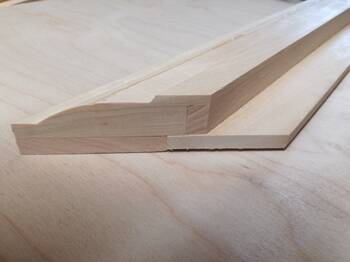
Black and Gold Leaf Frame for Canvas Paintings
- Add feedback:
- Code: 135MB
- Manufacturer: Karol Milewski
-
Availability:
 Exists
Delivery time: 20 - 30 working days
- pcs.
- €252.78
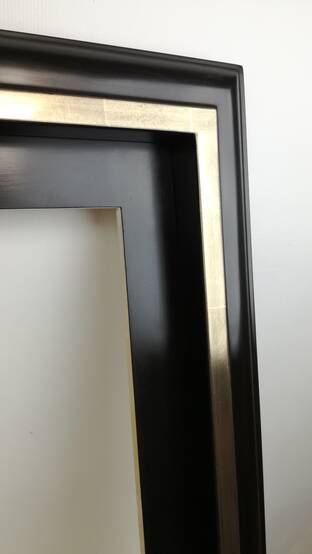
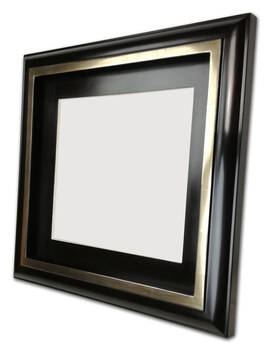
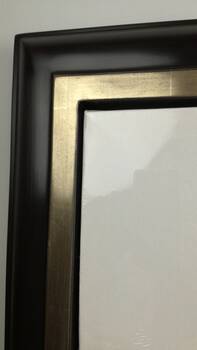
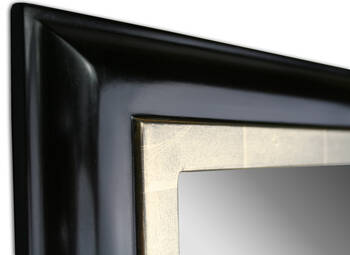
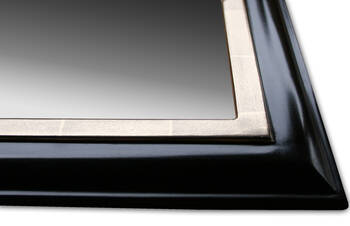
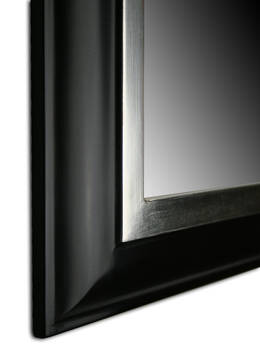
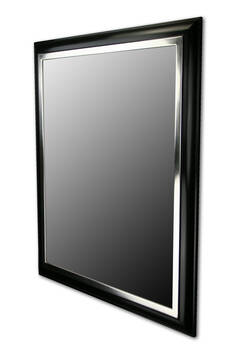
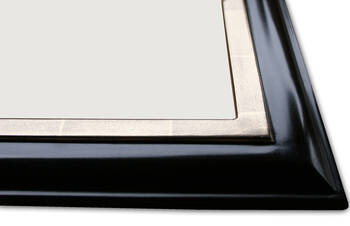
A 69 mm reverse-profile frame for stretched canvas: the flat frieze at the sight edge is water-gilded with genuine gold leaf, the rest of the face hand-painted in satin black. I make it to the dimensions of your artwork, either with a classic rabbet or as a floater, with a visible gap running round the canvas.
A black and gold leaf frame for canvas paintings, made to measure for oils, acrylics and prints stretched over bars. The moulding is 69 mm wide with a reverse profile: a fine band of genuine gold leaf runs along the sight edge, and the rest of the face is hand-painted in satin black. You decide how the work sits inside it, enclosed by a rabbet or floating, with a gap round the canvas.
The moulding profile
The face opens with a flat frieze along the sight edge, and this is the highest point of the whole section. The frieze carries the gilding; everything beyond it is satin black. From there the moulding descends towards the outer edge in a broad convex arc taking up most of the width of the face, closing with a step down to the vertical outer side. The direction is the reverse of a classical profile: instead of rising towards the wall, the frame falls away from the artwork. I go into that construction in my guide to Dutch frames and reverse profiles. The gold therefore sits closest to the painting, and 69 mm of black mass carries everything outside it.
Specification
- moulding width: 69 mm
- moulding thickness, face to back: from 22 mm
- profile: reverse, flat frieze at the sight edge, convex arc descending outwards, outer step
- rabbet: 7 mm wide, depth matched to the stretcher thickness chosen in the menu, 10 mm or 20 mm
- floater version: no rabbet, gap of about 10 mm round the artwork
- timber: low-tannin wood used in museum work and conservation
- corner joinery: mitred at 45 degrees, reinforced with wooden splines
- gilding: flat frieze at the sight edge, 6-karat white gold or 22-karat moon gold leaf laid on water over bole
- black finish: convex arc and outer step, painted by hand, satin sheen
- glass, backing and mounts: outside the calculator, quoted individually on request
- fixing and hanging: spring clips, picture wire, orientation chosen from the menu
- lead time: 20 to 30 working days
The frame is made to the dimensions of the artwork, so the size you enter in the calculator is the size of the work itself. I add 2 to 3 mm of technical clearance, and in the rabbet version the moulding laps about 4 to 5 mm over the edge of the artwork.
Which artworks and interiors it suits
I built this frame for work stretched over bars: oil and acrylic painting, canvas prints and photographs printed on canvas. The gilded frieze draws a fine bright line right at the edge of the composition, while the black arc pushes the wall back, so the painting keeps its own space without a mount.
Black with a gold edge reads well in a contemporary scheme and in a traditional interior with dark timber. If your piece is a canvas print, or arrived rolled and still needs stretching, see my page on frames for canvas prints.
How I make and finish it
The order of work is traditional. I cut the timber profile at 45 degrees, join the corners and reinforce them with wooden splines. Only then does the frame receive gesso, sanded smooth before I lay the bole. The gilding is done with genuine gold leaf laid on water, leaf by leaf, overlapping about a millimetre, then burnished with an agate stone to a lustre no metallic paint reproduces.
The arc and the outer step are painted by hand and finished to a satin sheen; the gilded frieze is sealed with traditional shellac and wax. White gold at 6 karat gives a cool, almost chrome-like reflection that suits photography and a cold palette. Moon gold at 22 karat is paler and cooler than classic 23-karat yellow, with a faintly silvery tone. The rest of this finish family sits in my range of gilded and part-painted picture frames.
How it differs from a mass-produced frame
A shop-bought frame is cut to length from finished, lacquered moulding, and its metallic effect comes from paint or foil. Here every stage happens by hand on an assembled frame, and the metal is real gold leaf laid on water. Corners splined before the gesso goes on do not open up over the years, and a burnished band has a depth no sprayed coating matches.
Floater or classic rabbet
The fixing method is chosen from the order menu. In the rabbet version the moulding laps a few millimetres over the edge of the stretcher. In the floater version there is no rabbet: I fix the work from behind and leave a gap of roughly 10 mm round the canvas, so the painting appears to hover inside it. The sides of the stretcher stay in view, which counts when the painting carries on round them. I compare both in my guide to floating frames for canvas art.
Stretcher thickness is selected separately, 10 mm or 20 mm, and I match the rabbet depth to it. For thicker bars, message me before ordering.
Choosing the gold leaf and the bole colour
Two combinations are set up in the order menu: 6-karat white gold on the frieze, and 22-karat moon gold over grey bole. The rest of the face is satin black in both. The leaf decides the temperature of the metal, the bole decides what shows once the surface is burnished and patinated: grey quietens and cools the gold, red pushes it warmer, black gives the deepest contrast. Other pairings are made on request.
Complete framing – additional options
Every frame I make can be completed with full archival and museum-quality framing: anti-reflective UV-filtering glass (four classes to choose from), acid-free museum mat board, spacers wrapped in acid-free paper and a Dibond backing. This kind of mounting protects the work from light, acids and distortion. I set out the full glass and material specification on a separate page: archival and museum framing for paintings and photographs. All components are available at extra cost, as an individual quote on request.
Mounting and hanging
Spring clips are fitted as standard, installed in the workshop and rotated aside to seat or swap the painting without dismantling the frame. Brass plates with screws are available on request, supplied loose with the screws included, for you to fit once the work is in place; this is the permanent retention used in exhibition mounting.
Hanging orientation, portrait or landscape, is selected from the order menu, and the frame is fitted only in the chosen orientation. Picture wire is standard; a single D-ring hanger is available on request.
Ordering to measure
Measure the painting itself, and on a stretched canvas take the outside of the bars. Enter those figures to the nearest millimetre without adding clearance. The base price shown is the price per running metre of moulding: the perimeter of the painting is not the whole length a frame needs, because corners cut at 45 degrees consume extra length, and the wider the moulding, the more each corner takes. The calculator accounts for full consumption including corners. At this moulding width it handles artworks up to 180 cm around the perimeter; anything larger is made to individual order. The lead time is 20 to 30 working days.