Dutch Black Picture Frame with a 23-Karat Gold Sight Edge, Made to Measure
- Add feedback:
- Code: 250
- Manufacturer: Karol Milewski
-
Availability:
 Exists
Delivery time: 20 - 30 working days
- pcs.
- €238.89
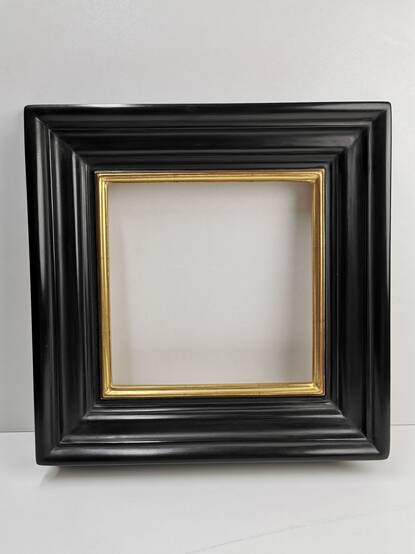
A Dutch black picture frame, made to measure for oil paintings on canvas. The face is hand-painted in satin black and the gold sits in one place only, on the half-round at the opening, water gilded in genuine 23-karat leaf over red bole. A substantial section: 79 mm across the face, just over 3 inches, and 67 mm from face to back.
A Dutch black picture frame in the seventeenth-century manner: black across the whole face, with a single fine line of gold at the opening, water gilded in genuine 23-karat leaf. It is a painted frame with gilded accents rather than a gilded frame, and that is exactly why it sits so quietly around oil painting on canvas: the black holds the wall back, the gold works only where it meets the picture. I make each one in my workshop to the size of a specific painting.
The profile
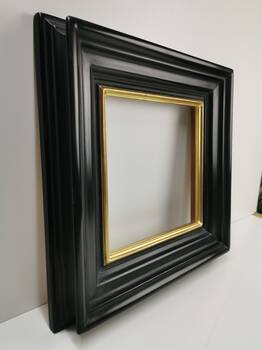
At the opening the moulding starts with a low step capped by a half-round, and it is this half-round that carries the gilding. Behind it the face drops into an inner hollow, the lowest point of the section, then climbs back through steps. From there an ogee rises: a convex arc that turns into a concave sweep and climbs more and more steeply to a narrow flat. Beyond the flat sits a large roll, the highest point of the frame, overhanging the side. Under the roll the side is cut back in a deep concave undercut, which meets a quarter-round low down and turns into a foot; the foot projects past the line of the roll and drops vertically to the back.
Specification
- Style: Dutch-style frame, black with a gilded sight edge
- Finish: hand-painted black, satin sheen, sealed with traditional shellac and wax
- Gilding: half-round at the sight edge, water gilded in 23-karat gold leaf over red bole, burnished with an agate stone
- Moulding width: 79 mm
- Moulding thickness (face to back): 67 mm
- Rebate: 7 mm wide, 10 mm or 20 mm deep, chosen with the picture thickness at checkout
- Material: low-tannin timber of the kind used in museum work and art conservation
- Corner joints: mitred corners reinforced with wooden splines, fitted before gessoing
- Glazing, backing and mat: available as an add-on, priced individually
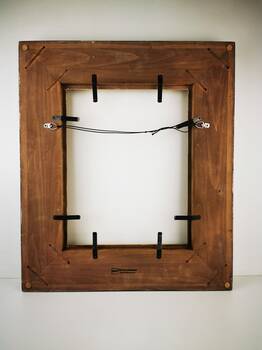
- Mounting and hanging: spring clips and picture wire as standard, portrait or landscape chosen at checkout; brass plates or a single D-ring on request
- Floating version, without a rebate: available
- Suitable for: oil and acrylic on canvas, prints, drawings, photography; medium and larger formats
- Lead time: 20–30 working days
Dimensions: the sizes given are the outer dimensions of the finished frame with the moulding, and the opening is correspondingly smaller. Every frame is made to the size of one particular work, so please give me the dimensions of the painting rather than of the frame.
What it suits
It is built first for oil and acrylic on canvas: portraits, landscapes, still lifes and figurative work, where a dark surround settles the composition and the gilded half-round keeps the eye inside the picture. With a mat and glazing it frames prints, drawings and photography just as well. The 79 mm face wants a certain amount of wall around it, so it reads best from medium formats upwards; below about 30 cm on the short side the moulding starts to dominate the work.
On the wall it behaves like a gallery frame: it holds its own against a deep, saturated paint colour, works in classic and transitional rooms, and gives a single piece enough weight to anchor a plain wall. If you are still comparing options, you can browse the other black picture frames, and my page on framing oil paintings goes through proportion, depth and glazing in more detail.
How it is made
I cut the corners at 45 degrees and reinforce them with wooden splines before any gesso goes on, so the joints stay closed as the wood moves. Then come the layers of gesso, the red bole ground under the gilding, and the black, brushed on by hand in thin coats and sealed with shellac and wax to a satin sheen. The faint brush texture in the surface is part of a hand-painted finish, not a defect.
The half-round at the sight edge is water gilded with genuine 23-karat gold leaf: the leaves go down side by side with about 1 mm of overlap, then get burnished with an agate stone until the gold turns mirror-bright. Leaf comes in sheets of about 80 mm, so for a member this narrow I cut it to width with a knife on the gilder's cushion. The faint joins you can catch in raking light are the signature of water gilding. The form itself belongs to a long tradition, which I write about in my guide to Dutch frames.
How it differs from a mass-produced frame
A shop frame of this size is a wrapped or foil-finished profile cut to length, with a gold edge that is printed or sprayed. Here the moulding is timber, the ground is gesso and bole, the black is brushed and sealed by hand, and the gold is real leaf laid one sheet at a time and burnished. The corners are splined rather than stapled. It takes longer to make, and it keeps its surface and its shape for decades rather than seasons.
Function
The frame arrives ready to take the work. Spring clips hold the canvas gently against the rebate and let you take it out again without tools; the rebate is 7 mm wide and either 10 mm or 20 mm deep, so a standard stretcher or a deeper bar both sit fully inside the frame, with the moulding covering about 4 to 5 mm of the painted edge. For work on paper the same frame takes a mat, backing and glazing. The profile can also be made without a rebate at all, as a floating frame, where a work on a thin panel stands inside the moulding with an even gap all round.
Frequently asked questions
Is the whole frame gilded, or only the edge next to the painting?
Only the half-round at the opening is gilded, in genuine 23-karat leaf. Everything outside it is hand-painted black. That is the point of this frame: a broad dark surround with gilded accents, rather than gold across the whole face. If you want the whole moulding gilded, I make that as a separate commission, and the price changes considerably.
Which gold tone suits an oil painting?
23-karat yellow, as here, is the warmest and most intense, and it sits naturally with earth pigments, varnished surfaces and darker classical painting. For cooler canvases, blues, greys and contemporary work, the same moulding is also made with a 22-karat moon gold edge, which is paler and slightly silvery. I can also gild in 12-karat or 6-karat white gold, or in palladium, and change the colour of the bole underneath, which shifts the final tone.
What mat width suits a frame like this?
For work on paper behind glazing, a border of about 2 to 3 inches, 50 to 75 mm, holds its own against a 79 mm moulding; anything narrower gets squeezed between the picture and the frame. A weighted mat, with the bottom margin slightly deeper than the top, is the traditional choice for portraits and for anything that will hang at eye level.
Can it take conservation-grade low-reflection UV glazing?
Yes. The rebate takes glazing, a mat and a backing panel together, and I fit conservation-grade low-reflection UV glazing on request, up to 60 × 80 cm in the anti-reflective classes. Send me the size of the work and I will price the frame with the mounting.
Can a gilded frame be made to a tighter budget?
Yes, and the saving comes from the profile, not from the gold. A narrower or simpler section uses less material and less time at every stage, while the gilded edge stays genuine leaf over bole. Tell me the size of the painting and the figure you have in mind and I will suggest the profile that fits it.
Conservation and museum framing
Every frame I make can be completed in the workshop with conservation-grade mounting: low-reflection UV glazing, a museum-grade mat, spacers and an archival Dibond backing panel, assembled as one package with the frame. The materials, the four glazing classes and the way each one is used are set out on my page on archival and museum framing, and I quote every mounting individually against the size of the work.
Mounting and hanging
As standard the artwork is secured with spring clips, which are turned aside for removal and hold the work without pressure. Brass plates, supplied loose with their screws for permanent fixing, are available on request. The frame is prepared for hanging in the orientation chosen in the order menu: picture wire is fitted as standard, and a single D-ring on request.
Ordering made to measure
Measure the width and height of the painting to within 0.1 cm and enter them in the calculator on this page, for example 42.0 × 30.2 cm. I build in the technical clearance, 2 to 3 mm, that lets the canvas sit in the frame without strain. The base price shown is the price per running metre of moulding: the perimeter of the painting is not the whole length a frame needs, because each 45 degree mitre takes extra length, and the wider the moulding the more it takes. The calculator works out the full usage including corners, along with any options you select.
For this moulding width the calculator handles artworks up to 180 cm around the perimeter; anything larger is made to individual order, so send me the dimensions and I will price it. The same applies to glazing, backing and matting, a floating version, or a different gold or bole colour. The lead time is 20–30 working days.