Custom black picture frame with a gilded cavetto
- Add feedback:
- Code: 182
- Manufacturer: Karol Milewski
-
Availability:
 Exists
Delivery time: 20 - 30 working days
Exists
Delivery time: 20 - 30 working days
- szt.
- €238.89
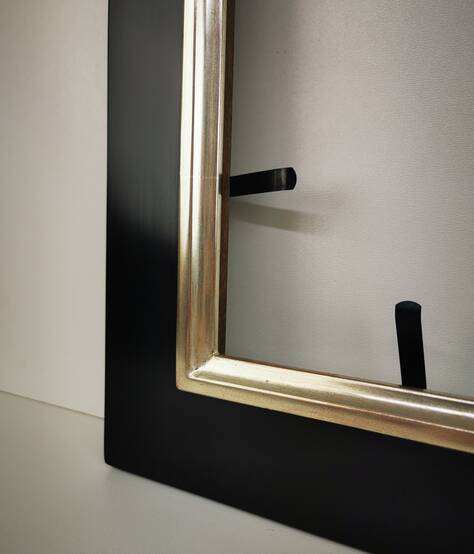
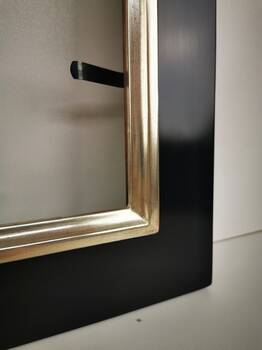
A wide black picture frame with a gilded cavetto at the sight edge: a 70 mm face, painted by hand and patinated, with 12-karat white gold leaf water-gilded over red bole along the 20 mm nearest the artwork. I make every frame to measure, in black or in dark brown.
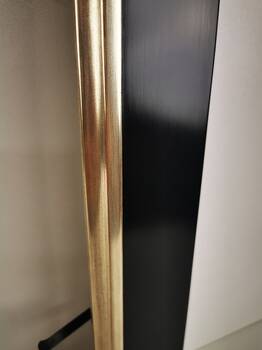
This is one of the widest mouldings I keep in the workshop: a face of 70 mm, painted black by hand and patinated, gilded over the concave cavetto nearest the painting. The metal is 12-karat white gold leaf, water-gilded over red bole, so the line reads as quietly silvery rather than warm, lifting the edge of the work away from the black without brightening the frame as a whole. The rest of this direction sits in my black picture frames collection. The same frame is also made in dark brown, with identical gilding. For brown with a warmer gold tone on a wider face, see my wide brown gilded picture frame in 22-karat moon gold.
Moulding profile
Read from the artwork side outwards, the face opens with a cavetto, a shallow concave hollow that climbs gently from the sight edge and flattens into a narrow flat, the highest point of the moulding. Cavetto and flat together carry the gilding, across 20 mm. Immediately beyond it the face drops through a small step and passes into a flat frieze, which runs without further detail to the outer edge. The lateral flank is carried as flat as the frieze. Across 70 mm the gilding takes up less than a third of the face, so the plain black frieze carries the character of the frame.
Specification
- Style: wide, flat profile with a gilded cavetto at the artwork edge
- Finish: hand-painted black with a satin sheen, hand-patinated
- Painted colour: black or dark brown, selected in the order options
- Gilding: 12-karat white gold leaf, water-gilded over red bole
- Sealing: shellac and wax over the whole frame, painted surface and gilding alike
- Gilded section: cavetto and narrow flat, 20 mm across
- Moulding width: 70 mm
- Moulding thickness (face to back): 28 mm
- Rebate: 7 mm wide, 20 mm deep; other depths made to order
- Material: seasoned timber with a low tannin content, of the kind used in museum and conservation work
- Corner joinery: mitred at 45 degrees and reinforced with wooden splines
- Ground beneath the gold: gesso and bole, built up in layers
- Glass, backing and matting: archival add-ons, described below
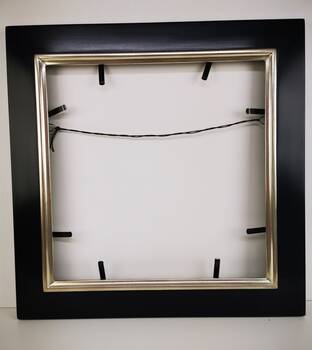
- Mounting and hanging: sprung retaining clips as standard; brass plates, picture wire and D-ring options
- Suited to: oil and acrylic paintings on stretchers, painting panels, graphic art and photographs on a rigid support
I make the frame to the dimensions of the artwork itself. Enter the size of the work in the calculator; I build the frame 2–3 mm larger, which gives the technical clearance needed to seat the painting, and the moulding covers about 4–5 mm of its edge.
Which artworks and interiors it suits
A moulding this wide and this dark asks for a painting with a clear composition. It works best with oil and acrylic on a stretcher: landscape, still life, portrait, and above all a dense, saturated palette, where black closes the image instead of competing with the colour. Scale matters more than usual: at 70 mm the moulding dominates a small picture, and it comes into its own from roughly half a metre upwards.
In a room, black with a gilded edge reads as gallery hanging: against pale walls the frame draws a firm outline, against dark walls the cavetto stays the single point of light. Because the white gold is cool rather than yellow, it sits easily with grey, steel and cool timber.
Craftsmanship and finish
I start with the corners: the mouldings are cut at 45 degrees and reinforced with wooden splines while still bare, before any surface work. Only then does the assembled frame receive gesso, worked back to an even surface, and red bole where the gold is to sit.
The gilding is 12-karat white gold leaf laid on water, leaf beside leaf with a slight overlap, forming one continuous layer. White gold reads cool and silvery, clearly paler than yellow gold, and the red bole works in its favour: after patination it shows through in places and warms the metal. The frieze is painted black by hand and patinated, then brought to a satin sheen. Shellac and wax seal the whole frame, cavetto included. I describe the technique on my water gilding page.
How it differs from mass production
A shop-bought frame is cut from moulding wrapped in foil or sprayed with metallic paint, in one of a dozen or so stock sizes. Here the dimensions are calculated for one painting, the bole is laid by hand, the metal is genuine gold leaf, and the patina is judged against the work it will hold. I work alone, so each frame passes through the same pair of hands from the first cut to the final sealing. Small differences between pieces follow from that, most visibly in the patina.
Functionality
The rebate is 20 mm deep, which takes an ordinary stretcher without packing pieces; I cut a different depth to order for an unusual support. Rebate depth describes what the frame can enclose, not how far it stands off the wall: at a moulding thickness of 28 mm this one stays comparatively flat. As standard it comes without glass or backing board, which is how paintings on canvas are most often framed. The same profile can be made without a rebate, as a floating frame, with the painting suspended behind a narrow shadow gap; I set that out in my guide to floating picture frames for canvas art.
Complete framing – additional options
Every frame I make can be completed with full archival and museum-quality framing: anti-reflective UV-filtering glass (four classes to choose from), acid-free museum mat board, spacers wrapped in acid-free paper and a Dibond backing. This kind of mounting protects the work from light, acids and distortion. I set out the full glass and material specification on a separate page: archival and museum framing for paintings and photographs. All components are available at extra cost, as an individual quote on request.
Mounting and hanging
This frame is intended for paintings on canvas and stretchers, so it does not include glass as standard. To hold the painting, I fit sprung retaining clips as standard; they pivot to the side, so the canvas can be removed and replaced quickly without tools. On request I supply brass plates with screws instead (provided loose, for permanent self-installation). The hanging orientation – portrait or landscape – is chosen at checkout. Picture wire is standard, with a single D-ring available on request.
Ordering made to measure
The base price shown on the site is the price per running metre of moulding. The perimeter of the painting is not the full length the frame needs: corners cut at 45 degrees take extra length, and the wider the moulding, the more they take. The calculator accounts for the full moulding consumption with corners and for any options you choose, so you only need to enter the dimensions of your painting to within 0.1 cm. For this moulding width the calculator handles artworks up to 180 cm around the perimeter; anything larger is made to individual order, so send me the dimensions and I will price it. The lead time is 20 to 30 working days.