Grey Picture Frame for Oil Paintings with 12-Karat White Gold Trim
- Add feedback:
- Code: 169GG
- Manufacturer: Karol Milewski
-
Availability:
 Exists
Delivery time: 20 - 30 working days
- pcs.
- €247.22
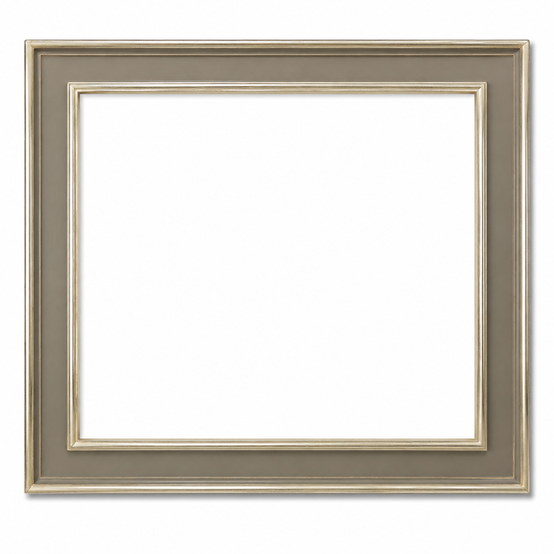
A classical picture frame painted by hand in two matched greys, with gilded accents in real 12-karat white gold leaf: a cyma with a half-round bead at the artwork edge, a 3 mm gold step across the face and a quarter-round crowning the outer edge. The moulding is 70 mm wide, about 2¾ inches. I make it to the size of your painting, and the two greys, the gold tone and the mounting are all settled per order.
I make this frame for oil and acrylic paintings that need a firm, quiet border: a 70 mm architectural profile, painted by hand in two shades of grey, with gold trim in real 12-karat white gold leaf. The gilding is partial by design, so the grey carries the frame and the metal draws the lines. Frames worked this way sit in my picture frames gold gilded and partially painted collection.
Moulding profile
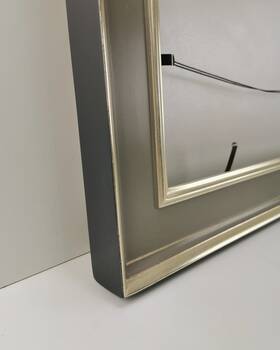
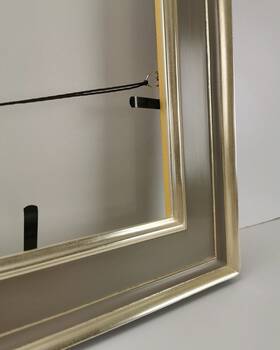
At the artwork side the face opens with a gilded hollow that rises into a convex half-round bead, the two together forming the cyma that closes the frame at the artwork edge. Behind it the surface falls to a flat frieze, the widest part of the face, painted in the first grey. The frieze ends at a step: a vertical gilded plane 3 mm high, set at a right angle to the frieze, and this is the fine line of gold between the two painted areas. From the step the face rises again through a concave cavetto of quarter-circle section, painted in the same grey as the frieze, and closes with a convex ovolo crowning the outer and highest edge. The lateral flank is flat and painted in the second grey.
Specification
- Style: classical, architectural, part painted and part gilded
- Finish: face in one grey, lateral flank in a second, both to a satin sheen
- Gilding: 12-karat white gold leaf on the cyma and its half-round bead, the 3 mm step and the ovolo
- Gold tones to order: 6-karat white, 22-karat moon, 23-karat yellow
- Sealing: shellac and wax over the gilding, wax over the paint
- Moulding width: 70 mm; widened frieze to order
- Moulding thickness (face to back): 33 mm with a 10 mm rebate, 43 mm with a 20 mm rebate
- Rebate: 7 mm wide, 10 or 20 mm deep, chosen in the order options
- Material: seasoned timber with a low tannin content, of the kind used in museum and conservation work
- Corner joinery: mitred at 45 degrees, reinforced with wooden splines
- Glass, backing and matting: archival add-ons, described below
- Mounting and hanging: sprung retaining clips as standard; brass plates, picture wire and D-ring options
- Suited to: oil and acrylic on stretchers, painting panels, works on paper, photographs on a rigid support
Ordering dimensions: I make the frame to the dimensions of the artwork itself. Enter the size of the work in the calculator; I build the frame 2 to 3 mm larger, which gives the technical clearance needed to seat the painting, and the moulding covers about 4 to 5 mm of its edge.
Which artworks and interiors it suits
The profile suits painting with a settled palette: landscape, still life, portrait, abstract work in muted colour. Cool greys and white gold sit well with canvases built on whites, blues, navy, olive and earth tones, where a yellow gold would push the picture warmer than the painter intended. At 70 mm it wants a work with some presence, from roughly half a metre upwards, and in a room it draws a classical outline in a contemporary colour. More on matching frame to canvas on my framing oil paintings page.
Craftsmanship and finish
The moulding is milled to profile before any surface work. I cut the corners at 45 degrees and reinforce them with wooden splines while the wood is bare; only then does the frame take its ground, worked back until the surface is even enough to paint and to gild.
Frieze and cavetto are painted by hand in the first grey, from a curated, richly pigmented paint range, the flank in the second, and both are waxed to a satin sheen. The gilding is 12-karat white gold leaf, laid leaf beside leaf with a slight overlap so that it reads as one continuous layer, cut with a knife on the gilder's cushion so that an element as narrow as the 3 mm step takes gold without a joint showing. Shellac and wax seal the metal. More in my note on gilded picture frames, gold leaf and hand gilding.
How it differs from mass production
A shop-bought frame of this appearance is pressed from an MDF and polymer mix, then wrapped in metallised foil or sprayed with metallic paint, and it looks even because the surface has no depth. Here it runs the other way: genuine gold leaf on a wooden body, pigment laid by hand, each frame cut for one painting.
Functionality
The frame is supplied without glass, as a mount for a painting on a stretcher or a work seated in the rebate. You choose the rebate depth in the order options: 10 mm suits thinner supports, 20 mm takes an ordinary stretcher. Rebate depth describes what the frame can enclose, not how far it stands off the wall. The same moulding can be made without a rebate, as a floating frame.
Common questions
Is this frame gilded all over, or painted with gold trim?
Painted, with gold trim. Three elements carry metal: the cyma with its half-round bead, the 3 mm step and the ovolo, together well under a third of the face. The frieze and cavetto stay grey. If you want leaf across the whole surface, I make that on other profiles.
Which gold tone should I choose for an oil painting?
Match the metal to the temperature of the painting, not the room. On a cool canvas the 12-karat white gold shown here keeps the edge quiet; for ochres, reds and browns 23-karat yellow answers better, with 22-karat moon gold between them.
Can this frame take conservation-grade low-reflection UV glazing?
Yes. Choose the 20 mm rebate and the depth takes glazing, an acid-free mat of about 1½ to 2¼ inches, 40 to 57 mm, spacers and a Dibond backing, fitted in the workshop and priced per work.
Complete framing – additional options
Every frame I make can be completed with full archival and museum-quality framing: anti-reflective UV-filtering glass (four classes to choose from), acid-free museum mat board, spacers wrapped in acid-free paper and a Dibond backing. This kind of mounting protects the work from light, acids and distortion. I set out the full glass and material specification on a separate page: archival and museum framing for paintings and photographs. All components are available at extra cost, as an individual quote on request.
Mounting and hanging
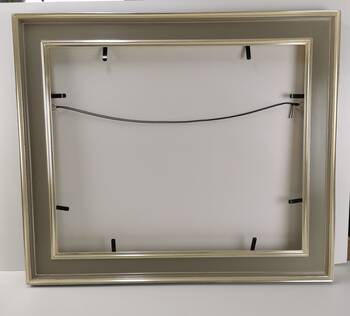
This frame is intended for paintings on canvas and stretchers, so it does not include glass as standard. To hold the painting, I fit sprung retaining clips as standard; they pivot to the side, so the canvas can be removed and replaced quickly without tools. On request I supply brass plates with screws instead (provided loose, for permanent self-installation). The hanging orientation – portrait or landscape – is chosen at checkout. Picture wire is standard, with a single D-ring available on request.
Ordering made to measure
The base price shown on the site is the price per running metre of moulding. The perimeter of the painting is not the full length the frame needs: corners cut at 45 degrees take extra length, and the wider the moulding, the more they take. The calculator accounts for the full moulding consumption with corners and for any options you choose, so you only need to enter the dimensions of your painting to within 0.1 cm. For this moulding width the calculator handles artworks up to 180 cm around the perimeter; anything larger is made to individual order, so send me the dimensions and I will price it. The lead time is 20 to 30 working days.
The colour is as open as the size. I match both greys to the painting or paint the frame in a single shade, and the gold can be changed to 6-karat white, 22-karat moon or 23-karat yellow. The frieze is widened to order, as on the frame photographed here.