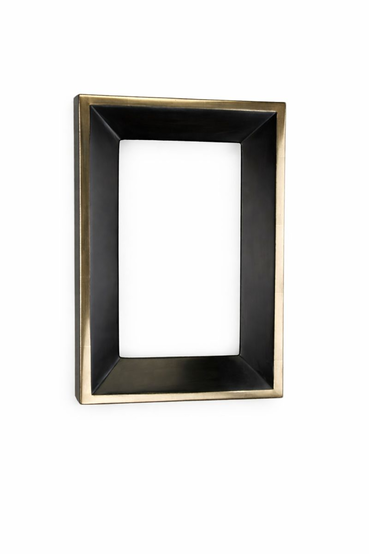
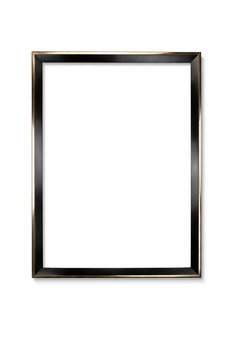
Black picture frame with gold trim, 22-karat moon gold leaf
- Add feedback:
- Code: 152
- Manufacturer: Karol Milewski
-
Availability:
 Exists
Delivery time: 20 - 30 working days
- pcs.
- €219.44
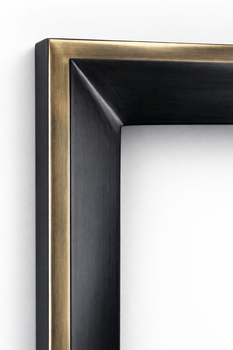
A made-to-measure black picture frame carrying a single band of gold trim along the outer edge of the moulding. The 45 mm face rises from the artwork in one long slope, held in deep satin black; the flat band at the crest is gilded in 22-karat moon gold leaf over grey bole and burnished with an agate stone. Solid timber of a low-tannin species, mitred corners reinforced with wooden splines.
A modern black picture frame with one narrow line of gold. The 45 mm moulding is deep satin black across its whole face, closed at the outer edge by a flat band of gold trim. The gilding is done in 22-karat moon gold leaf, an alloy of gold and silver that reads distinctly cooler than yellow 23-karat leaf, almost silver-cast in some lights. Laid over grey bole and burnished with an agate stone, that single band draws a bright, precise outline around the work without adding ornament to it. The frame belongs with the other black picture frames in the workshop, and is the quietest of them.
The moulding profile
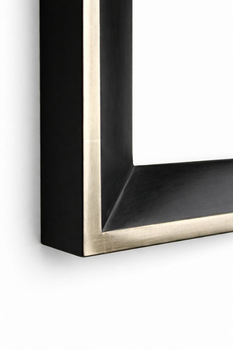
From the artwork the moulding rises in one long, straight slope that takes up roughly three quarters of the width of the face. This is the most visible plane of the frame and it stays in satin black. At the outer edge the slope closes in a flat band, parallel to the plane of the artwork. The band lies at the highest point of the profile and is the only gilded element on the frame. From there the outer side of the moulding falls vertically to the back plane and stays black, like the slope. The profile itself is machine milled; everything that happens afterwards on its surface is done by hand.
Specification
- Style: modern, minimalist, collector-grade
- Face and outer side: satin black, hand-painted and hand-waxed
- Gilded band: 22-karat moon gold leaf over grey bole, burnished with an agate stone, sealed with shellac and wax
- Moulding width: 45 mm
- Moulding thickness, face to back: 35–40 mm, depending on the rabbet version
- Rabbet: width 7 mm × depth 15 mm or 20 mm, chosen in the variant menu
- Material: solid timber of a low-tannin species, used in museum framing and art conservation
- Corners: mitred at 45° and reinforced with wooden splines, joined before any ground goes on
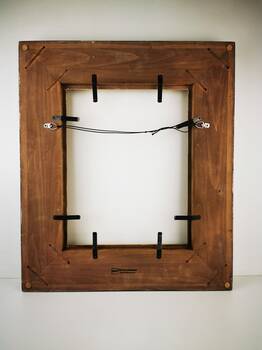
- Artwork retention: spring clips fitted in the rabbet as standard; brass plates with screws supplied loose on request
- Hanging: cord as standard, single D-ring on request; portrait or landscape chosen in the variant menu
- Glass, backing and mount: available on request, for an additional fee
- Suits: oil and acrylic on canvas or panel, photography, printmaking, works on paper
- Lead time: 20–30 working days
The dimensions above describe the moulding itself. The overall size of the frame and the size of the rabbet opening follow from the size of your artwork: I build every frame 2–3 mm larger than the work you give me, so that the canvas or panel seats without stress, and the rabbet then covers roughly 4–5 mm of the artwork all round.
What it suits
The black face gives a painting a closed, quiet setting, and the gilded band at the crest keeps that setting from reading as severe. It works well with oil and acrylic painting in restrained palettes, with earth tones, greys, whites, ochres and deep blues, and with anything gestural or abstract that needs a firm outer boundary. It also frames black-and-white and colour photography, etching, lithograph and linocut, watercolour and other works on paper. Moon gold is cooler and paler than 23-karat yellow leaf, which is why it sits more comfortably beside a cool or monochrome palette than a warm yellow gold would; the differences between leaf types are set out in the guide to gold and gilded frames.
In an interior it belongs in modern, loft and gallery spaces: minimalist rooms in muted colours, studies in walnut and brass, hanging walls in taupe, olive, anthracite or putty. The black holds the visual order of the wall and the gold contributes one line of warmth, carried entirely by the geometry of the moulding.
How I make it
I cut the moulding to the dimensions of one particular work and join the corners first, mitred at 45° and reinforced with wooden splines, a wooden tongue set across the joint. Only when the structure is fully fitted does any finish go on, which is why the surface runs continuously across the corners instead of breaking along them.
The face and the outer side are hand-painted in black in successive coats, smoothed between drying cycles, from a richly pigmented studio paint range. The satin sheen comes from hand-waxing rather than from a spray gun: a soft, fabric-like reflection instead of a laboratory-flat one.
The band at the crest is prepared with a multi-layered ground of gesso and grey bole, then gilded by the traditional water-gilding method. The gilding is done in 22-karat moon gold leaf, laid leaf beside leaf with an overlap of about a millimetre, a single layer of metal over a many-layered ground. Sheets measure roughly 80 × 80 mm and are cut by hand on a gilder's cushion for a band this narrow. The surface is then burnished with an agate stone to a mirror-bright finish and sealed with shellac and wax, which deepens the metal and holds the tone over time.
How it differs from mass production
This is not a length of ready-made moulding bought from a wholesaler and chopped to size. In a factory frame the gold is usually yellow paint or a copper-zinc imitation leaf that darkens and turns green as it ages, the black is sprayed lacquer with an even plastic gloss, and the corners are held with glue and staples over a veneered core.
Here the metal is real 22-karat moon gold leaf on a proper gesso and bole ground, water-gilded and burnished by hand, and it reflects light in a way no sprayed metallic can. The black is built up in layers and finished with wax. The corners are mechanically registered with wooden splines, visible at close range and decisive for the life of the frame once factory adhesives begin to fail. Small irregularities in burnishing and finish are part of hand work, not a defect in it.
Functionality
The frame is sold without glass, as a setting for a stretched canvas, a panel or another rigid support. The rabbet is 7 mm wide, with a depth of 15 mm or 20 mm chosen at the time of order: 15 mm for thinner works and studio stretchers, 20 mm for deeper ones. This moulding can also be made without a rabbet, as a floater frame, where the canvas appears to hover inside a narrow gap.
Complete framing – additional options
Every frame I make can be completed with full archival and museum-quality framing: anti-reflective UV-filtering glass (four classes to choose from), acid-free museum mat board, spacers wrapped in acid-free paper and a Dibond backing. This kind of mounting protects the work from light, acids and distortion. I set out the full glass and material specification on a separate page: archival and museum framing for paintings and photographs. All components are available at extra cost, as an individual quote on request.
Artwork retention and hanging
As standard the frame comes with spring clips fitted inside the rabbet. Once the work is seated they press it evenly against the moulding, and turning them aside lets you swap the work out later. On request I supply brass plates with screws instead, sent loose with the frame for you to fit to the back edge of the stretcher, a permanent and discreet fixing in the gallery manner. Hanging is by cord as standard, with a single D-ring available on request. Portrait or landscape orientation is chosen from the variant menu and the frame is prepared that way in the workshop.
Made to measure
Measure the width and height of your artwork, taking the outer edge of the stretcher for a canvas or the edge of the support for a panel, and enter those figures in the calculator to 0.1 cm. The 2–3 mm technical clearance is added here, so there is no need to add it yourself. The base price shown is the price per running metre of moulding: the perimeter of a painting is not the full length of moulding a frame needs, because the 45° mitred corners take up extra length, proportionally more the wider the moulding is. The calculator accounts for the full moulding consumption including corners, together with the options you select. It supports artwork up to 120 × 80 cm; larger formats are made to individual order. Lead time is 20–30 working days.
Each frame is built individually and further personalisation is possible: a different bole colour, a different leaf (6-karat white, 12-karat white, 23-karat yellow, palladium or sterling silver), a high-gloss lacquered face instead of satin, or a different colour altogether. The same profile is also made with the outer side gilded rather than the crest, as the black frame with a gilded edge in 6-karat white gold.