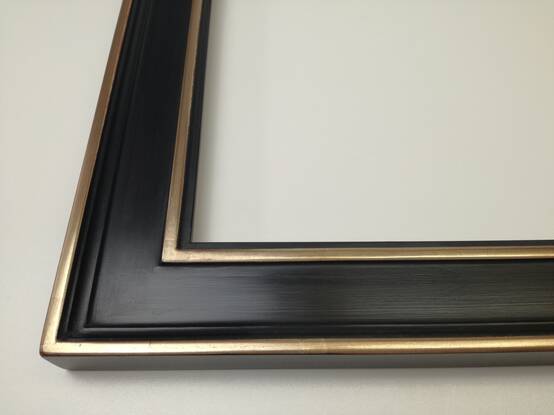
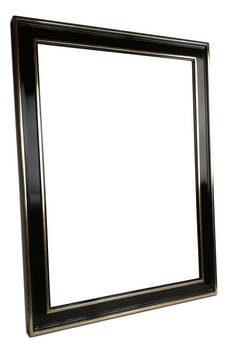
Italian-style black picture frame with 22-karat moon gold
- Add feedback:
- Code: 78B
- Manufacturer: Karol Milewski
-
Availability:
 Exists
Delivery time: 20 - 30 working days
Exists
Delivery time: 20 - 30 working days
- pcs.
- €247.22
A black picture frame in the Italian cassetta style: a wide satin black frieze set between two narrow mouldings water gilt with genuine 22-karat moon gold over red bole. I make every frame to measure for paintings on canvas and stretchers, without glass; rabbet depth of 10 or 20 mm to choose from.
A black picture frame in the Italian cassetta style: a wide, satin black frieze set between two narrow mouldings water gilt with genuine 22-karat moon gold. The layout goes back to Renaissance Italy, where cassetta frames were made for portraits and panel paintings; I make this version to measure in my workshop, for oil paintings and other works on canvas. Among my black picture frames it is the most classical composition of all: one calm plane of black held between two precise lines of pale gold.
The moulding profile
Read from the artwork side outwards, the profile opens with the rabbet: 7 mm wide, with a depth of 10 or 20 mm chosen at checkout, into which the stretcher sits. Directly beside it runs the inner moulding, a narrow profiled band raised above the frieze and gilded with moon gold, so a fine gold border traces the very edge of the painting. The centre of the face belongs to the frieze: a wide, flat plane of hand-painted satin black that makes up most of the 56 mm width and gives the cassetta its calm, architectural order. The profile closes at the outer edge with the outer moulding, again raised above the frieze and gilded, drawing the second gold line around the whole frame. The lateral flank descends to the wall and is painted the same satin black. The moulding measures 56 mm across the face and 32 mm in depth.
Specification
- Style: Italian cassetta
- Finish: frieze and flanks hand painted in satin black, sealed with traditional shellac and wax
- Gilding: genuine 22-karat moon gold leaf, water gilt on red bole on the inner and outer mouldings
- Moulding width: 56 mm
- Moulding depth: 32 mm
- Rabbet: 7 mm wide; depth of 10 or 20 mm to choose from
- Timber: low-tannin timber of the kind used in museums and art conservation
- Corner joinery: mitred at 45 degrees and reinforced with wooden splines before finishing
- Glass, backing and matting: available as archival add-ons, priced individually
- Mounting and hanging: sprung retaining clips; picture wire for portrait or landscape hanging
- Suited to: oil paintings, acrylics and other works on canvas or stretchers
Enter the dimensions of your painting in the calculator: I make the frame to the size of the artwork, with a technical allowance of 2 to 3 mm so the canvas slides in without force. The finished frame is larger than the painting by twice the 56 mm moulding width.
Which paintings and interiors it suits
The cassetta was designed for paintings and it still serves them best. The flat black frieze quietens the wall around the canvas, while the gilded inner moulding leads the eye towards the composition, which makes the frame a natural choice for portraits, still lifes and landscapes in oil. It is equally at home when framing oil paintings from a collection as it is with contemporary acrylics or a canvas print that deserves a proper, handmade setting.
Moon gold sets the palette. At 22 karat it is cooler and paler than classic 23-karat yellow gold, with a restrained, faintly silvery cast; the red bole beneath warms that tone gently from below rather than turning it yellow. Against the black frieze the effect reads as quietly elegant rather than opulent, so the frame works in classical rooms and in modern interiors alike: on white, grey or deep green walls, beside dark timber or steel, in a study, a gallery hang or a collector's living room.
Craftsmanship and finish
Every frame starts as joinery: I mitre the corners at 45 degrees and reinforce them with wooden splines before any ground or paint goes on, so the finish runs unbroken across each joint. The two mouldings then receive a traditional gesso ground and a layer of red gilding bole. I gild them on water, leaf by leaf with an overlap of about a millimetre, in a single layer of genuine moon gold, and burnish the metal with an agate stone until it takes on its characteristic sheen; you can read more about the technique on my water gilding page. The frieze and the flanks are painted by hand in black and sealed with traditional shellac and wax, which gives the surface its soft satin sheen and protects it in daily use.
How it differs from a factory frame
A factory moulding is finished by the kilometre and only then cut, so the corners meet as four separate pieces and the joint line stays visible; the gold is usually a printed or imitation metal film. Here the sequence is reversed: the corners are joined first, and the gesso, bole, gold and paint are applied to the assembled frame, so the finish flows across the mitres. The gilding is genuine 22-karat moon gold laid by hand, and the small variations of the brush and the leaf remain part of the surface: exactly what gives a handmade frame its individual character.
Functionality
The frame is made without glass, as a setting for paintings on stretchers: the rabbet takes canvases up to 10 or 20 mm thick depending on the depth you choose, and I can adjust it for deeper stretcher bars on request. If you prefer the canvas edges to remain visible, I can make the same moulding as a floating frame with a shadow gap instead of a rabbet; I explain how that construction works in my guide to the floating picture frame for canvas art.
Frequently asked questions
What is moon gold?
Moon gold is genuine 22-karat gold leaf with a cooler, paler tone than classic yellow gold: a soft, faintly silvery shade of gold rather than a deep yellow. On this frame it is water gilt over red bole, which warms it subtly from beneath.
Will this frame suit an oil painting on canvas?
Yes, that is exactly what it is designed for. The painting is held from the back with sprung clips, without glass, so the surface of the canvas remains open to the room; archival glazing can be added as an option for works that need protection.
Can I order the same profile in a different colour or gold?
Yes. This moulding is also made in other hand-painted colours and gilding variants, and I can match a specific shade to your painting and interior as a bespoke commission: please contact me before ordering.
Complete framing – additional options
Every frame I make can be completed with full archival and museum-quality framing: anti-reflective UV-filtering glass (four classes to choose from), acid-free museum mat board, spacers wrapped in acid-free paper and a Dibond backing. This kind of mounting protects the work from light, acids and distortion. I set out the full glass and material specification on a separate page: archival and museum framing for paintings and photographs. All components are available at extra cost, as an individual quote on request.
Mounting and hanging
This frame is intended for paintings on canvas and stretchers, so it does not include glass as standard. To hold the painting, I fit sprung retaining clips as standard; they pivot to the side, so the canvas can be removed and replaced quickly without tools. On request I supply brass plates with screws instead (provided loose, for permanent self-installation). The hanging orientation – portrait or landscape – is chosen at checkout. Picture wire is standard, with a single D-ring available on request.
Ordering made to measure
The base price shown on the site is the price per running metre of moulding. The perimeter of the painting is not the full length the frame needs: corners cut at 45 degrees take extra length, and the wider the moulding, the more they take. The calculator accounts for the full moulding consumption with corners and for any options you choose, so you only need to enter the dimensions of your painting to within 0.1 cm. The calculator handles formats up to 120 × 80 cm, and I make larger sizes to individual order. The lead time is 20 to 30 working days.