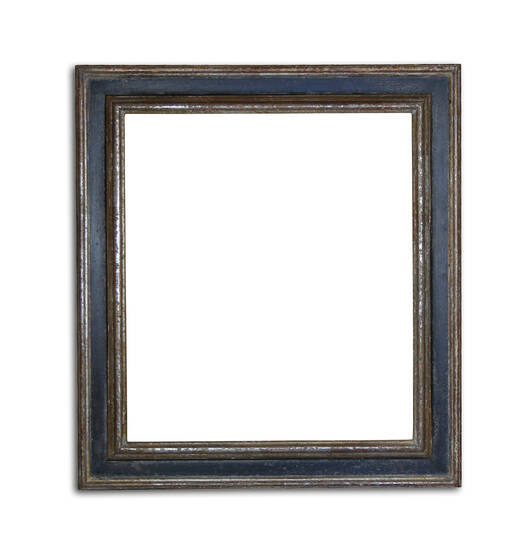
Antique-Style Gilded Picture Frame, Black and White Gold Leaf
- Add feedback:
- Code: 49
- Manufacturer: Karol Milewski
-
Availability:
 Exists
Delivery time: 20 - 45 working days
- pcs.
- €247.22
A black picture frame in the antique manner, built on a reverse profile: the crown of the section stands at the artwork and the face falls away to a wide, flat frieze. The rounds are water gilded in 6-karat white gold over red and yellow bole, then worn back by hand, and the black frieze carries a worked craquelure. Made to measure for oil and acrylic paintings on stretched canvas.
An antique-style gilded picture frame built on a reverse profile, made to measure in my workshop. The frieze and the sides are painted black and carry a worked craquelure; the rounds on either side of the frieze are water gilded in 6-karat white gold leaf over red and yellow bole. 6-karat leaf is the coolest alloy I keep, closer to chrome than to yellow gold, and where it is worn back the warm bole shows through. The result is the surface of an old gilded frame on a frame built now, to one particular painting.
Moulding profile
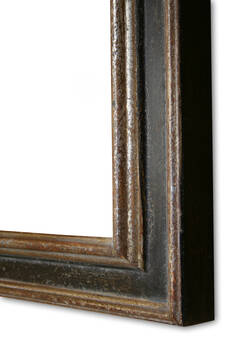
At the artwork the moulding rises to the highest point of the whole section. A quarter-round lifts first, then, higher still, a half-round, and immediately beside it two smaller rounds that already fall away. This is a reverse arrangement: the crown of the profile stands at the artwork rather than at the outer edge. Beyond them runs a flat frieze, a wide, smooth band lying lowest across the whole face, the only quiet plane in the section. Past the frieze the profile rises again, in further rounds set out much as in the crown but finer. The frieze is bordered by convex members on both sides, and the moulding reads as a rhythm of several small elements.
Specification
- Style: reverse profile with a flat frieze, partially gilded, antiqued by hand
- Finish: frieze and sides hand-painted black with worked craquelure; rounds water gilded and patinated
- Gilding: 6-karat white gold leaf, water gilded over red and yellow bole
- Moulding width: 68 mm
- Moulding thickness (face to back): 40 mm in the version for a 30 mm stretcher; the version for a 20 mm stretcher is slimmer
- Rabbet: 7 mm wide, 20 or 30 mm deep, selected when ordering
- Material: low-tannin timber of the kind used in museum work and art conservation
- Corner joinery: mitred at 45 degrees, reinforced with wooden splines
- Glass, backing and matting: available as add-ons
- Mounting and hanging: spring clips, picture wire
- Suitable for: oil and acrylic paintings on stretched canvas
I make the frame to the dimensions of the painting, not to the dimensions of the finished frame. Please enter the size of the artwork itself in the calculator. I add 2 to 3 mm of technical clearance, and the moulding overlaps the edge of the painting by roughly 4 to 5 mm.
Which paintings and interiors it suits
This is a frame for painting on canvas: oils and acrylics in a dark or muted palette, still life, portraits, landscapes, and studies after earlier painting, where the framing has to agree with the convention of the picture. The black frieze works as a pause between the image and the wall, and the gilded rounds lift the lighter passages of the canvas.
The reverse arrangement does specific work here. The highest point stands next to the canvas and closes the painting with a clear gilded edge, and everything further out stays lower. Decoration does not build up around the picture; it falls away from it, which is why the same section carries earlier painting and contemporary work equally well. It sits comfortably in period rooms and holds its own as a single dark object on a plain white wall. For more on framing conventions for canvas, see my notes on framing oil paintings, and for this section fully gilded, the gilded Dutch frame for oil paintings.
How it is made and finished
The frame exists as a whole before it takes any colour. I cut the lengths at 45 degrees and join them with wooden splines, then lay up the gesso ground and rub it down. Over the gesso goes the bole, red and yellow, and the bole decides how the metal reads once the surface is worn back.
Gilding is carried out with loose leaf at 6 karat, laid by the water gilding method, leaf beside leaf with a slight overlap. The leaves measure about 80 by 80 mm, so for the narrow rounds on this section I cut them with a knife on the gilder's cushion. Patination follows, and the layer of metal is taken locally back to the bole, which is where the cool, pale gold with warm, reddish breaks along the edges and corners comes from.
The black on the frieze and the sides is painted separately, and the craquelure is brought up deliberately. It is a technique rather than a mark of age: the network of cracks is produced under control, so its density and direction can be set to the scale of the frame. Being planned rather than accidental, it repeats across several frames ordered for one hanging. The same section can be finished in another colour and another metal; the painted and parcel-gilt work sits together in my category of picture frames gold gilded and partially painted.
How it differs from mass production
Ready-made antique-style moulding carries a printed or sprayed finish and one appearance for the whole batch. Here every stage is done by hand on the individual piece: gesso, bole, real gold leaf, patina, craquelure, so the ageing is an arrangement made for one frame rather than a pattern repeating every few decimetres. On this section that matters more than usual, because each round is gilded separately and the patina has to be laid so the rhythm of the convex members stays legible rather than blurred.
The practical difference lies elsewhere. Stock moulding cut to a standard format makes the painting fit the frame. Here it is the other way round: you give the size of the canvas and the thickness of the stretcher, and the lengths and the section are worked out from them, so the painting sits square and does not stand out past the back of the frame. Collectors and galleries commissioning this kind of work usually have further requirements, which I have set out in my notes on specialist and collector's frames.
Practical points
The frame is intended for a painting on a stretcher and is supplied without glass as standard. The canvas enters the rabbet from the back and is held with spring clips, so it can be removed without dismantling the frame.
There are two versions of the section, chosen when ordering: one for a 20 mm stretcher and one for a 30 mm stretcher. These are not one moulding with a deeper rabbet cut into it but two different sections. The version for the thicker stretcher is built up and stands further off the wall, and that is the version shown in the photographs. The 20 mm version has a slimmer moulding and reads lighter at the same face width. The same section can also be made without a rabbet, as a floating frame, with the painting hanging inside the frame and a visible gap around it.
Complete framing: additional options
Every frame I make can be completed with a full archival mounting prepared in the workshop: anti-reflective UV-filtering glass, museum-grade matting, spacers and Dibond backing. The glass classes, the selection criteria and the full material specification are set out separately: archival and museum framing for paintings and photographs.
Mounting and hanging
As standard the painting is held with spring clips, turned aside for fitting and removal. Brass plates and screws are available on request, sent loose and fitted once the painting is in the frame. Orientation, portrait or landscape, is chosen in the order menu. Picture wire is fitted as standard, a single D-ring hanger on request.
Ordering made to measure
The base price shown is the price per running metre of moulding. The perimeter of the painting is not the whole length a frame needs: corners cut at 45 degrees take additional length, and the wider the moulding the more they take. The calculator accounts for the full consumption including the corners, together with any options selected.
The calculator handles artwork up to 120 x 80 cm. Larger formats are made to individual order: please write with the size of the work and the stretcher thickness. Production takes 20 to 30 working days.