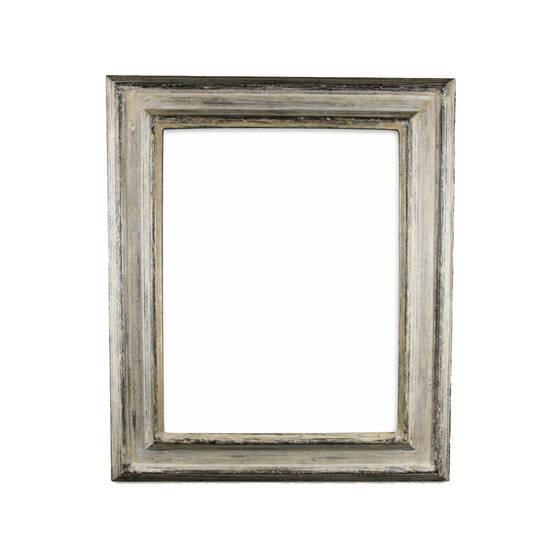
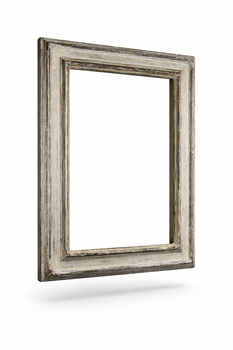
Silver leaf picture frame for canvas paintings
- Add feedback:
- Code: 121
- Manufacturer: Karol Milewski
-
Availability:
 Exists
Delivery time: 20 - 30 working days
Exists
Delivery time: 20 - 30 working days
- pcs.
- €275.00
A hand-silvered picture frame for oil and acrylic paintings on stretched canvas, gilded with pure silver leaf and patinated by hand. The 80 mm face and 48 mm depth take stretcher bars up to 30 mm thick. Made to measure in my workshop, to the dimensions of your painting.
I make this frame to order, for the framing of oil and acrylic paintings on stretched canvas. The moulding is cut from solid timber with a low tannin content, the species used in museum-grade framing and conservation work, and the surface is gilded with pure silver leaf, then patinated by hand. The depth of the profile takes the thicker stretcher bars used in contemporary painting, and the patinated silver holds light without the hard reflection of a bright metal surface, so it carries the picture rather than competing with it. It is a frame for collectors who treat the mounting as part of the work itself.
The moulding profile
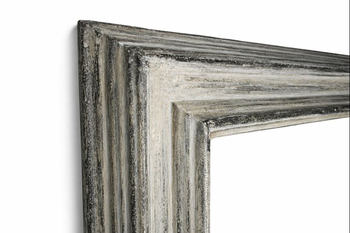
At the artwork the moulding stands at its highest: the edge beside the rabbet forms the crown of the profile, and from there the wide face falls away towards the outer edge. At 80 mm across and 48 mm deep that descent is long and clearly stated, not a chamfer taken off the edge.
This is a reversed profile, the inverse of the classical arrangement in which the crown sits at the outer edge and the face rises towards it. The reversal is the recognisable feature of Dutch frames: nothing decorative is built up on the wall side, so for all its width the frame stays quiet. I write about the type, and what it does to a painting, in my guide to Dutch frames and the reverse profile.
Specification
- Style: reversed profile, the face falling from the artwork side outwards; hand-silvered with controlled patina
- Finish: pure silver leaf (sterling), hand-patinated, sealed with traditional shellac and wax, satin sheen
- Moulding face width: 80 mm
- Moulding depth: 48 mm
- Rabbet: 7 mm wide, 20 mm or 30 mm deep, chosen in the order menu
- Material: solid timber with a low tannin content, the species used in museum-grade framing and conservation work
- Corner joinery: mitred at 45°, reinforced with wooden splines before gessoing
- Ground: animal glue size, gesso and bole, built up in several layers
- Mounting: supplied without glass, as a canvas mount
- Hanging: portrait or landscape, chosen when ordering
- Suited works: oil and acrylic on stretched canvas, abstract and contemporary painting
- Lead time: 20–30 working days
The dimensions given on the site are the outside measurement of the complete frame. The rabbet lip is 7 mm wide, and the sight opening is built 2–3 mm larger than the painting as a technical allowance, so the moulding actually covers about 4–5 mm of the picture surface. Every frame is built individually to the dimensions of your work.
Which paintings and which interiors it suits
The frame is built first of all for oil and acrylic on stretched canvas. With the rabbet at 30 mm it seats the deeper bars used in contemporary practice; at 20 mm it suits standard studio stretchers and panels. The silver is cool, but quietened by the patina, which makes it a sound match for abstract painting, modern figurative work and pictures held in a restrained, near-monochrome palette. The reversed profile matters here as much as the colour: because the moulding carries nothing decorative at the outer edge, 80 mm of width reads as breadth rather than as ornament, and the eye is turned back into the picture instead of being held at the rim. In interiors it settles into minimalist, Nordic and industrial rooms and into gallery architecture, and it works as a deliberate counterpoint in classical city interiors, where gold would be the obvious answer and therefore the wrong one.
How the frame is made and finished
Each length of moulding is cut and mitred in the workshop, and the corners are joined with wooden splines before any finishing begins. Only then does the assembled frame go to the gilding bench. The classical grounds are laid down first: animal glue size, then gesso and bole in several layers, rubbed back between coats. The silver is laid leaf by leaf, side by side with an overlap of about a millimetre, which makes one continuous layer of metal. A sheet of pure silver leaf is a few thousandths of a millimetre thick and answers to any movement of air in the room, so the work needs a still bench and an unhurried pace.
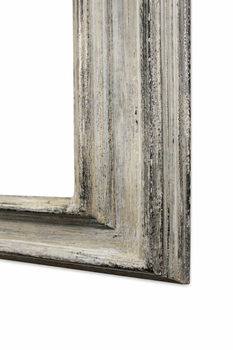
After leafing, the surface is patinated under control: darkened in selected passages, lifted in others, and rubbed back at the edges to the layers underneath. The range of tone runs from cool, fresh silver through to deeper, almost graphite passages.
The whole frame is then sealed with traditional shellac and wax. That does two things at once. Pure silver tarnishes on contact with air, and the shellac arrests the oxidation; it also deepens the colour, replacing a hard metallic reflection with a satin sheen. I set out the technique in more detail on my water gilding page.
How this differs from a mass-produced frame
In factory production the mouldings are finished as straight lengths, before the frame is assembled. Once the lengths are joined, the corners are covered over with paint, filler or a stick-on strip imitating the surface. Here the order is reversed: the frame is built first, as a complete and stable structure, and only the finished form goes to the gilding bench. The corners are therefore finished as part of the whole surface, sealed with shellac, retouched by brush and softened at the edge rather than cut off sharply. It takes more skill and more time, and it gives a result that does not open up later: the patina at the corner is as alive as the patina in the middle of the moulding.
Practical points
The frame is supplied without glass, as a canvas mount. The rabbet is 7 mm wide, and you choose the depth in the order menu: 20 mm for standard stretchers and panels, 30 mm for the deeper bars common in contemporary painting.
The same moulding can also be made without a rabbet, as a floating frame: the canvas sits within the frame with a visible gap around it and the edges of the stretcher left open. I write more about that in my guide to floating frames for canvas art.
Complete framing
Every frame I make can be completed with a full mount: anti-reflective UV-filtering glass, an acid-free mat and a Dibond backing board, to a museum standard that protects the artwork from light and acids. I set out the glass classes and details on my archival and museum framing page.
Mounting and hanging
As standard the frame is fitted with sprung clips, which turn to release and make it easy to change the canvas. On request I fit brass plates with screws instead, supplied loose for you to install for a permanent fixing. For hanging, the frame takes picture wire as standard, with a single D-ring hanger available on request; you choose portrait or landscape orientation when you order.
Ordering to measure
You order the frame through the calculator on the product page. Measure your painting to the millimetre and enter the dimensions: I build the frame with a technical allowance of about 3 mm, needed to seat the artwork freely. The calculator handles formats up to 120×80 cm; larger sizes I make to individual order. Lead time is 20–30 working days.
The base price shown is the price per linear metre of moulding. The perimeter of your painting is not the full length of moulding the frame needs: the corners, cut at 45°, take up extra length, more so the wider the moulding. The calculator accounts for the full run of moulding with its corners, along with the options you choose: rabbet depth, glass and backing, and the hanging method.
The same profile is available in other finishes: 23-karat yellow gold leaf, 22-karat moon gold, 12-karat and 6-karat white gold, palladium, and painted versions in a curated, richly pigmented paint range, over a choice of bole colours. You can see the range in custom picture frames, or write to me with the details of your commission.