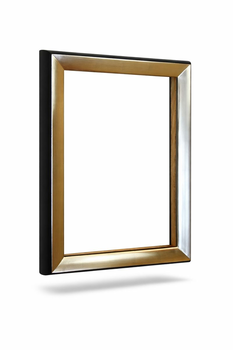
Gold Picture Frame — Hand-Gilded Made-to-Measure Frame for Canvas
- Add feedback:
- Code: 1170
- Manufacturer: Karol Milewski
-
Availability:
 Exists
Delivery time: 20 - 30 working days
Exists
Delivery time: 20 - 30 working days
- pcs.
- €275.00
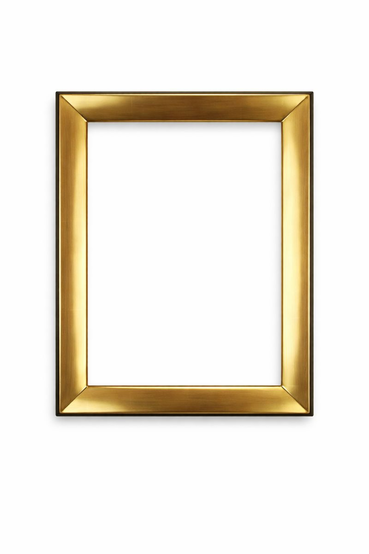
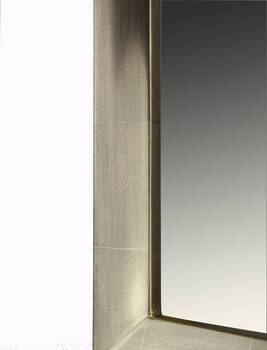
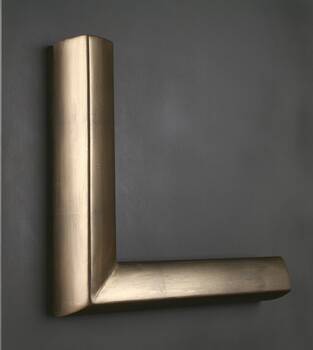
A deep, made-to-measure frame for canvas paintings, hand-built from solid timber and gilded with genuine leaf. Five finishes available: classic 23-karat yellow gold, cooler 22-karat moon gold, 6-karat white gold, the same moon gold in a satin variant with the side gilded as well, and palladium with hand-painted black sides. Single-torus moulding with an almost square cross-section, 44 mm wide; rabbet up to 40 mm deep accommodates deep stretcher bars.
This frame is built as a setting for canvas on stretcher — supplied without glass, as a hand-finished moulding for oil and acrylic paintings or photographs printed onto stretched canvas. Five finish variants cover four classical water-gilt options and a palladium-on-black presentation. The base price refers to a running metre of moulding; the calculator scales the final cost from the artwork's perimeter.
The moulding is built from a single continuous half-round torus with asymmetric curvature — falling steeply on the artwork side and easing into a gentler descent toward the outer edge, which gives the surface two distinct planes of light play. Immediately above the rabbet the profile closes with a pronounced fillet — that thicker inside lip is the signature feature of this moulding, distinctly more legible than in typical gallery profiles, framing the artwork with a clean structural step. The rabbet itself is 7 mm wide and up to 40 mm deep — sufficient for canvases on standard, deep-cradled or built-up stretchers. The moulding is deep, almost square in cross-section, giving the artwork a fully three-dimensional setting.
Five finish variants
Each variant is executed in the traditional water-gilding method: the timber receives a chalk-and-rabbit-skin gesso ground, then a layer of coloured polishing bole, on top of which the metal leaf is laid. The bole reads through the metal and determines the final tonal warmth.
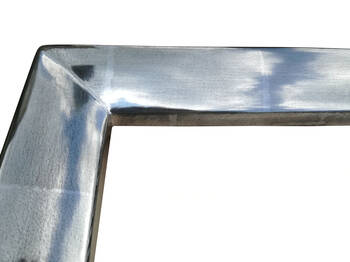
6K white gold on grey bole
White gold leaf at 6 karats — a cool, almost chrome-like reflectance. The grey bole neutralises the tone, producing a metallic silver-grey finish with no warm undercurrent. A contemporary variant that pairs well with monochrome photography, prints and paintings in a cool palette.
23K yellow gold on plum bole (default variant)
Classical 23-karat yellow gold leaf at its most saturated, warmest reflectance. The plum bole — a deep red-violet — reads through the leaf in agate-burnished areas and at the corners, producing the characteristic warm undertones associated with sacred painting and 19th-century salon framing. The strongest gilding statement in the range.
22K moon gold on plum bole
Moon gold is a 22-karat alloy with a cooler, paler tone and a subtle silvery cast — distinctly lighter than 23K but without the metallic chill of white gold. Over plum bole it retains a warm core, producing a balanced finish that suits both contemporary painting and works on paper.
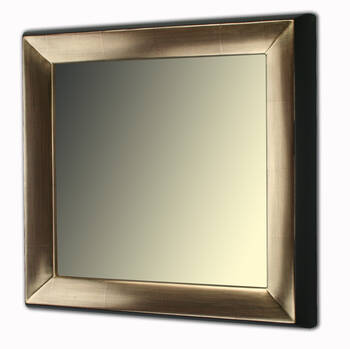
22K moon gold on grey bole — satin, side gilded
The conservation-grade variant: 22-karat moon gold over cool grey bole. Finished satin — no agate burnishing, with a subtle textural raise of the kind valued in fine-art conservation. The frame's side is gilded as well with the same 22K leaf, yielding a continuous gilded edge visible from any angle. The most demanding variant in the range. Surcharge: +PLN 390.
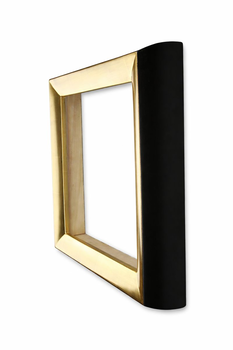
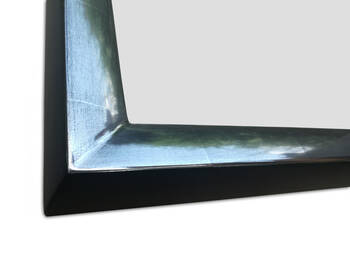
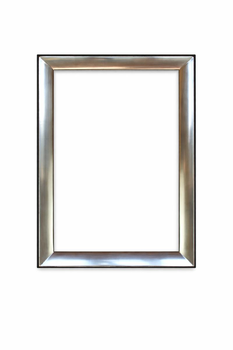
Palladium with black sides
The face is laid with palladium — a noble metal with a stable, neutrally silver tone that does not oxidise or tarnish (unlike pure silver). The frame's sides are hand-painted black and finished satin in wax — a graphic, gallery-style detail. Mounted in a single orientation (portrait or landscape), specified at order. Surcharge: +PLN 40.
Specification
- Profile: single torus with asymmetric curvature, pronounced fillet at the rabbet; almost square cross-section (deep moulding)
- Moulding width: 44 mm
- Moulding depth: 42 mm
- Rabbet: 7 mm wide, up to 40 mm deep
- Material: solid low-tannin timber of the kind used in museum and conservation framing
- Construction: mouldings joined with timber splines before finishing — guarantees corner stability
- Gilding: hand-laid, water-gilt, genuine gold or palladium leaf
- Sealing: traditional shellac and wax (gilded and palladium variants); black sides finished satin in wax
- Artwork retention: spring clips factory-fitted (included); brass plates on screws available as an alternative
- Hanging system: cord on rear hangers (orientation specified at order); single D-ring on request
- Lead time: 20–30 working days
- Application: oil and acrylic painting on stretched canvas, photography on stretched canvas, fine-art canvas prints
The dimensions you enter in the calculator refer to the artwork, not the overall frame. The rabbet covers the work's edge by approx. 4–5 mm; the frame is built 2–3 mm larger than the artwork to provide the technical clearance required for a correct fit. The base price is the price per running metre of moulding. Mitred corners cut at 45° consume additional length — the wider the moulding, the greater the consumption. The calculator accounts for full corner allowance plus selected add-ons.
Workshop construction
Every frame is built from raw stock. Solid low-tannin timber arrives as boards, is profiled and cut to length in the workshop, joined at the corners with timber splines and glued under 45° mitres. The frame is assembled before finishing — this matters, because the chalk gesso, polishing bole and gold leaf are all laid onto a closed corner. The hairline cracks routinely seen at the corners of cheap pre-gilded mouldings, where leaf is laid on the straight stick and only then mitred, do not occur with this method.
Water gilding is the classical school's technique. The chalk gesso is sanded to a porcelain-smooth surface; the polishing bole, activated with water, allows the gold leaf to bond by surface tension alone — without adhesives. After drying, selected areas are agate-burnished to a mirror polish, the rest left in the natural matte texture of leaf. 22K and 23K leaf comes in approximately 80×80 mm sheets; for narrow profiles it is cut by hand with a gilder's knife on a leather cushion.
How this differs from a production frame
Mass-produced gold frames typically use composition metal (so-called Dutch metal — a copper-zinc alloy) or glitter paint; both yellow within a few years and lose their original tone. This frame is laid with genuine gold leaf — 6K, 22K or 23K — or palladium. These noble metals do not oxidise; their colour comes from alloy composition, not pigment. Spline-jointed corners (rather than glue-only mitres) and solid timber (rather than MDF) eliminate the typical failures of production framing: gilt cracking at the corners and material movement under humidity changes.
Functionality
The frame is supplied without glass, as a setting for canvas on stretcher. Standard artwork retention is by spring clips factory-fitted to the rabbet — swapping a painting takes only a turn of the clip. Brass plates on screws are available as an alternative (supplied loose with screws; you fit them yourself once the painting is seated in the rabbet).
The 40 mm rabbet depth is a meaningful figure: it accepts canvases on standard 18 mm stretchers, on deep 40 mm stretchers, and on built-up support constructions. The deep, single-torus profile gives the frame a distinct optical perimeter — the artwork doesn't recede into the moulding, it sits within a clearly articulated three-dimensional setting.
Floater (no-rabbet) variant
Each of the five finishes can be ordered as a floater frame without a rabbet. The canvas is mounted inside the frame with a visible gap on all sides — the stretcher edges remain exposed. The standard presentation for contemporary painting and premium framing.
Calculator options
- Stretcher depth: 18 mm (standard), 20 mm, 40 mm (+PLN 10/m)
- Glass and back: no glass with spring clips (standard); OptiWhite 4 mm glass + 3 mm back panel (+PLN 39)
- Finish: 5 variants (see above)
- Hanging orientation (palladium variant): portrait / landscape
Complete framing — additional options
Every frame can be completed with a full archival mounting prepared in the workshop: glass, archival backing and matting. All components are available as a custom add-on — quote on request.
Glass — four classes available
Opti White, 4mm — low-iron glass with a neutral, colourless appearance (no green tint typical of standard float glass). Available up to 90×90 cm — the only option for larger works.
Ultra Vue UV70 (Tru Vue), 2.0mm — anti-reflective glass with 70% UV protection, low-iron. Available up to 60×80 cm.
Art View — premium-class anti-reflective glass: reflection reduced below 1%, up to 75% UV protection, scratch-resistant coating, low-iron, can be cut and mounted from either side. Meets ISO 18916 (Photographic Activity Test) — safe for archival photography. Premium quality at an accessible price. Available up to 60×80 cm.
Optium Museum Acrylic (Tru Vue) — top-tier museum acrylic: over 99% UV protection, museum-grade reflection reduction, anti-static, lightweight, shatter-resistant. The museum standard for conservation work and archival photography. Available up to 60×80 cm.
Archival backing
Dibond 3mm aluminium composite panel — two layers of aluminium with an acid-free polymer core. Rigid, chemically neutral, dimensionally stable. An industry standard in archival photographic framing and art conservation.
Mounting and matting
Acid-free foam board — chemically neutral, will not yellow over time, will not react with paper or photographic emulsions. Archival standard.
Full museum framing
Combining anti-reflective UV-filtering glass, acid-free matting, Dibond backing and conservation hinging tapes provides a museum-grade mounting — protecting the work from light damage, acid migration from typical framing materials, and mechanical distortion. This type of framing is used in museums, galleries and private collections.
To order: all of the above components are available as a frame add-on on request. Please get in touch with the dimensions of your work and your preferred glass class — I will prepare an individual quote.
Artwork retention and hanging system
The frame is supplied ready to receive the artwork. Two retention methods are available:
- Spring clips (standard, factory-fitted) — allow quick artwork swaps: rotate the clip, lift out the painting, drop in the next. Convenient for users who change displays.
- Brass plates on screws (option, supplied loose) — permanent installation, fitted by you after seating the painting in the rabbet. The gallery solution — greater long-term stability, no risk of clip relaxation over time.
Hanging: the frame is fitted with cord on rear hangers as standard. Orientation (portrait or landscape) is specified at order and factory-set — the frame will hang stably in the chosen orientation. A single D-ring (centred single-nail hanging) is available on request.
Made-to-measure ordering
Enter your artwork dimensions in the calculator to 0.1 cm precision. The price is computed automatically from the perimeter and the moulding's running-metre rate. In the calculator you specify: finish variant (1 of 5), stretcher depth, glass option, and hanging orientation (palladium variant). Lead time: 20–30 working days.
For sizes beyond the calculator's range, full archival mounting orders (glass + back + matting) or non-standard modifications, please get in touch directly. Every frame is made to order: the workshop produces a limited number of frames per year, which translates into the time spent on each individual piece.