Hand-Carved Gilded Picture Frame for Oil Paintings, Custom Made
- Add feedback:
- Code: 169GC
- Manufacturer: Karol Milewski
-
Availability:
 Exists
Delivery time: 20 - 30 working days
Exists
Delivery time: 20 - 30 working days
- pcs.
- €217.07
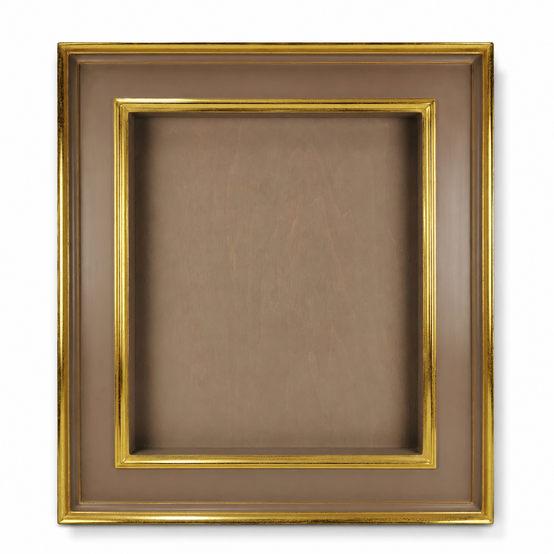
A handcrafted, deep floating frame for paintings on stretched canvas — built without a rabbet, with the inner side wall painted in colour. Latte front, soft grey outer side, moulded edges in 23-karat hand-applied gold leaf. 33 mm moulding depth; built as standard for a 10 mm canvas stretcher (20 mm option in the variant menu).
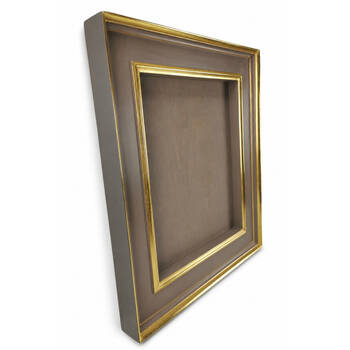
A floating frame for canvas paintings — hand-painted in a contemporary latte tone and edged on both sides with hand-applied 23-karat yellow gold leaf laid down by water gilding. In its standard configuration the frame is built as a floater (floating mount, no rabbet) — in place of a conventional inner lip, a vertical inner side wall painted in colour drops away from the front, opening a deep chamber in which the canvas hangs with a deliberate gap on every side. This kind of mounting lifts the work, reveals the texture of the oil paint, and gives the piece an air no traditional rabbeted frame can produce. Each frame is built individually in the workshop, sized to the specific painting it will hold.
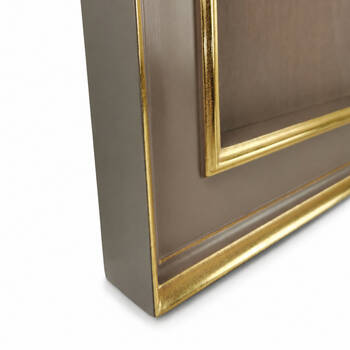
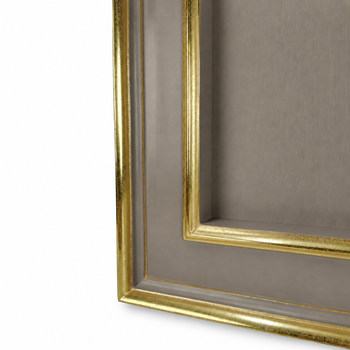
In cross-section the profile reads as a richly worked cassetta: a broad, flat front band framed on both sides by moulded edges, all gilded in real gold leaf. The outer edge rises into a half-round torus falling into a reversed cyma (ogee) — a classical architectural motif translated to a picture frame. The inner edge, on the artwork side, picks up a second smaller torus with a gilded ovolo (quarter-round). Behind the inner edge, in the floater configuration, the wall drops vertically — painted in colour — opening the deep floating chamber. The outer side stays vertical, painted soft grey. The whole composition reads as a quiet, contemporary reinterpretation of the Italian cassetta — rich in moulded profile, free of literal ornament.
What it suits — paintings and interiors
The profile is built around easel painting on stretched canvas. Total moulding depth is 33 mm; in the standard configuration the chamber is sized for a canvas stretcher 10 mm thick, with a 20 mm stretcher option selectable from the variant menu. For non-standard stretcher thicknesses, please get in touch before ordering.
- Oil and acrylic painting — particularly compositions in warm, earth-bound palettes: ochres, terracottas, siennas, umbers, muted blues
- Watercolours and gouaches mounted to a stretcher or floated within an acid-free mat
- Prints and limited editions — minimal compositions gain a warm counterpoint inside this profile
- Interiors in modern classic, slow living, retro modernist, mid-century or warm-neutral idioms — equally at home in a panelled study and a contemporary loft
The latte tone works as a grounding neutral: it does not compete with the artwork, it builds a warm zone of attention around it. The gilded edges add light rather than glare — a result that is harder to achieve in painted frames with partial gilding than in fully gilded pieces.
Specification
- Style: floating frame (floater), cassetta profile with gilded edges
- Standard configuration: front band and inner wall — latte (layered hand-painted tone); outer side — soft grey; gilded edges — 23-karat yellow gold leaf laid on grey bole
- Surface finish: traditional shellac and wax over both painted sections and gilding — semi-matte glow, depth of colour
- Profile depth: 33 mm
- Mounting style: floater (floating mount, no rabbet) — default configuration; the same profile is also made in a rabbeted version (traditional, with rebate) — see personalisation below
- Frame material: low-tannin solid timber, the species used in conservation and museum framing
- Construction: mortise-and-tenon corner joinery, wedged — dimensionally stable for decades
- Gilding: 23-karat yellow gold leaf in standard build; remaining options — 22-karat moon gold, 12-karat white gold, 6-karat white gold — available through personalisation on request
- Bole (clay underlay): grey in standard build; further bole tones available through personalisation
- Selectable from the variant menu: stretcher thickness (10 mm standard, or 20 mm), artwork retention system (spring clips or screw-mounted brass plates), hanging orientation (portrait or landscape)
- Use: oil and acrylic paintings, watercolours and gouaches mounted to a stretcher, prints on canvas
The dimension entered in the calculator refers to the size of the painting itself (the stretcher). The chamber is built with approximately 1 cm of clearance on every side, generating the floating effect — the canvas appears suspended within the frame rather than pressed against the inner side wall. Stretcher thickness (10 mm standard, or 20 mm) is selected from the variant menu. For a different floating gap or a non-standard stretcher thickness, please get in touch before ordering.
Workshop process
Every frame is built from raw timber. Profile milled from solid wood, corners joined with wedged mortise-and-tenon, ground with several layers of levigated chalk gesso, hand-painted in successive coats, gilded by hand with real gold leaf using the water-gilding method (the leaves come at roughly 80×80 mm — the narrow fillets call for precise strip-cutting on the gilder's cushion). The finish is traditional: shellac with wax gives the painted sections their depth and semi-matte glow, and gives the gilding a patinated, almost historical surface that contemporary varnish cannot reproduce.
The paint range is drawn from a curated, in-house palette of more than a hundred richly pigmented tones, selected specifically for picture framing. The bole beneath the gilding is a deliberate choice: its colour shows through the leaf wherever the gold is burnished, and decides whether the metal reads warm or cool. More on this process is set out under water gilding.
How it differs from mass-produced frames
A factory frame is typically built from MDF or veneered moulding wrapped in a wood-look foil; its "gold" is usually metallic paint or composition leaf (a copper-zinc alloy that darkens over time and needs lacquering). A hand-built frame belongs to a different order: solid timber, hand-applied real gold leaf, hand-painted layers, traditional shellac-and-wax finish. Each piece carries small variations in tone and in the way leaf overlaps along the fillets — and these are intended marks, not defects.
For a deeper look at the difference between a floater (floating mount) and a traditional rabbeted frame, see types of picture frames for canvas paintings.
Functionality
The frame is supplied as a setting for a painting on stretched canvas — without glass, in the configuration that lets the brushwork breathe. Optional archival framing components (glass, backing, mat) are available as a separate add-on, detailed below.
Complete framing — additional options
Every frame can be completed with a full archival mounting prepared in the workshop: glass, archival backing and matting. All components are available as a custom add-on — quote on request.
Glass — four classes available
Opti White, 4mm — low-iron glass with a neutral, colourless appearance (no green tint typical of standard float glass). Available up to 90×90 cm — the only option for larger works.
Ultra Vue UV70 (Tru Vue), 2.0mm — anti-reflective glass with 70% UV protection, low-iron. Available up to 60×80 cm.
Art View — premium-class anti-reflective glass: reflection reduced below 1%, up to 75% UV protection, scratch-resistant coating, low-iron, can be cut and mounted from either side. Meets ISO 18916 (Photographic Activity Test) — safe for archival photography. Premium quality at an accessible price. Available up to 60×80 cm.
Optium Museum Acrylic (Tru Vue) — top-tier museum acrylic: over 99% UV protection, museum-grade reflection reduction, anti-static, lightweight, shatter-resistant. The museum standard for conservation work and archival photography. Available up to 60×80 cm.
Archival backing
Dibond 3mm aluminium composite panel — two layers of aluminium with an acid-free polymer core. Rigid, chemically neutral, dimensionally stable. An industry standard in archival photographic framing and art conservation.
Mounting and matting
Acid-free foam board — chemically neutral, will not yellow over time, will not react with paper or photographic emulsions. Archival standard.
Full museum framing
Combining anti-reflective UV-filtering glass, acid-free matting, Dibond backing and conservation hinging tapes provides a museum-grade mounting — protecting the work from light damage, acid migration from typical framing materials, and mechanical distortion. This type of framing is used in museums, galleries and private collections.
To order: all of the above components are available as a frame add-on on request. Please get in touch with the dimensions of your work and your preferred glass class — I will prepare an individual quote.
Artwork retention and hanging
The frame is supplied without glass, as a setting for a painting on stretched canvas. Two retention systems are offered, selectable from the product menu. Spring clips are factory-fitted and rotate aside with a fingertip, allowing the work to be swapped quickly. Screw-mounted brass plates are supplied loose with screws included; the owner installs them in their preferred position — a permanent fixing, recommended for long-term display.
Hanging orientation (portrait or landscape) is chosen from the variant menu; the frame is fitted with hardware in that single orientation. The standard hanging system is a cord running through fixings in the upper corners; alternatively, on request, I fit a single D-ring at the centre of the top edge.
Personalisation — what can be changed
The profile itself stays as cast — what changes is the colour palette of the painted sections, the karat and tone of the gold leaf, the bole colour beneath the gilding, and the mounting style. All of the variants below are made to individual order; once you have selected the size in the calculator, please get in touch with your preferred configuration — I will prepare a quote and confirm a lead time.
Mounting style — floater frame or rabbeted frame
Every moulding I make can be built in either mounting configuration, regardless of the version shown on a given product page:
- Floater frame (floating mount, no rabbet) — the default configuration of this listing. The canvas sits in a deep, open chamber with a vertical inner side wall painted in colour, with a deliberate gap to the inner edge of the frame. The edges of the stretcher remain visible. A contemporary mounting for oil and acrylic painting that emphasises the structure of the work.
- Rabbeted frame (traditional, with rebate) — a 4–5 mm rabbet is cut into the moulding, so the inner lip overlaps the edge of the painting. The work sits flush against the inner edge of the frame, and the stretcher edges are hidden. The classical mounting tradition seen in 19th- and 20th-century European painting — the natural choice for work in a classical or historical idiom.
The same profile in a rabbeted version, in soft grey with 12-karat white gold leaf, is also part of my catalogue — please get in touch for a comparison example. Studied side by side, the two builds make the range visible: how the same carved profile changes character with the mounting style (floater vs rabbeted), the colour palette (cool grey vs warm latte) and the gold karat (cool 12-karat white vs warm 23-karat yellow).
Gold leaf — four karats
- 23-karat yellow gold — the most intense classical lustre, warm in tone, the most familiar historical palette. Standard configuration of this frame.
- 22-karat moon gold — lighter, cooler, subtly silvery; visibly paler than 23-karat — well suited to painting in muted palettes.
- 12-karat white gold — a cool tone with a discreet sheen; understated and timeless.
- 6-karat white gold — an almost chrome-like reflection; the coolest of the available tones.
Bole (clay underlay) beneath the gilding
Bole shows through the leaf wherever the gold is burnished, and sets the underlying temperature of the gilding. The available tones include grey (standard build of this frame), Victorian grey, plum, black, brown, red, yellow, olive, light blue. Each gives the gold a different character — red warms and deepens (the Renaissance classical), grey and black cool and modernise, plum and olive bring an interior tone forward.
Painted sections — colour and finish
The front band, inner side wall and outer side can be painted in any tone from a curated, in-house palette of more than a hundred richly pigmented colours: cool and warm whites, beiges, greys, pastels, earth ochres and terracottas, deep blacks, intense pigments (umber green, Prussian blue). Two surface finishes are standard on the painted sections: semi-matte hand-finished with wax, and high gloss finished with lacquer (the popular choice for sides painted in black). A patinated tonal transition and a two-tone front/side palette — as in the standard configuration of this frame, where the front sits in latte and the outer side in soft grey — are both available.
Made to measure — ordering
The frame is sized from the dimensions of the painting itself (the stretcher). The online price calculator supports artwork sizes up to 120×80 cm. Larger formats are made to individual order — please get in touch with the dimensions of your work and your preferences.
The base price shown is the price per running metre of moulding. Mitred corners cut at 45° consume additional length — proportionally more on wider profiles. The calculator accounts for full material consumption including corners and the chosen options (stretcher thickness, retention system).
Lead time: 20–30 working days from order confirmation. The workshop builds a small number of frames each year — every piece receives the workshop's full attention, which reads back in the surface as a noticeable difference from serial production. More on the underlying approach is set out at framing oil paintings.