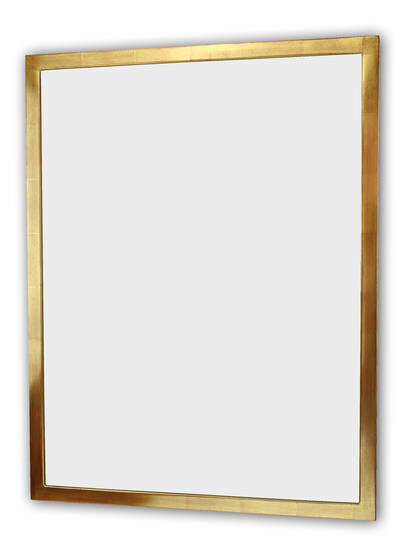
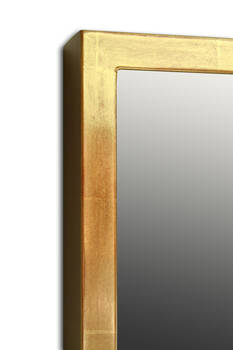
Gold-leaf picture frame, made to measure — handcrafted with 23-karat gold leaf
- Add feedback:
- Code: 17
- Manufacturer: Karol Milewski
-
Availability:
 Exists
Delivery time: 20 - 30 working days
Exists
Delivery time: 20 - 30 working days
- pcs.
- €312.20
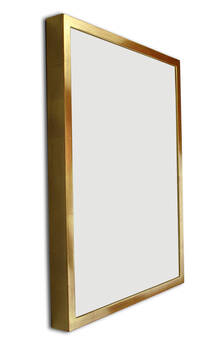
A slim, handcrafted gold-leaf picture frame made to measure — 22 mm wide on the face, 46 mm deep, with a generous 40 mm rabbet that allows it to hold not only a stretched canvas but also serve as a shadow-box for three-dimensional objects under glass. Real 23-karat gold leaf laid by hand on red bole, in the traditional water-gilding technique
A slim, classical picture frame in real 23-karat gold leaf — proportioned to support the artwork rather than compete with it. The 22 mm face keeps the framing line discreet, while the 46 mm depth and the 40 mm rabbet give the frame the structural depth of a much wider profile. Each frame is made to measure in solid wood, water-gilded by hand in the traditional manner: gesso, red bole and gold leaf laid one piece at a time. The result is a single, classical picture frame that works equally well for a stretched oil painting, a watercolour under museum glass, or a shadow-box display of objects.
What this frame is for
The slim 22 mm face means the frame supports the work without overwhelming it. The 23-karat tone — warm, classical, gently burnished to reveal the red bole beneath — is at home with:
- oil and acrylic paintings on stretched canvas — fitted directly into the rabbet, traditional unglazed presentation;
- watercolours, prints and works on paper — under museum-grade glass with acid-free matting and archival backing;
- fine-art photography, posters and archival prints — in full conservation framing with anti-reflective UV-filtering glass and Dibond backing;
- collectibles and three-dimensional objects — keepsakes, textiles, miniatures, small sculptural pieces — in a shadow-box configuration with painted spacers and front glass.
The 23-karat tone settles naturally into classical, neoclassical and traditional interiors, but the slim profile keeps the frame light enough to also work as a deliberate accent in modern, gallery-style spaces.
Specification
- Style: classical, plain narrow profile
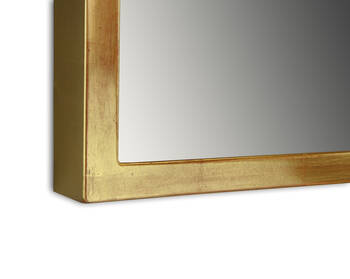
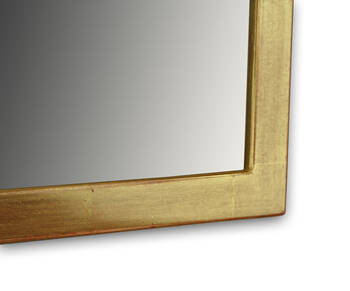
- Front finish: 23-karat gold leaf on red bole, hand-burnished, sealed with traditional shellac and wax
- Face width: 22 mm
- Profile depth: 46 mm
- Rabbet: 7 mm wide × 40 mm deep (i.e. the maximum thickness of artwork or stretcher that fits inside the rabbet — other depths to order)
- Profile customisation: the moulding can be made in a different face width and depth on individual order
- Material: solid wood with low tannin content, of the type used in museum and conservation framing
- Joinery: mitred and reinforced with timber splines, glued
- Side finish — choice of two: fully gilded (gold leaf on all visible surfaces) or gilded face with painted black sides (higher graphic contrast)
- Mounting hardware and hanging: included as standard (details below)
- Glass, archival backing, matting: available as add-on — quote on request
- Recommended use: oil and acrylic paintings, watercolours, prints, photography, certificates, shadow-box display
The dimensions above describe the frame profile itself. The aperture (rabbet) is correspondingly smaller than the outside dimensions of the frame. The frame is built with a working tolerance of approximately 2–3 mm relative to the artwork dimensions you specify, so the work slides into the frame without forcing. Each frame is made to measure for one specific painting, photograph or stretched canvas.
How it is made — water gilding on red bole
Each frame is built from scratch in the workshop. The moulding is cut from seasoned solid wood, with mitred corners reinforced by timber splines before any surface preparation begins — a construction that holds its dimensions over time, unlike frames that are merely butt-jointed or stapled together at the corner.
The surface is prepared in the traditional manner. Layers of gesso (chalk and animal-glue size) and red bole — a fine clay traditionally used as the bed for water gilding — are built up in succession. Around nine coats in total go down before any gold touches the surface, each layer dried and smoothed separately before the next is applied. This is what gives the prepared surface its dense whiteness and its sharp, level edges, and it is what allows the bole to lend warmth and depth to the finished gold.
23-karat gold leaf is laid one piece at a time, with a slight overlap between leaves. A single sheet of leaf measures roughly 80 × 80 mm; for a profile this slim, each piece is cut to size on a gilder's cushion with a gilder's knife, by hand, immediately before laying. Once the leaf has dried, the surface is gently and selectively burnished — controlled, never random — so that the warm tone of the red bole shows through the gold only at the chosen high points. This produces the classical, soft sheen of true water gilding, without the flat, mechanical reflectivity of factory-applied imitation finishes.
The gilded surface is sealed with traditional shellac and wax — the materials used in conservation gilding workshops. Shellac protects the leaf and adds depth; wax leaves a soft, silky lustre on the surface.
The deep rabbet — frame as a shadow box
The 40 mm rabbet depth is the structural feature that distinguishes this frame from most factory mouldings. It allows a single frame to hold:
- paintings on deep stretcher bars (up to 40 mm) — either showing the canvas edge or with the stretcher fully concealed inside the frame;
- three-dimensional objects under glass with internal spacers — keepsakes, medals, miniatures, textiles, small sculptural pieces, natural-history specimens;
- archival works on paper held away from the glass — where the spacer or matting separates the glazing from the surface of the work, eliminating the risk of paper sticking to glass during humidity changes.
The spacers — narrow timber strips fitted inside the rabbet — are made to measure and can be painted to match the work (typically white, black, or the dominant tone of the composition), so they read either as a quiet recess or as a deliberate framing line around the object. This is the construction used in museums, galleries and private collections wherever both display and protection of the object matter.
For unusual projects the frame can also be built with a non-standard rabbet depth — please get in touch with details of the object.
How this differs from factory frames
Most "gold" frames sold in this profile width are extruded by machine — typically from polyurethane, MDF or softwood — and finished with sprayed metallic paint or with imitation leaf made from base-metal alloys (copper-zinc compositions). Those finishes oxidise and darken with time, losing the fresh tone they had when new.
This frame is built differently:
- moulding cut from solid wood, corners joined with timber splines;
- surface prepared by hand — gesso, bole, sanding between layers;
- real 23-karat gold leaf (Au — a noble metal, chemically inert);
- finished with shellac and wax used in conservation practice.
The cost of this approach is time — a single frame takes 20 to 30 working days to complete (each of the roughly nine gesso and bole layers, then the shellac, dries and is worked separately, and the gold is laid one leaf at a time). The return is a frame that does not lose its value over time, ages well, and remains serviceable in any gilding workshop in the future.
Complete framing — additional options
Every frame can be completed with a full archival mounting prepared in the workshop: glass, archival backing and matting. All components are available as a custom add-on — quote on request.
Glass — four classes available
Opti White, 4mm — low-iron glass with a neutral, colourless appearance (no green tint typical of standard float glass). Available up to 90×90 cm — the only option for larger works.
Ultra Vue UV70 (Tru Vue), 2.0mm — anti-reflective glass with 70% UV protection, low-iron. Available up to 60×80 cm.
Art View — premium-class anti-reflective glass: reflection reduced below 1%, up to 75% UV protection, scratch-resistant coating, low-iron, can be cut and mounted from either side. Meets ISO 18916 (Photographic Activity Test) — safe for archival photography. Premium quality at an accessible price. Available up to 60×80 cm.
Optium Museum Acrylic (Tru Vue) — top-tier museum acrylic: over 99% UV protection, museum-grade reflection reduction, anti-static, lightweight, shatter-resistant. The museum standard for conservation work and archival photography. Available up to 60×80 cm.
Archival backing
Dibond 3mm aluminium composite panel — two layers of aluminium with an acid-free polymer core. Rigid, chemically neutral, dimensionally stable. An industry standard in archival photographic framing and art conservation.
Mounting and matting
Acid-free foam board — chemically neutral, will not yellow over time, will not react with paper or photographic emulsions. Archival standard.
Full museum framing
Combining anti-reflective UV-filtering glass, acid-free matting, Dibond backing and conservation hinging tapes provides a museum-grade mounting — protecting the work from light damage, acid migration from typical framing materials, and mechanical distortion. This type of framing is used in museums, galleries and private collections.
To order: all of the above components are available as a frame add-on on request. Please get in touch with the dimensions of your work and your preferred glass class — I will prepare an individual quote.
Mounting and hanging
Supplied unglazed by default — the frame is delivered ready to take a stretched canvas. Glass, backing and matting are available as add-ons (section above).
Mounting the artwork in the rabbet — to be chosen when ordering:
- Spring clips — factory-fitted to the back of the frame. They press the artwork against the rabbet and pivot aside when the work is changed, with no need to remove the hanging hardware.
- Brass mending plates — supplied loose with screws. The customer fixes them in the rabbet after inserting the artwork. A traditional, permanent solution that sits flatter against the back of the frame.
Hanging — portrait or landscape orientation to be chosen when ordering. The frame comes fitted with two lateral D-rings and a hanging cord matched to the weight of the artwork. On request, a single central D-ring may be fitted instead of the cord.
Ordering — made to measure
To order:
- measure the artwork accurately, to within 1 mm (e.g. 35.0 × 30.2 cm);
- enter those dimensions in the calculator on the product page — the frame will be built with a working tolerance of approximately 2–3 mm relative to the entered size, so the artwork slides in without forcing;
- choose the side finish — fully gilded or gilded face with painted black sides;
- add to cart — the calculator returns the price automatically.
Base price shown on the page is the price per running metre of moulding. The perimeter of the artwork is not the full length of moulding the frame requires — mitred 45° corners take additional length, and the wider the moulding, the more length they consume. The calculator accounts for the full moulding length including corners, plus the mounting and hanging hardware. Glass, archival backing and matting are quoted separately on request.
Customisation — beyond the side-finish option, the frame can be ordered with a different face width and profile depth, with a different rabbet (for objects thicker or thinner than 40 mm), with spacers in a different colour for the shadow-box variant, and in dimensions outside the calculator's range. Larger formats are built individually — please get in touch with the dimensions of the work and a brief description of the project.
Lead time — 20 to 30 working days. The reason is that each of more than a dozen layers (gesso, bole, shellac, wax) dries and is worked separately, and the gold is laid one leaf at a time, by hand. For a deadline-driven order (an exhibition, a gift) please get in touch in advance — where possible I prioritise such work.