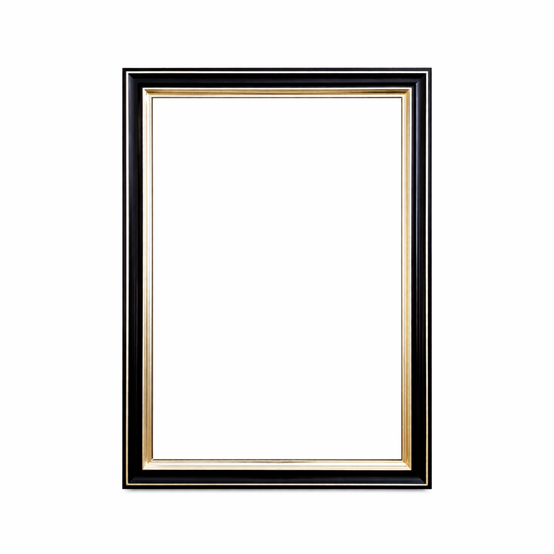
Black Coved Picture Frame for Oil Paintings, Gilded with White Gold Leaf
- Add feedback:
- Code: 63
- Manufacturer: Karol Milewski
-
Availability:
 Exists
Delivery time: 20 - 30 working days
Exists
Delivery time: 20 - 30 working days
- pcs.
- €247.22
A black, hand-gilded coved picture frame for oil paintings on canvas, finished in 6-karat white gold leaf with a cool, almost silvery sheen. A wide 80 mm reverse profile, made to measure in my workshop.
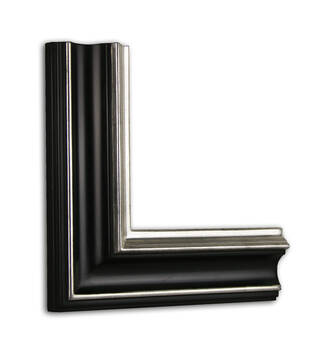
I make this black coved frame to measure for oil and acrylic paintings on canvas. The wide, 80 mm moulding follows a classic reverse profile: a deep half-round hollow rises to a softly rounded outer crest, and I gild the raised edges by hand in 6-karat white gold leaf. Against the satin-black hollow the cool, near-chrome leaf reads almost as silver, lending a painting quiet authority in a traditional room and becoming a crisp, contemporary accent in a modern one. The form draws on the Dutch and Flemish tradition of ebonised, reverse-profile frames, reworked here in a clean black-and-silver palette.
The moulding profile
The moulding is wide and deep, with a soft, coved section. A gilded band of 6-karat white gold runs along the sight edge by the rabbet, framing the painting with a narrow line of light. The face is a broad expanse of satin black, and it gathers into a stepped, terraced edge on the outside. The cool, silvery reflections of the white gold against the deep black create a strong play of light and shade, while 80 mm of width and 42 mm of depth give the frame the presence a larger canvas needs.
Specification
- Style: glamour, a classic reverse profile in a black-and-silver finish
- Finish: satin black with hand-laid 6-karat white gold leaf, burnished with an agate stone
- Moulding width: 80 mm
- Moulding depth: 42 mm
- Rabbet: 7 mm wide, up to about 20 mm deep (takes a canvas stretcher up to roughly 20 mm; deeper formats made to measure)
- Material: solid, low-tannin wood used in museum and conservation framing
- Corners: mitred at 45 degrees and reinforced with wooden splines
- Glass: not supplied as standard (a canvas mount); full archival glazing on request
- Backing: optional 3 mm Dibond panel on request
- Fixings and hanging: spring clips as standard, brass plates on request; hanging wire, portrait or landscape orientation to choose
- Matting: acid-free foam board on request
- Lead time: 20–30 working days
- Use: oil and acrylic paintings on canvas, including larger formats; works on paper and photographs when matted
- Variant: also available as a floating (spacer) frame, with no rabbet, the canvas set within a narrow reveal and its edges exposed
The dimensions given refer to the complete frame including the moulding; the rabbet opening is correspondingly smaller. I make the frame 2–3 mm larger than the artwork, so the moulding overlaps the work by about 4–5 mm and holds it securely. You order to the size of the painting, giving the dimensions of the canvas or stretcher.
Paintings and interiors it suits
The wide moulding and deep hollow make a strong yet quiet surround for oil and acrylic paintings on canvas, especially in larger formats where a narrow frame would be lost against the composition. The black separates the work from the wall and deepens its colour, while the silvery glow of the white gold brings light without excess. It suits portraits, landscapes and abstract work, and graphics or photographs once a mount is added. In a classic living room or study it raises the standing of a painting; in a modern, pared-back interior it works as a single decorative accent. It is a frame for anyone looking for a black frame for an oil painting with real character. For an overview of the profile family, see my note on Dutch frames and the reverse profile.
How it is made and finished
I mill the moulding from solid, low-tannin wood, then mitre the corners at 45 degrees and reinforce them with wooden splines before any gesso is laid, which keeps the frame stable for years. I prepare the surface with a multi-layer gesso ground and lay a bole (clay) beneath the gilding, which gives the leaf depth and lets it be burnished. The leaves are laid one beside the next with a slight overlap, in a single layer, and then burnished with an agate stone to bring up the cool, silvery sheen of the 6-karat white gold. The black is finished to a satin sheen and sealed with traditional shellac and wax; on request I also make it in high gloss or in a semi-matte finish. The profile is milled rather than carved, and the craft lies in the ground, the gilding, the burnishing and the corner joinery. You can read more about my approach to framing oil paintings.
How it differs from mass production
Off-the-shelf frames are made from foil-wrapped or machine-stained mouldings, and their gold or silver shine is usually an imitation. Here every stage is done by hand: milling and corner joinery, the gesso ground and bole, gilding in genuine white gold leaf and burnishing with agate. I use no metallic imitation paint. Each piece differs in the small nuances of its gilding, and that is the mark of handwork rather than a flaw. A frame like this belongs among black picture frames of the highest order and is intended for collectors and for anyone who treats the frame as part of the work.
Functionality and pricing
The frame is supplied without glass, as a mount for a painting on canvas: the stretcher sits in the rabbet and is held with spring clips. The rabbet, up to about 20 mm deep, takes a standard stretcher, and deeper formats are made to measure. The same profile is also offered as a floating (spacer) frame, with no rabbet, where a narrow reveal surrounds the canvas and the edges of the painting stay visible. The price depends on the perimeter of the frame: the moulding is cut at 45 degrees and each cut consumes an extra length of moulding at the corner, so the cost rises with size. The base price is for a standard format; larger and non-standard sizes are quoted individually.
Complete framing: additional options
Every frame can be completed with a full archival mounting prepared in the workshop: glass, archival backing and matting. All components are available as a custom add-on – quote on request.
Glass – four classes available
Opti White, 4mm – low-iron glass with a neutral, colourless appearance (no green tint typical of standard float glass). Available up to 90x90 cm – the only option for larger works.
Ultra Vue UV70 (Tru Vue), 2.0mm – anti-reflective glass with 70% UV protection, low-iron. Available up to 60x80 cm.
Art View – premium-class anti-reflective glass: reflection reduced below 1%, up to 75% UV protection, scratch-resistant coating, low-iron, can be cut and mounted from either side. Meets ISO 18916 (Photographic Activity Test) – safe for archival photography. Premium quality at an accessible price. Available up to 60x80 cm.
Optium Museum Acrylic (Tru Vue) – top-tier museum acrylic: over 99% UV protection, museum-grade reflection reduction, anti-static, lightweight, shatter-resistant. The museum standard for conservation work and archival photography. Available up to 60x80 cm.
Archival backing
Dibond 3mm aluminium composite panel – two layers of aluminium with an acid-free polymer core. Rigid, chemically neutral, dimensionally stable. An industry standard in archival photographic framing and art conservation.
Mounting and matting
Acid-free foam board – chemically neutral, will not yellow over time, will not react with paper or photographic emulsions. Archival standard.
Full museum framing
Combining anti-reflective UV-filtering glass, acid-free matting, Dibond backing and conservation hinging tapes provides a museum-grade mounting – protecting the work from light damage, acid migration from typical framing materials, and mechanical distortion. This type of framing is used in museums, galleries and private collections.
To order: all of the above components are available as a frame add-on on request. Please get in touch with the dimensions of your work and your preferred glass class – I will prepare an individual quote.
Fixings and hanging
As standard I fit spring clips, which hold the stretcher securely in the rabbet, together with hanging wire. On request I add brass plates with screws (supplied loose for you to fit) or a single D-ring. You choose the hanging orientation, portrait or landscape, when you order, and I prepare the fixings to match the way the painting hangs.
Ordering made to measure
I make the frame to the size of your painting. Simply give the dimensions of the canvas or stretcher and the orientation. You can also choose the colour of the bole beneath the gilding, which gently tones the gilded surface, and decide on the black finish: satin, high gloss or semi-matte. The calculator handles formats up to 120x80 cm; larger and non-standard sizes are taken as individual orders. Lead time is 20–30 working days.
Frequently asked questions
Is this frame suitable for a large oil painting?
Yes. The wide 80 mm moulding and deep hollow balance larger formats well. The calculator handles sizes up to 120x80 cm, and larger canvases are made as individual orders.
Is white gold the same as silver?
No. It is genuine gold leaf in a 6-karat alloy with a cool, almost chrome-like tone. It looks silvery but is more durable and more tarnish-resistant than pure silver.
Can I frame a canvas without glass?
Yes, that is how the frame is supplied as standard. The stretcher sits in the rabbet, up to about 20 mm deep, and is held with spring clips. A floating version, with a narrow reveal around the canvas, is also available.
Can I order glass and full archival framing?
Yes, on request. Four classes of glass are available, along with a Dibond backing and an acid-free mount. I prepare the quote individually once I know the size of the work.
How do I order to measure and what is the lead time?
Give the dimensions of the painting, the orientation and your preferences for the black finish and bole colour. Lead time is 20–30 working days.