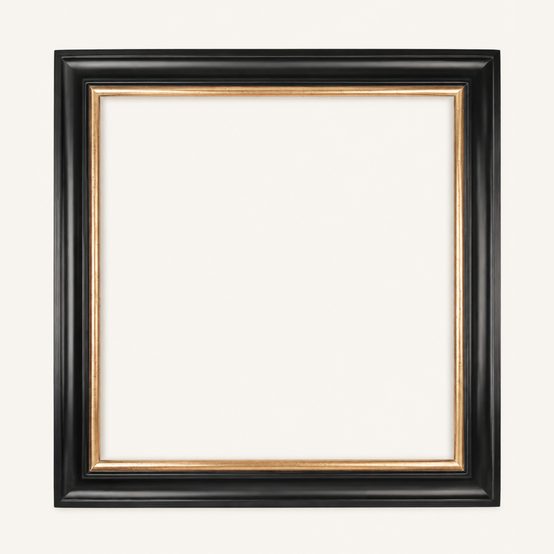
Black and gold picture frame with 22-karat gold leaf
- Add feedback:
- Code: 300
- Manufacturer: Karol Milewski
-
Availability:
 Exists
Delivery time: 20 - 30 working days
Exists
Delivery time: 20 - 30 working days
- pcs.
- €247.22
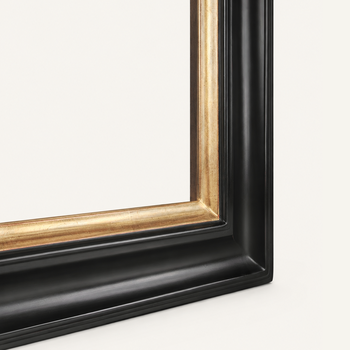
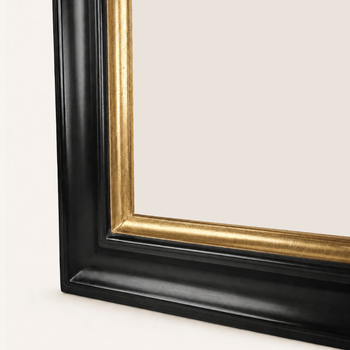
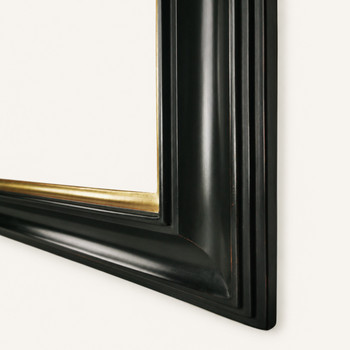
A black picture frame in which the gold sits where it is seen first: on the narrow fillet at the artwork and across the whole quarter-round hollow beside it, laid leaf by leaf in genuine 22-karat gold over red bole. Beyond the crown of the profile the black face runs out in a broad cove to a stepped outer edge. An 80 mm moulding, water-gilded and painted by hand, made to the measurements of one particular painting.
A black and gold picture frame built around one idea: a wide, quiet black face with the gilding gathered close to the painting. The 22-karat gold leaf is laid by water gilding over red bole, so the band beside the artwork carries a metallic depth that paint and foil cannot reproduce. At 80 mm the moulding has gallery presence, and it belongs among the gilded and partially painted frames I make to measure for paintings on stretchers.
Moulding profile
At the artwork the moulding opens with a narrow fillet, and immediately beyond it a concave hollow of gentle quarter-round section rises towards the middle of the width. The fillet and the whole of that hollow are covered with gold leaf; from there outwards the face stays black. The hollow runs up into a torus, the highest point of the profile, and from that crown the face descends in a broad cove which occupies most of the width of the moulding and collects the deepest shadow. The outer edge is closed by three steps, set a little above the floor of the cove and each dropping lower than the last towards the outline of the frame. The profile itself is milled; its character comes from the painting, the gilding and the patination that follow.
Specification
- Style: classical gallery moulding, black with a gilded band at the artwork
- Finish: satin black, hand-painted, sealed with shellac and wax; gilded band burnished with an agate stone and lightly patinated
- Moulding width: 80 mm
- Moulding thickness, face to back: 42 mm
- Rebate: 7 mm wide, 20 mm deep
- Material: low-tannin timber used in museum and conservation work
- Gilding: genuine 22-karat gold leaf, water-gilded over red bole; layered gesso and bole ground, a single layer of leaf
- Variants: 23-karat, 12-karat white gold or 6-karat white gold; other bole colours on request
- Corner joinery: mitred at 45 degrees, reinforced with wooden splines
- Glass, backing and matting: archival additions
- Artwork retention: spring clips as standard, brass plates with screws on request
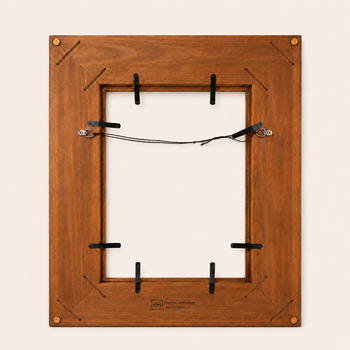
- Hanging: picture wire on two D-rings, portrait or landscape from the order menu
- Suitable for: oil and acrylic paintings on stretchers
- Lead time: 20 to 30 working days
Every frame is made to the dimensions of the artwork, so enter the size of the painting in the calculator on this page. The frame is cut 2 to 3 mm larger than the figures you give, and the moulding overlaps the edge of the work by roughly 4 to 5 mm.
Which artworks and interiors it suits
Black with a gilded inner band is the classical setting for oil painting, and it does two things at once: the gold picks up the warm passages of the canvas and carries them to the edge, while the wide black face absorbs light and stops the wall from crowding the picture. It suits portraits, landscapes, still life and old-master copies, in a panelled room as readily as on a plain gallery wall. The stepped outer edge keeps the silhouette crisp rather than ornamental, so it reads as well in a modern interior. My guide to gold frames and how they behave in a room sets out the differences between finishes.
How it is made
The moulding is cut at 45 degrees and the corners are joined with wooden splines before any finishing begins. The joint is made in bare timber, so nothing has to be disturbed later and the corner stays closed for the life of the frame.
The black is built from a richly pigmented paint range, brushed and smoothed by hand, then sealed with shellac and wax for a satin sheen. The gilded band is prepared the traditional way: a ground of gesso, then red bole, then the gold laid on water, leaf beside leaf with about a millimetre of overlap. The leaves measure roughly 80 mm to a side and are cut down on the gilder's cushion for the narrower elements. Once dry the gold is burnished with an agate stone, which gives water gilding its depth, and lightly patinated so the bole reads through. I use genuine gold leaf rather than imitation metal, a difference that matters less in a photograph than in ten years of daylight. The technique is set out on my page about water gilding.
How it differs from a mass-produced frame
In volume production the gold is metallic paint or printed foil, the profile is wrapped in film and the corners are stapled. Here the gold is real, laid over bole and burnished by hand, the black is painted and waxed rather than covered, and the mitres are splined. The timber is low in tannin, so it will not discolour the finish from underneath. Small variations in the patination are part of the object rather than a fault in it.
Function
The frame is supplied without glass, as a setting for a painting on a stretcher. What it can enclose is set by the rebate rather than by the 42 mm thickness of the moulding: the rebate is 20 mm deep, which takes a standard stretcher and can be made deeper to order.
The same profile can also be made without a rebate, as a floating frame for canvas art, with the painting held clear of the moulding and a visible gap around it.
Complete framing, additional options
Every frame I make can be completed with full archival and museum-quality framing: anti-reflective UV-filtering glass (four classes to choose from), acid-free museum mat board, spacers wrapped in acid-free paper and a Dibond backing. This kind of mounting protects the work from light, acids and distortion. I set out the full glass and material specification on a separate page: archival and museum framing for paintings and photographs. All components are available at extra cost, as an individual quote on request.
Mounting and hanging
Spring clips are fitted as standard, installed in the workshop and rotated aside to seat or swap the painting without dismantling the frame. Brass plates with screws are available on request, supplied loose with the screws included, for you to fit once the work is in place; this is the permanent retention used in exhibition mounting.
Hanging orientation, portrait or landscape, is selected from the order menu, and the frame is fitted only in the chosen orientation. Picture wire is standard; a single D-ring hanger is available on request.
Ordering made to measure
Enter the size of the painting in the calculator and choose the hanging orientation. The base price shown is the price per running metre of moulding. The perimeter of the painting is not the whole length of moulding a frame needs: corners cut at 45 degrees consume additional length, and the wider the moulding, the more each corner takes. The calculator accounts for the full consumption including corners, along with any additions you select.
For this moulding width the calculator handles artworks up to 180 cm around the perimeter; anything larger is made to individual order, so send me the dimensions and I will price it. Lead time is 20 to 30 working days. For a different gold or bole colour, write to me with the size of the painting first.