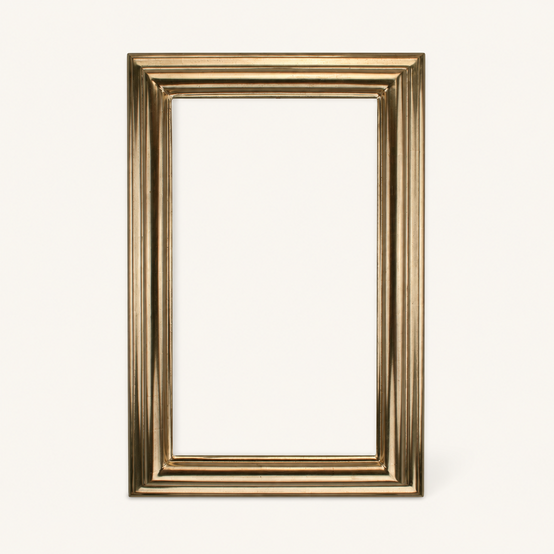
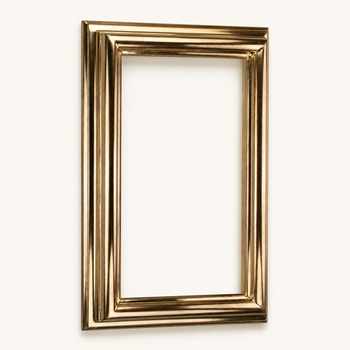
Hand-Gilded 22-Karat Moon Gold Leaf Picture Frame on Plum Bole
- Add feedback:
- Code: 1123
- Manufacturer: Karol Milewski
-
Availability:
 Exists
Delivery time: 20 - 30 working days
Exists
Delivery time: 20 - 30 working days
- pcs.
- €358.33
Hand-gilded 22-karat moon gold leaf on plum bole, agate-burnished to a cool, almost-silvered finish. Solid-timber moulding with a 50 mm moulded profile composed of rounded and concave forms at varying levels. Made to measure in a Polish water-gilding workshop.
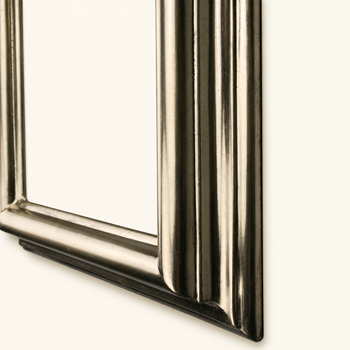
A 50 mm × 39 mm moulded profile composed of rounded forms (beads) and concave hollows at varying levels, hand-gilded with 22-karat moon gold leaf over plum-coloured bole. Each curve and hollow catches light differently; the agate-burnished surface returns it as a smooth, cool reflection — almost silvered, with the warm undertone of plum bole reading through controlled distress along the high points. A contemporary frame in feel, traditional in technique: water-gilded in the workshop, made to the dimensions of your work.
Cross-section of the moulding. The profile is built from four classical elements running from the outer edge of the moulding inward toward the rabbet. At the outer bottom corner — a small ovolo (quarter-round bead); above it a gentle cyma (S-curve) ascending toward the crown; at the highest point a dominant half-round torus; closer to the inner edge a smaller secondary bead, separated from the crown by a fine fillet. The profile is closed on the inner side by the rabbet — an L-shaped recess 7 mm wide and 20 mm deep that receives the artwork. Each element catches light differently: the half-round beads as bright, almost mirror-like reflective bands, the cyma as a soft tonal gradient between light and shadow, and the outer ovolo as a fine line of light along the back rim of the frame. It is a composition drawn from classical architectural moulding, transposed onto a picture frame and gilded by hand.
Suited for
Contemporary oil paintings, watercolours with a strong colour structure, art photography (colour and monochrome), prints, and graphic works. The cool palette of moon gold leaf — markedly paler than yellow gold — sits naturally with silver, pale timber, architectural concrete, and white-painted galleries. The rhythm of cyma and beads holds its line in minimalist, design-led, and gallery interiors, while the cool gold reading offers a quiet counterpoint in classical rooms that lean warm.
Specifications
- Style: contemporary picture frame, classical moulded profile (cyma + beads + ovolo)
- Finish: 22-karat moon gold leaf on plum bole, agate-burnished, sealed with traditional shellac and wax
- Profile width: 50 mm
- Profile depth: 39 mm
- Rabbet width (artwork hold): 7 mm
- Rabbet depth: 20 mm
- Material: solid low-tannin timber, used in museology and art conservation
- Corner construction: mitred at 45° and reinforced with workshop joinery
- Artwork retention: sprung clips or brass plates with screws (selectable)
- Suitable for: oil on stretcher, photography, prints; watercolours with archival matting (separate quote)
- Lead time: 20–30 working days
The outer dimensions of the frame include the full moulding width on every side. The rabbet — the recess that holds the artwork — is correspondingly smaller. When ordering, please supply the actual dimensions of your work; the frame is built with a 2–3 mm technical clearance for easy fitting.
Workshop process
The frame is built using traditional water gilding — gold leaf laid over a chalk gesso ground and pigmented bole. The plum bole here serves as the chromatic ground beneath the leaf and determines the final temperature of the gold reading. The 22-karat moon gold leaves arrive at roughly 80 × 80 mm; for the narrow contours of this moulded profile, each leaf is cut on a gilder's cushion using a long-blade knife and laid bead by bead, along the cyma and across the ovolo, edge-to-edge with a slight overlap. The overlaps remain readable in raking light — they are the signature of laid leaf, not a defect.
After laying, the surface is burnished with an agate stone. Burnishing closes the bole and brings the leaf to the smooth, near-mirror sheen specific to water gilding (oil gilding cannot be burnished this way). The gold is then sealed with traditional shellac and wax — the protective layer most consistent with the technique, giving a soft, satin gleam rather than the hard plastic shine of varnish.
Workshop detail: controlled distress. Along the high points of the profile (the bead crowns and outer rims), the gold leaf is selectively rubbed back to expose the plum bole beneath. The result is a frame that arrives looking already lived-with — the patina that natural wear would generate over decades is generated cleanly, in the workshop, in a single rhythmic process. The technique is hard to imitate: the gold has to be perfectly bonded and the rubbing has to be even, otherwise it reads as damage rather than age.
How this differs from mass-produced frames
Most commercial picture frames are extruded MDF or polyurethane mouldings finished with metallic foil or gold-tone paint. From across a room they read; under direct gallery light they flatten. There is no depth in the surface, no warmth, and the reflection is uniform.
What you receive here is real 22-karat gold leaf laid by hand over plum bole. The bole gives the gold its temperature, the agate closes it to a smooth reflection, and the controlled distress lets the bole read back through — an interplay of materials no spray finish or transfer foil can reproduce. The moulding is solid timber (not MDF), the corners are mitred at 45° and reinforced with workshop joinery, and the finish is traditional shellac and wax.
Functionality
Artwork retention and hanging system
The frame is supplied as a setting for canvas on stretcher — without glass or backing (full archival framing is described in the section below). The artwork retention method is selected from two workshop options.
Sprung clips — factory-fitted in the frame. The artwork is loaded by rotating the clips, slotting the canvas in, and releasing. Quick to swap; well suited for studio practice and rotating exhibition cycles.
Brass plates with screws — supplied loose with mounting screws included. The customer screws the artwork to the frame. This is a permanent solution, standard in gallery and private-collection mounting where the painting stays in one frame.
Hanging — orientation (portrait or landscape) is selected in the product menu; the frame is finished in that orientation. Standard hanging is on cord. A single D-ring hanger is available on request.
Complete framing — additional options
Every frame can be completed with a full archival mounting prepared in the workshop: glass, archival backing and matting. All components are available as a custom add-on — quote on request.
Glass — four classes available
Opti White, 4 mm — low-iron glass with a neutral, colourless appearance (no green tint typical of standard float glass). Available up to 90×90 cm — the only option for larger works.
Ultra Vue UV70 (Tru Vue), 2.0 mm — anti-reflective glass with 70% UV protection, low-iron. Available up to 60×80 cm.
Art View — premium-class anti-reflective glass: reflection reduced below 1%, up to 75% UV protection, scratch-resistant coating, low-iron, can be cut and mounted from either side. Meets ISO 18916 (Photographic Activity Test) — safe for archival photography. Premium quality at an accessible price. Available up to 60×80 cm.
Optium Museum Acrylic (Tru Vue) — top-tier museum acrylic: over 99% UV protection, museum-grade reflection reduction, anti-static, lightweight, shatter-resistant. The museum standard for conservation work and archival photography. Available up to 60×80 cm.
Archival backing
Dibond 3 mm aluminium composite panel — two layers of aluminium with an acid-free polymer core. Rigid, chemically neutral, dimensionally stable. An industry standard in archival photographic framing and art conservation.
Mounting and matting
Acid-free foam board — chemically neutral, will not yellow over time, will not react with paper or photographic emulsions. Archival standard.
Full museum framing
Combining anti-reflective UV-filtering glass, acid-free matting, Dibond backing and conservation hinging tapes provides a museum-grade mounting — protecting the work from light damage, acid migration from typical framing materials, and mechanical distortion. This type of framing is used in museums, galleries and private collections.
To order: all of the above components are available as a frame add-on on request. Please get in touch with the dimensions of your work and your preferred glass class — I will prepare an individual quote.
Floater frame variant (rabbet-less)
Every frame in the range can be made as a floater — a rabbet-less frame in which a canvas-on-stretcher sits inside the moulding with a small gap to its edges, and the stretcher edges remain visible. This is a standard mounting in contemporary painting and premium framing, where the work is meant to "breathe" — the frame builds the field, not the boundary. Available on request.
Made to measure
Each frame is built individually to the dimensions of your work. The base price quoted is per linear metre of moulding. Mitred corners cut at 45° take additional length, more so on wider profiles; the calculator on the product page accounts for full corner consumption and any add-ons selected.
The product menu lets you select orientation (portrait or landscape) and the basic glass + backing variant (Opti White 4 mm with HDF backing). Full archival mounting (anti-reflective UV glass, Dibond backing, acid-free matting) is quoted individually — see the section above.
The frame can also be made in alternative finish variants — different leaf (6-karat white gold, 12-karat white gold, 23-karat yellow gold, palladium, sterling silver leaf) or different bole (red, grey, green, black, blue, Victorian grey). Floater variant available on request.
Lead time: 20–30 working days. Order workflow: measure your artwork to the millimetre → enter the dimensions in the product calculator → confirm the order. The frame is built with 2–3 mm technical clearance.