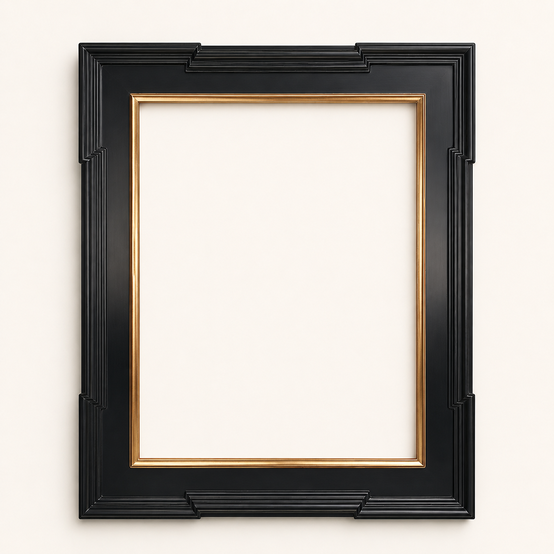
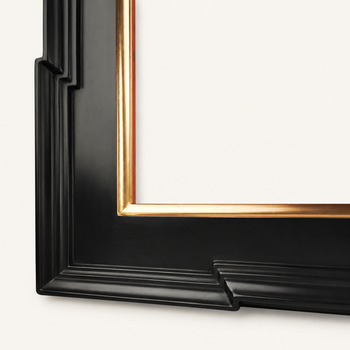
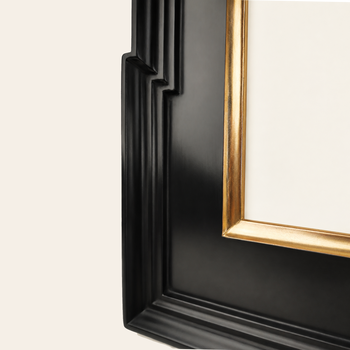
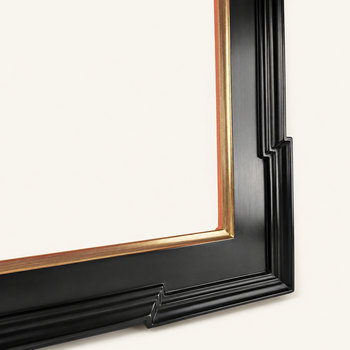
Black picture frame with Flemish corners in 22-karat moon gold — Casina 2
- Add feedback:
- Code: 343
- Manufacturer: Karol Milewski
-
Availability:
 Exists
Delivery time: 20 - 30 working days
Exists
Delivery time: 20 - 30 working days
- szt.
- €200.00
A black picture frame with Flemish corners, hand-built from solid timber and water-gilded with 22-karat moon gold leaf on red bole. A contemporary reading of the seventeenth-century Flemish framing tradition. Made to measure in Karol Milewski's workshop.
A hand-built, made-to-measure gilded picture frame in the classical form of seventeenth-century Dutch and Flemish workshops. A 100 mm wide profile structured around a precise division of mass: a broad, satin black frieze and a narrow gilded sight edge. The gilding is executed in 22-karat moon gold leaf (96% Au, alloyed with silver) on red bole — a cool, subtly silvery shade of gold, warmed by the red clay glowing through where the surface has been agate-burnished. The frame was conceived in a tradition where the mounting was treated as an autonomous piece of craftsmanship, counterpointing the painting through the gravity of black timber and a measured accent of gold.
The profile is built around a wide black frieze that leads the eye from the inside of the frame outward. On the artwork side — a narrow, profiled gilded sight edge with red bole glowing through in places, drawing the painting forward without competing with it. From the frieze, the profile transitions outward through a stepped descent — three subtle steps lifting the outer edge. The outer edge itself is rounded, with a soft curved transition to the lower face of the moulding. At the corners — the unmistakable Flemish element: shaped corners in the form of a three-step decorative projection where the outer profile extends beyond the line of the frieze, creating a rhythmic accent. A workshop detail demanding precise cutting and separate fitting — a signature of the Flemish carver's tradition.
For which paintings and interiors
A profile of this mass and finish counterbalances paintings with a saturated colour palette — oil, acrylic, tempera in the classical manner. The black frieze gives the work a neutral visual field, while the narrow gilded sight edge holds the gravity of a historical frame without the heaviness of full gilding. The frame also serves well for copies of the Old Masters, icons and archival portrait photography, and in contemporary interiors — set against raw surfaces, dark timber, unbleached linen — it becomes a deliberate accent of historical weight in an otherwise minimalist scheme. It is one of the workshop's black picture frames, but consciously addressed to the collector segment — with a clear reference to the Dutch and Flemish framing tradition.
Specification
- Style: Flemish / 17th-century Dutch framing tradition
- Sides finish: black, satin, hand-finished with wax
- Sight edge finish: 22-karat moon gold leaf on red bole, burnished with an agate stone
- Gilding technique: water gilding, multi-layered
- Moulding width: 100 mm
- Moulding depth: 50 mm
- Rabbet depth: 7 mm
- Timber: solid timber with low tannin content, used in museum conservation
- Corner construction: spline-joined mitres
- Gold sealing: traditional shellac and wax
- Black sealing: hand-polished wax
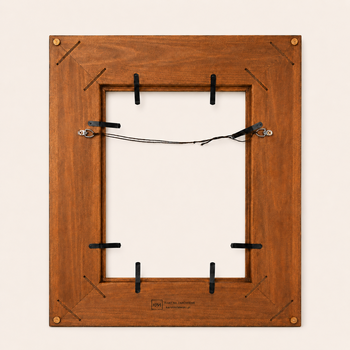
- Artwork retention: spring clips or screw-mounted brass plates (selectable)
- Hanging: cord; portrait / landscape from the variant menu
- Use: frame for canvas on stretcher (sold without glass)
Dimensions given at order refer to the artwork (canvas on stretcher). The frame is made approximately 2–3 mm larger than the stated dimension — a standard technical clearance that lets the work seat freely in the rabbet.
Workshop process
Each frame is built entirely by hand. The moulding is cut at 45° and the corners are joined by traditional means — on wooden splines. A spline is an internal wooden key reinforcing the mitre joint, a technique drawn from conservation framing that gives the frame dimensional stability at large sizes and resistance to the seasonal movement of timber.
The gilding is applied by the water-gilding method — in layers. First, a chalk-and-glue ground (gesso); then a layer of bole clay in a red tone (terra rossa). The bole serves two functions: it provides a warm tonal ground that glows through the gold leaf, and — critically — it allows the gold to be burnished with an agate stone: the surface of the leaf is smoothed by hand with a polished agate until it reaches the deep, velvety lustre that no other method can produce. The full process is described on the water gilding page.
The moon gold leaf — a 22-karat alloy (96% Au) with silver — has a cooler, faintly silvery cast, clearly distinct from the warm radiance of classical 23-karat yellow gold. The leaves themselves, approximately 80 × 80 mm, are cut on the gilder's cushion with a specialist knife to the narrow width required by the sight edge of this profile.
Once the gold has dried and been burnished, the surface is sealed by the traditional method — shellac and wax — which gives depth to the colour and a soft matte sheen, unlike the cool, technological reflection of modern lacquers. The black side surfaces are finished with hand-polished wax for a uniform satin appearance.
What distinguishes this frame from mass production
Three workshop decisions set this frame apart from catalogue products. First — material: solid timber with low tannin content, used in museum conservation, rather than pressed foam, MDF with imitation carving or polystyrene. Second — gilding technique: genuine 22-karat gold leaf applied by water gilding and agate-burnished, not metallised foil or aerosol paint with glitter. Third — corner construction: wooden splines that absorb the seasonal movement of timber, rather than thermoplastic weld tape or glued composite joints. Three decisions that make the frame an object designed to last centuries — not a product for periodic replacement.
Artwork retention and hanging
The frame is offered without glass — as a setting for canvas on stretcher. Artwork retention in the rabbet uses one of two systems, selectable from the variant menu. Spring clips are factory-fitted inside the rabbet — rotate them aside, place the artwork, rotate them back into the holding position; this allows for quick changes. Screw-mounted brass plates are supplied loose, with the screws included — the client fixes the artwork in the rabbet from the back of the frame; a permanent solution for works intended for long-term display.
Orientation — portrait or landscape — is selected from the variant menu; the frame is physically finished for that single orientation. The standard hanging system is a cord attached to the back of the frame. A single central D-ring hanger is available in place of cord on request.
Complete framing — additional options
Every frame can be completed with a full archival mounting prepared in the workshop: glass, archival backing and matting. All components are available as a custom add-on — quote on request.
Glass — four classes available
Opti White, 4mm — low-iron glass with a neutral, colourless appearance (no green tint typical of standard float glass). Available up to 90 × 90 cm — the only option for larger works.
Ultra Vue UV70 (Tru Vue), 2.0mm — anti-reflective glass with 70% UV protection, low-iron. Available up to 60 × 80 cm.
Art View — premium-class anti-reflective glass: reflection reduced below 1%, up to 75% UV protection, scratch-resistant coating, low-iron, can be cut and mounted from either side. Meets ISO 18916 (Photographic Activity Test) — safe for archival photography. Premium quality at an accessible price. Available up to 60 × 80 cm.
Optium Museum Acrylic (Tru Vue) — top-tier museum acrylic: over 99% UV protection, museum-grade reflection reduction, anti-static, lightweight, shatter-resistant. The museum standard for conservation work and archival photography. Available up to 60 × 80 cm.
Archival backing
Dibond 3mm aluminium composite panel — two layers of aluminium with an acid-free polymer core. Rigid, chemically neutral, dimensionally stable. An industry standard in archival photographic framing and art conservation.
Mounting and matting
Acid-free foam board — chemically neutral, will not yellow over time, will not react with paper or photographic emulsions. Archival standard.
Full museum framing
Combining anti-reflective UV-filtering glass, acid-free matting, Dibond backing and conservation hinging tapes provides a museum-grade mounting — protecting the work from light damage, acid migration from typical framing materials, and mechanical distortion. This type of framing is used in museums, galleries and private collections.
To order: all of the above components are available as a frame add-on on request. Please get in touch with the dimensions of your work and your preferred glass class — I will prepare an individual quote.
Made to measure
Every frame is built individually to the dimensions of your artwork. On the product page, enter the dimensions of the work into the calculator — the system will return the total frame cost.
The base price is the price per linear metre of moulding. Mitres cut at 45° take an additional length, greater the wider the moulding. The calculator accounts for full consumption including corners and any selected add-ons.
The online price calculator supports artwork sizes up to 120 × 80 cm. Larger formats are made to individual order — please get in touch with the dimensions of the work and a description of the painting support.
Lead time: 20–30 working days from order confirmation.
Alternative gilding variants of this frame — white gold 12-karat and yellow gold 23-karat — will be listed as separate products. The specific variant described here (22-karat moon gold on red bole) is also discussed in detail on the gold-gilded picture frames category page.